Unlock Your Prefrontal Cortex Potential
Recent Research Advances
A Hierarchy of Thought
Think of the prefrontal cortex (PFC) not as a single entity, but as a company's management structure. At the lower levels, you have junior managers handling specific, concrete tasks. Further up, senior managers oversee broader strategies. At the very top, the CEO sets long-term, abstract goals for the entire organization.
Recent research suggests the PFC is organized in a similar hierarchical fashion along a posterior-to-anterior axis. The posterior regions, closer to the motor areas of the brain, deal with more concrete, immediate actions. For example, deciding to pick up a specific pen. As you move forward toward the anterior pole (your forehead), the processing becomes more abstract. These areas handle long-term goals, complex rules, and thinking about the future, like planning a career path.
This structure allows for incredible cognitive flexibility. A simple goal, like 'make coffee,' is managed by posterior PFC regions. But this goal is nested within a more abstract goal, 'get ready for work,' which is handled by more anterior regions. This hierarchy ensures that our immediate actions are always guided by our larger, long-term objectives.
This organization isn't just about thinking; it's also about doing. The PFC must weigh potential rewards and costs to guide behavior. This is where motivation meets cognitive control.
Motivation and Control
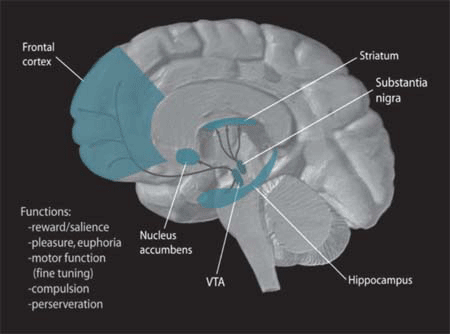
Executive functions aren't purely logical. Our decisions are deeply intertwined with our motivations, a process orchestrated by the PFC's connections with other key brain regions. The ventral tegmental area (VTA) and the nucleus accumbens, central players in the brain's reward system, are in constant communication with the PFC.
These regions use the neurotransmitter dopamine to signal the potential for reward. The PFC integrates this information to guide decision-making. For example, when you choose to study for an exam instead of watching a movie, your PFC is using cognitive control to override the immediate reward (the movie) in favor of a larger, delayed reward (a good grade). This decision is fueled by dopamine signals that help the PFC represent the value of that future reward.
Neuroimaging studies show that activity in these PFC-striatal loops predicts how well individuals can delay gratification and stick to long-term goals. This integration of motivation and control is fundamental to understanding why we pursue certain goals and how we manage the self-control needed to achieve them.
The Brain's Conductor
The PFC doesn't operate in isolation. It acts like the conductor of an orchestra, coordinating a vast network of brain regions to produce coherent thought and behavior. Its extensive connections are crucial to its function.
Recent advances in neuroimaging, particularly diffusion tensor imaging (DTI), have allowed researchers to map these connections in unprecedented detail. We can now see the 'superhighways' of white matter tracts linking the PFC to virtually every other part of the cortex.
Key connections include:
- The Hippocampus: For retrieving memories to inform current decisions.
- The Amygdala: For integrating emotional significance into planning and social behavior.
- Parietal and Temporal Lobes: For incorporating sensory information about the world around us.
This network structure allows the PFC to synthesize information from memory, emotion, and sensation, creating a unified model of the world that guides our actions. When you decide what to say in a conversation, your PFC is drawing on memory (what you know about the person), emotion (the tone of the discussion), and sensory input (their facial expression).
Results from functional magnetic resonance imaging and lesion studies indicate that the prefrontal cortex (PFC) is essential for successful navigation through a complex social world inundated with intricate norms and moral values.
This integration is the essence of high-level cognition. The latest research is moving away from seeing the PFC as a collection of separate modules and toward understanding it as a flexible hub that dynamically coordinates activity across the entire brain to meet the demands of the moment.
Ready to check your understanding of the prefrontal cortex?
According to the hierarchical model of the prefrontal cortex, which of the following tasks would primarily be handled by the most anterior regions?
How does the prefrontal cortex integrate motivation into cognitive control when choosing a long-term goal over an immediate pleasure?
These new insights help us appreciate the complexity behind our ability to plan, decide, and act. The PFC's role as a hierarchical, motivated, and highly connected conductor is central to what makes us who we are.