Unlock Your Prefrontal Cortex Potential
Cognitive Training Techniques
Training Your Brain's CEO
Think of your prefrontal cortex as the CEO of your brain. It manages your executive functions: planning, decision-making, and focusing your attention. Just like any muscle, this crucial brain region can be strengthened with targeted exercises. Cognitive training isn't about becoming a genius overnight. It's about systematically improving the efficiency and power of your brain's control center.
By engaging in specific mental workouts, you can enhance your ability to manage complex tasks, regulate emotions, and make better decisions. These techniques work by strengthening the neural pathways within the prefrontal cortex and improving its communication with other brain regions. Let's explore some of the most effective, evidence-based methods for boosting your cognitive performance.
Mindfulness and Focus
Mindfulness meditation is a powerful tool for enhancing cognitive control. At its core, it's a practice of paying attention to the present moment without judgment. When you meditate, you're repeatedly guiding your focus back to a single point, like your breath, whenever your mind wanders. This simple act is a direct workout for your prefrontal cortex.
Each time you notice your thoughts drifting and gently bring your attention back, you strengthen the neural circuits responsible for attention regulation. Over time, this practice makes your prefrontal cortex more effective at filtering out distractions and maintaining focus, not just during meditation, but in everyday life. It enhances your ability to consciously direct your attention where you want it to go.
Infusing mindfulness into your daily routines through breathwork, visualization, or guided meditation can significantly improve your cognitive performance.
Games for Your Brain
Cognitive training games, often called "brain games," are designed to target specific executive functions. These aren't just any puzzles; they are exercises developed to challenge skills like working memory, mental flexibility, and planning. For example, a game might require you to remember a sequence of items that grows progressively longer, directly training your working memory.
The key to their effectiveness is a concept called "transfer." The goal is for the skills honed in the game to transfer to real-world situations. For this to happen, the training must be consistent, challenging, and varied. Simply playing the same easy game won't provide much benefit. You need to push your cognitive limits.
To be effective, cognitive games must constantly challenge you. If it feels easy, it's time to increase the difficulty or try a new game.
Memory and Movement
Improving memory isn't just about rote memorization. Effective strategies often involve creating richer, more meaningful connections in the brain. The Method of Loci, also known as a memory palace, is a powerful technique. It involves visualizing a familiar place, like your home, and mentally placing the items you want to remember in specific locations. To recall the items, you simply take a mental walk through your palace. This strategy leverages the brain's strong spatial memory capabilities to support verbal or abstract memory.
Physical exercise is another crucial, yet often overlooked, cognitive enhancement tool. Aerobic exercise, like running or swimming, increases blood flow to the brain, delivering more oxygen and nutrients. It also stimulates the release of brain-derived neurotrophic factor (BDNF), a protein that supports the growth of new neurons and synapses, particularly in areas like the prefrontal cortex and hippocampus.
Several research studies have established that regular physical exercise benefits cognitive skills including memory.
This means that a regular walk or bike ride can literally help your brain build a better infrastructure for thinking and remembering.
Neurofeedback
Neurofeedback is a more direct approach to brain training. It uses real-time displays of brain activity, most commonly from an electroencephalogram (EEG), to teach self-regulation of brain function. You are essentially watching your own brainwaves on a screen and learning to change them.
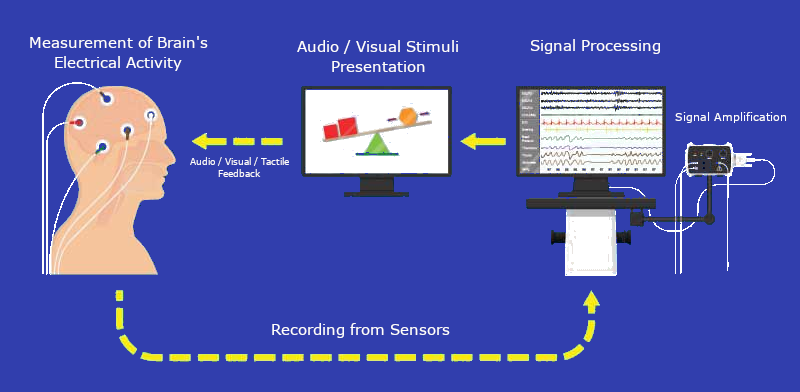
For example, a task might reward you with a positive sound or visual when your brain produces brainwave patterns associated with focus and calm. Your brain, seeking this reward, gradually learns to produce these states on command. This process provides direct feedback to the prefrontal cortex, helping it learn to better regulate attention and emotional responses.
Neurofeedback cognitive training is a promising tool used to promote cognitive functions effectively and efficiently.
Now, let's test what you've learned about these cognitive training techniques.
What is the primary role of the prefrontal cortex, often described as the 'CEO of the brain'?
How does the practice of mindfulness meditation act as a workout for the prefrontal cortex?
Consistently applying these techniques can lead to meaningful improvements in your cognitive abilities.