Quantum Physics Fundamentals
Wave-Particle Duality
Particle or Wave?
In the world we see around us, things are easy to categorize. A baseball is a particle. It's a solid object that exists in one specific place at a time. If you throw it, it follows a predictable path. A ripple in a pond is a wave. It's a disturbance that spreads out, and it doesn't have a single, precise location. Waves can do things particles can't, like passing through each other and creating interference patterns.
For centuries, this distinction was a bedrock of physics. Light was thought of as a wave, while matter, like tiny electrons, was made of particles. But as we learned in the last section, classical physics breaks down at the smallest scales. One of the first and most profound cracks in the old worldview was the discovery that this clean divide between particles and waves doesn't exist.
Theoretical physics is beset by a paradox that remains as mysterious today as it was a century ago: at the subatomic level things are simultaneously particles and waves.
The Double-Slit Experiment
The best way to see this paradox in action is with the double-slit experiment. It’s a simple setup that produces results that are impossible to explain with classical physics.
First, imagine firing a stream of tiny particles, like pellets from a BB gun, at a wall with two narrow, parallel slits in it. Behind this wall is a second wall that acts as a detector, recording where each pellet hits. Most pellets will be blocked, but some will go through one slit or the other. You'd expect to see two distinct bands on the detector wall, corresponding to the two slits. Simple enough.
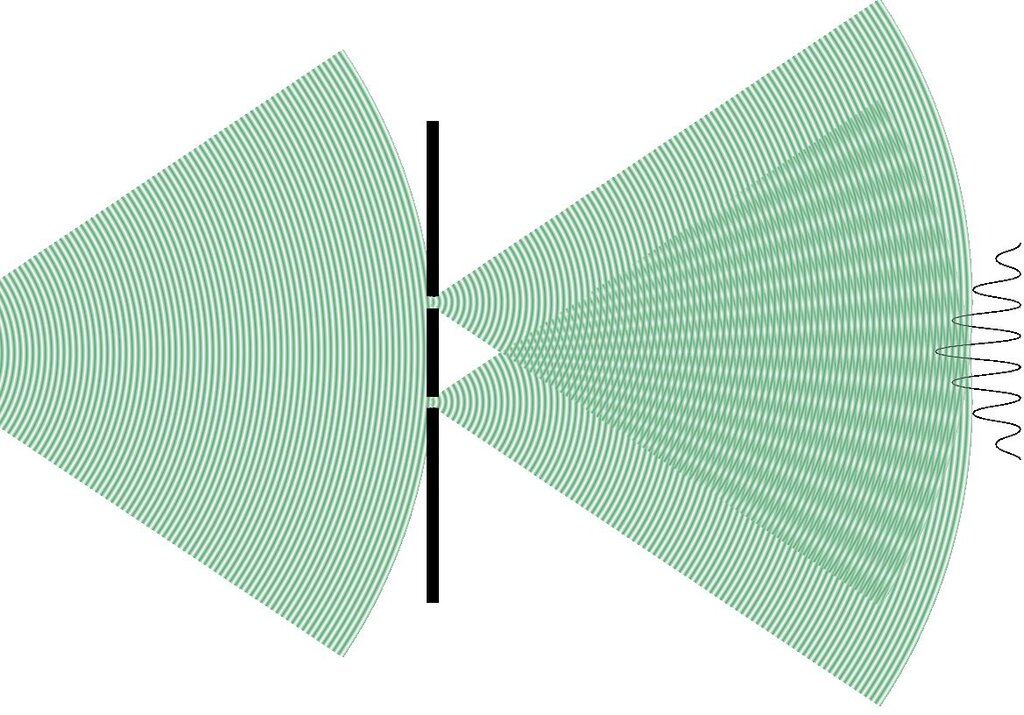
Now, let's replace the BB gun with a light source that sends out waves, like ripples in water. When the waves hit the barrier, they pass through both slits. As two new sets of circular waves emerge from the slits, they interfere with each other. Where the crest of one wave meets the crest of another, they combine to make a bigger wave (constructive interference). Where a crest meets a trough, they cancel out (destructive interference).
This creates a distinctive pattern on the detector wall: a series of bright and dark bands. The brightest band is in the middle, with alternating dimmer bands spreading out to the sides. This is a classic interference pattern, and it's a dead giveaway that you're dealing with a wave.
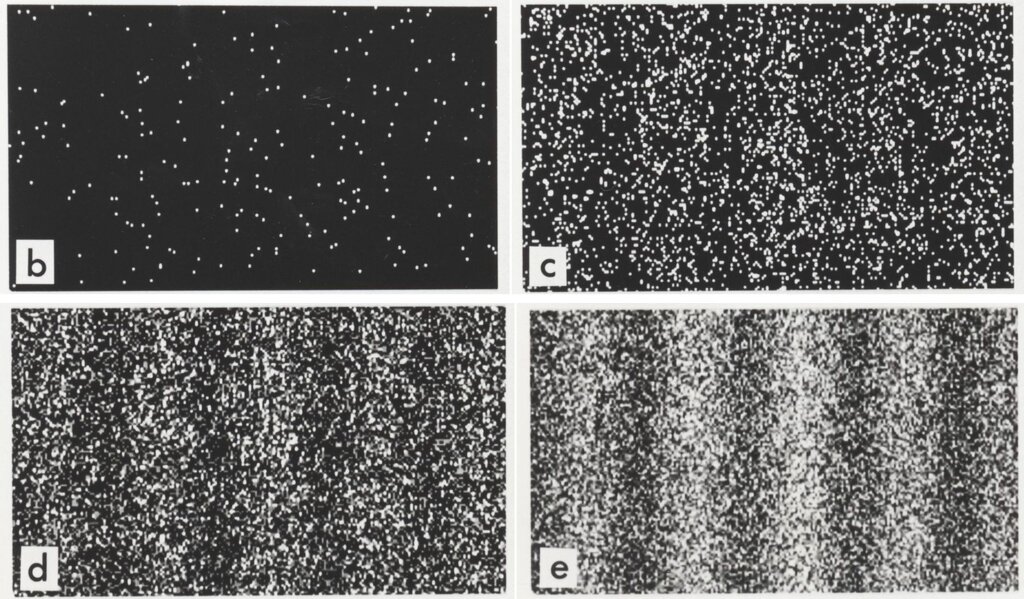
Here's where it gets strange. In the early 20th century, physicists performed this experiment with electrons, which everyone believed were tiny particles. They fired electrons one by one at the double slits. If electrons were just particles, you'd expect two bands on the detector. But that’s not what happened.
After many single electrons had been fired, a full interference pattern emerged. It was the same pattern that waves produce. This implied that each individual electron, traveling alone, somehow passed through both slits at once, interfered with itself, and then landed on the detector in a spot determined by that interference. The electron behaved like a particle when it was fired and when it hit the detector (as a single dot), but it behaved like a wave on its journey in between.
This wave-particle duality is not a trick or a flaw in the experiment. It is a fundamental property of the universe at the quantum level.
The weirdest part? If you place a detector at the slits to see which one the electron goes through, the interference pattern vanishes. The very act of observing the electron's path forces it to behave like a particle, and you get two simple bands on the screen. It's as if the particle "knows" it's being watched.
The de Broglie Hypothesis
This bizarre behavior isn't limited to electrons and photons. In 1924, a young French physicist named Louis de Broglie made a radical proposal. He suggested that all matter exhibits wave-particle duality. Not just subatomic particles, but everything: protons, atoms, molecules, and even you.
He proposed a simple equation to relate a particle's momentum (a particle property) to its wavelength (a wave property). This is now known as the de Broglie wavelength.
In this equation:
- (lambda) is the de Broglie wavelength.
- is Planck's constant, a very small number ( J·s).
- is the momentum of the particle ().
Because Planck's constant () is so tiny, the wavelength of a macroscopic object is absurdly small. For example, a baseball flying at 90 miles per hour has a de Broglie wavelength trillions of times smaller than a proton. It's so small that its wave-like properties are completely undetectable. But for a particle with very little mass, like an electron, the wavelength becomes significant enough to be observed and measured in experiments.
De Broglie's hypothesis was later confirmed by experiments that showed electrons could be diffracted by crystals, just like X-rays (a known form of wave). It was a revolutionary idea that reshaped our understanding of matter.
Time to check your understanding of these mind-bending concepts.
In the double-slit experiment, when electrons are fired one by one without any observation at the slits, what pattern eventually emerges on the detector screen?
According to Louis de Broglie's hypothesis, which of the following statements is true?
Wave-particle duality forces us to abandon our everyday intuition. The quantum world is not just a smaller version of our world; it operates by a completely different and more mysterious set of rules.