Quantum Physics Fundamentals
Quantum Entanglement
A Spooky Connection
Imagine you have a pair of coins that are magically linked. You give one to a friend and keep the other. You both travel to opposite ends of the Earth. When your friend flips their coin, it lands on heads. At that exact moment, you flip yours, and it's guaranteed to land on tails. No matter how many times you repeat this, the results are always opposite and perfectly correlated, instantly.
This is a rough analogy for quantum entanglement, one of the most peculiar ideas in physics. It's a phenomenon where two or more particles become linked in such a way that their fates are intertwined. Measuring a property of one particle—like its spin—instantaneously influences the corresponding property of the other particle, no matter how vast the distance separating them.
One of the most mind-boggling concepts is entanglement — the idea that two qubits can be so deeply linked that the state of one instantaneously affects the state of the other, no matter how far apart they are.
This connection is so strange that Albert Einstein famously called it “spooky action at a distance.” It seems to defy a core principle of physics: that information cannot travel faster than the speed of light. Let's represent two entangled particles, often called a Bell pair. If we measure the state of Particle A, we instantly know the state of Particle B.
Faster Than Light?
Does this spooky connection mean we can send messages faster than light? Surprisingly, no.
While the influence is instantaneous, it can't be used for communication. The outcome of measuring the first particle is completely random. For example, you can't force your entangled particle to be 'spin up' just to send a '1' to your friend. You simply measure it, get a random result, and only then does your friend's particle assume the opposite state.
To confirm the correlation, you and your friend would still need to communicate through conventional means, like a phone call, to compare your measurement results. The instantaneous link is real, but it doesn't allow for transmitting controllable information.
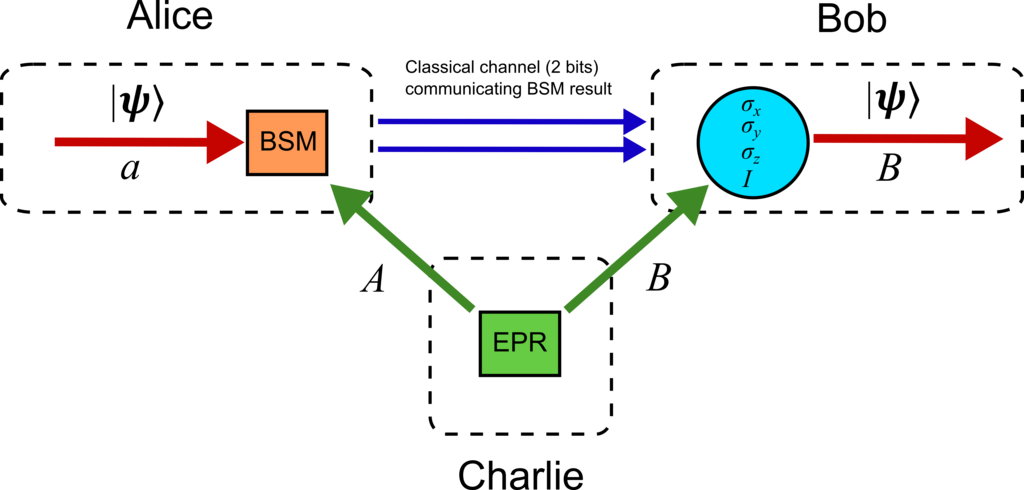
Powering Quantum Computers
So, if we can't use it for instant messaging, what is entanglement good for? Its real power shines in quantum computing. In the previous section, we saw how superposition allows a single qubit to exist in multiple states at once. Entanglement takes this to the next level by linking multiple qubits together.
When qubits are entangled, they no longer act as independent entities. They form a single, complex quantum state. This interconnectedness allows quantum computers to perform calculations on a massive number of possibilities simultaneously. Changing one qubit in an entangled set affects the entire system, creating computational power that grows exponentially with each added qubit.
This property is the key ingredient behind many powerful quantum algorithms that could solve problems currently intractable for even the most powerful supercomputers, from designing new materials to breaking complex codes.
Entanglement links qubits into a single system, allowing for complex, parallel computations that are impossible with classical bits.
Let's check your understanding of this spooky, but powerful, quantum connection.
What is the defining characteristic of quantum entanglement?
Albert Einstein famously referred to quantum entanglement as...?
Entanglement challenges our classical intuition about how the world works, revealing a deeply interconnected reality at the quantum level. It's a fundamental resource that transforms individual qubits into a powerful, unified computing machine.