Introduction to Fluid Dynamics
Fluid Dynamics
Energy in a Moving Fluid
When a fluid is in motion, it carries energy. This energy isn't just one type; it's a combination of a few different forms. We can think of it as the sum of energy from its pressure, its speed, and its height.
First, there's the energy related to pressure. Imagine a volume of water in a pipe. The water behind it pushes it forward, doing work on it. This is a form of potential energy stored in the fluid due to its compression. We call this pressure energy.
Second, any moving object has kinetic energy, and fluids are no exception. The faster the fluid flows, the more kinetic energy it possesses.
Finally, if the fluid is at a certain height, it has gravitational potential energy, just like a ball held up in the air. Lifting a fluid to a higher elevation requires work, and that work is stored as potential energy.
The key insight is that these three forms of energy can be converted from one to another as the fluid moves. If a fluid speeds up, its kinetic energy increases, but that energy has to come from somewhere. It might come from a decrease in pressure or a drop in height. This interplay is the core of energy conservation in fluid flow.
Bernoulli's Equation
This principle of energy conservation can be described by a powerful and elegant formula known as Bernoulli's equation. It's derived from the work-energy theorem, which states that the total work done on a system equals its change in kinetic energy.
For a small volume of fluid moving along a pipe, the work comes from the pressure of the fluid pushing on it and from the force of gravity. By setting this work equal to the change in the fluid's kinetic energy and doing some algebraic rearrangement, we arrive at the relationship Daniel Bernoulli formulated in the 18th century.
This equation connects the pressure, velocity, and height between any two points in a moving fluid.
Essentially, Bernoulli's equation tells us that the sum of these three terms remains constant along a streamline for an ideal fluid. If one term goes up, at least one of the others must go down to keep the total constant. It's a statement of energy conservation, tailored specifically for fluid dynamics.
For a horizontal pipe where the height doesn't change (), Bernoulli's equation simplifies. In this case, if the fluid's speed increases, its pressure must decrease.
Putting It to Work
Bernoulli's principle isn't just a theoretical curiosity; it has countless practical applications, especially in measuring fluid flow and creating pressure differences.
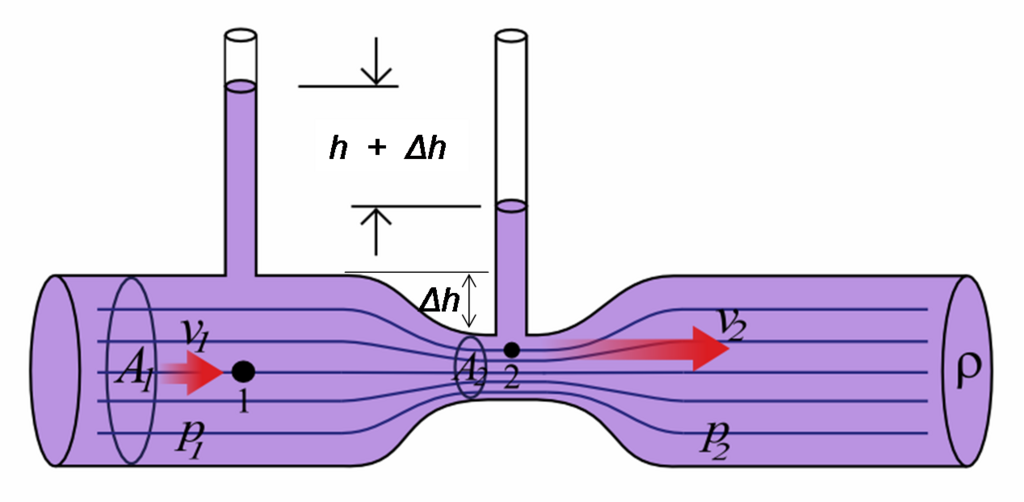
One of the classic examples is the Venturi effect, which describes the pressure reduction that occurs when a fluid flows through a constricted section, or a
throat
noun
The narrowest part of a tube or channel, where fluid velocity is highest.
Let's think about a Venturi tube. It's a pipe that narrows in the middle and then widens out again. According to the continuity equation (which we've seen before), the fluid must speed up as it enters the narrow throat to maintain a constant mass flow rate.
What does Bernoulli's principle say will happen to the pressure? Since the velocity () increases in the throat, the dynamic pressure () goes up. To keep the total energy constant, the static pressure () must drop. This measurable drop in pressure can be used to determine the fluid's flow rate.
This is the basis for the Venturi meter, a common device for measuring the flow speed of a fluid in a pipe. By measuring the pressure difference between the wider section and the narrow throat, engineers can calculate the velocity of the flow.
Other flow measurement devices also rely on these principles. An orifice plate, which is simply a thin plate with a hole in it placed inside a pipe, creates a pressure drop as fluid accelerates through the hole. A pitot tube, used to measure airspeed on aircraft, compares the total pressure at a point where the fluid is stopped to the static pressure of the surrounding flow to find the velocity.
So, by understanding the conservation of energy in a fluid, we can not only predict its behavior but also design tools to measure and control it.