Introduction to Fluid Dynamics
Dimensional Analysis
The Power of Dimensions
Why can’t you add 5 kilograms to 10 meters? The question seems silly because the units are different. One measures mass, the other length. This simple idea is the key to a powerful technique called dimensional analysis. It allows us to check if our equations make physical sense and simplify complex problems by focusing on the fundamental dimensions involved: mass (M), length (L), and time (T).
Every physical quantity can be broken down into these base dimensions. For instance:
- Velocity is distance over time, so its dimension is .
- Acceleration is velocity change over time, making it , or .
- Force, from Newton's second law (mass times acceleration), has dimensions of , or .
A core rule of physics is dimensional homogeneity: for any equation to be valid, the dimensions on both sides must be identical. You can't have an equation that claims kilograms equal meters per second.
The Buckingham Pi Theorem
While checking equations is useful, the true power of dimensional analysis comes from the Buckingham Pi theorem. It provides a method for reducing the number of variables in a problem. The theorem states that if a physical process involves n variables that can be described by k fundamental dimensions, the relationship can be simplified into an equation with n-k dimensionless groups. These groups are often represented by the Greek letter Pi ($\$Pi), hence the name.
Let’s see it in action. Imagine trying to find the drag force () on a smooth sphere moving through a fluid. You might guess that the force depends on the sphere's diameter (), its velocity (), the fluid's density (), and its viscosity ().
That's five variables: . Running experiments to test how each variable affects the force would be incredibly time-consuming.
Let's apply the theorem:
- Count variables (n): We have 5 variables (). So, .
- Count dimensions (k): The variables are described using mass (M), length (L), and time (T). So, .
- Find Pi groups (n-k): The theorem predicts we'll have dimensionless groups.
Through some algebraic manipulation (which we won't detail here), these two groups are found to be:
The complicated five-variable function now becomes a much simpler relationship between our two dimensionless Pi groups: . Instead of testing five variables, we now only need to explore how one dimensionless number affects another. This is a massive simplification.
Similarity and Model Testing
This leads us to one of the most practical uses of dimensional analysis: building and testing scale models. It would be too expensive and dangerous to test design changes on a full-size airplane or a massive new dam. Instead, engineers build smaller models and test them in wind tunnels or water flumes.
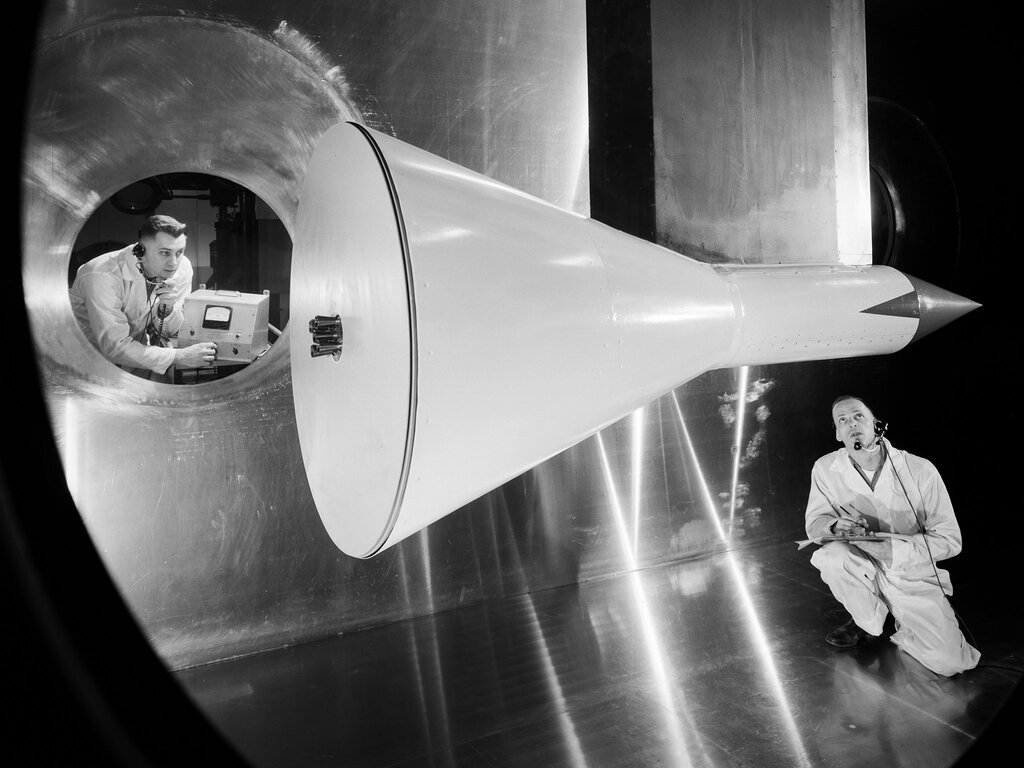
But for the model's behavior to accurately predict the full-size version's behavior, the two must be dynamically similar. This means the key dimensionless numbers for the model must be the same as for the real thing (the prototype).
If the Reynolds number for the flow around a model car in a wind tunnel is the same as the Reynolds number for a real car on the highway, then the drag coefficient () will also be the same. We can then use the model's to calculate the real drag force on the full-size car.
This principle of similarity is fundamental to modern engineering design, saving immense amounts of time and money.
Important Dimensionless Numbers
The Reynolds number isn't the only important dimensionless group in fluid dynamics. Different numbers become important depending on the dominant forces in the flow.
Reynolds Number (Re)
noun
The ratio of inertial forces to viscous forces. As you already know, it helps determine whether a flow is laminar or turbulent. It's crucial for any problem where viscosity is significant, like flow in pipes or around vehicles.
When testing a ship's design, another force becomes critical: gravity, which creates waves on the water's surface.
Froude Number (Fr)
noun
The ratio of inertial forces to gravitational forces. It's essential for analyzing flows with a free surface, such as the flow around ship hulls, water flowing over a dam, or flow in open channels.
For high-speed flows, like those involving aircraft or rockets, the compressibility of the fluid (usually air) is the dominant effect.
Mach Number (Ma)
noun
The ratio of the flow velocity to the speed of sound in the fluid. It determines how significant compressibility effects are. Flows are subsonic (), transonic (), supersonic (), or hypersonic ().

Achieving full similarity can be tricky. For example, trying to match both the Reynolds number and the Froude number for a ship model is often impossible because you can't change the value of gravity. In these cases, engineers must rely on experience and corrective formulas to extrapolate their model results.
Let's check your understanding of these concepts.
What is the primary principle of dimensional analysis?
Pressure is defined as Force per unit Area. Given that the dimensions of Force are and the dimensions of Area are , what are the dimensions of Pressure?
Dimensional analysis is a cornerstone of fluid mechanics, providing a bridge between theoretical principles and practical engineering applications. By grouping variables into dimensionless numbers, we can simplify problems and make powerful predictions from small-scale experiments.