Geothermal Energy Engineering and Economics
Thermodynamics and Fluids
Moving Heat from Deep Earth
Geothermal energy extraction is fundamentally a problem of heat transfer. The goal is to move thermal energy from hot rock formations deep underground to a power plant at the surface. Your civil engineering background gives you a head start in understanding the structural and fluid-flow challenges, but the thermal dynamics are unique. Three mechanisms are at play.
Conduction is the slow transfer of heat directly through the solid rock. It's how the Earth's mantle heats the crust above it. While fundamental, it's too slow to be the primary mechanism for a power plant.
Convection is the workhorse. This occurs when groundwater seeps into fractured hot rock, heats up, becomes less dense, and rises. Cooler, denser water sinks to take its place, creating a natural circulation that carries heat upward much more efficiently than conduction alone.
Counter-flow exchange is the engineered part of the process. In many systems, especially Enhanced Geothermal Systems (EGS), cold water is pumped down an injection well. It flows through the hot, fractured rock and is then drawn up a separate production well. The proximity of the hot production pipe to the cold injection pipe can create an efficient heat exchange, but the main event is the heat gathered from the rock itself.
The Working Fluid: Super-Pressurized Water
The fluid carrying this energy is almost always water, but not as we typically experience it. In a geothermal reservoir, pressures can range from 300 to 1500 psi, with temperatures between 200°C and 360°C. Under these conditions, water exists as either a compressed liquid or a mix of liquid and steam. Its ability to carry thermal energy is quantified by a property called ().
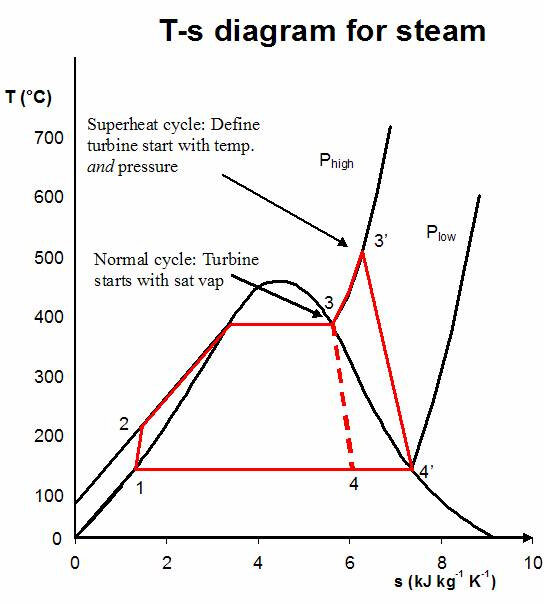
The T-s (Temperature-Entropy) diagram above is key. The dome shape is the saturation curve. To the left of the dome, water is a subcooled or compressed liquid. To the right, it's a superheated steam. Inside the dome, it's a two-phase mixture of liquid and vapor.
Geothermal reservoirs are classified by their position on this diagram. Liquid-dominated systems contain hot, pressurized water. When this water is pumped to the surface, the pressure drops, causing a portion of it to violently flash into steam. Vapor-dominated systems are rarer and contain mostly steam, which can be piped directly to a turbine.
Energy, Efficiency, and Entropy
The total energy of the geothermal fluid is its enthalpy, which combines its internal energy () with the product of its pressure () and volume ().
However, not all of this energy can be converted into electricity. The efficiency of heat extraction is limited by the laws of thermodynamics. As the geothermal fluid flows up the production well, friction with the pipe walls and turbulence from bends and valves cause irreversible energy losses. This is an increase in ().
Minimizing pressure drop and heat loss in the production piping is a primary design challenge. Every psi of pressure lost to friction is a psi that can't be used to spin a turbine.
Therefore, the design of the geothermal well and surface piping—its diameter, material, and insulation—is a balancing act. It's a classic civil and mechanical engineering problem of optimizing fluid flow, but with the added complexities of extreme temperatures and phase changes. The goal is to deliver fluid to the surface with the highest possible enthalpy and the lowest possible entropy gain.
Let's test what you've learned about the thermal properties of these systems.
In natural geothermal systems, what is the primary mechanism for transferring heat from deep underground hot rock to be utilized at the surface?
On a Temperature-Entropy (T-s) diagram for water, a geothermal reservoir containing a two-phase mixture of liquid and steam would be located where?