ADHD Management with CBT and DBT
Dialectical Behavior Therapy Basics
What is Dialectical Behavior Therapy?
While Cognitive Behavioral Therapy (CBT) focuses on changing thoughts and behaviors, Dialectical Behavior Therapy (DBT) takes a slightly different approach. It’s built on the idea of “dialectics,” which means bringing together two opposites: acceptance and change. For people with ADHD, this means learning to accept yourself and your challenges while also working to build a life you find more fulfilling.
DBT was originally developed to help people with intense emotional swings and self-destructive behaviors. Because emotional dysregulation and impulsivity are common struggles with ADHD, DBT skills can be incredibly useful.
DBT helps you learn how to regulate emotions, stay in the present moment, deal with crises, and be effective in your relationships.
The therapy is organized into four main skill sets, or modules. Think of them as four subjects in a class designed to help you navigate your inner world and your relationships with others.
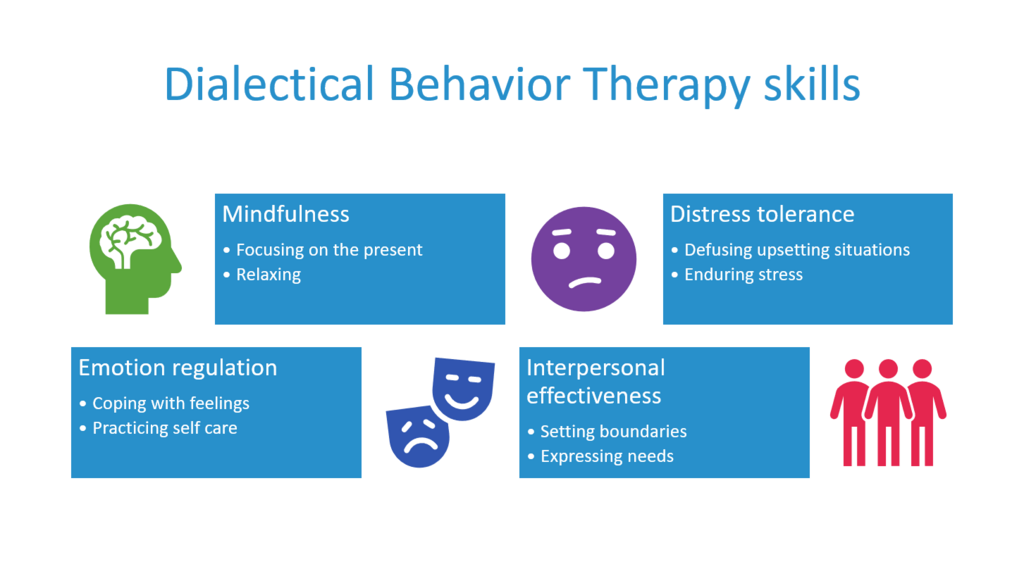
The Four Core Modules
DBT teaches practical skills in four key areas: Mindfulness, Distress Tolerance, Emotion Regulation, and Interpersonal Effectiveness. Mastering skills in each of these areas provides a well-rounded toolkit for managing the daily challenges of ADHD.
Let's break down what each one involves.
| Module | Primary Goal | How It Helps with ADHD |
|---|---|---|
| Mindfulness | Increase awareness of the present moment. | Reduces distraction and helps you focus on one thing at a time. |
| Distress Tolerance | Cope with painful emotions during a crisis. | Provides strategies to survive overwhelming moments without acting impulsively. |
| Emotion Regulation | Understand and manage your emotions. | Helps you identify what you're feeling and reduce the intensity of painful emotions. |
| Interpersonal Effectiveness | Build and maintain healthy relationships. | Teaches you how to ask for what you need and say no while respecting yourself and others. |
Skills in Practice
Just knowing about the modules isn't enough; the power of DBT comes from applying its specific skills. Let's look at a few examples from each area.
Mindfulness skills are considered the foundation of DBT. They are divided into “What” skills (what you do) and “How” skills (how you do it).
- Observe: Just notice sensations, thoughts, and feelings without pushing them away or clinging to them. It's like sitting on a riverbank and watching leaves float by.
- Describe: Put words to what you observe. For example, “I feel tightness in my chest,” or “I am having the thought that I will fail.”
- Participate: Throw yourself completely into the current moment, without self-consciousness.
These are done with the “How” skills: non-judgmentally, one-mindfully (focusing on one thing), and effectively (doing what works).
Distress Tolerance skills are for when you're in a crisis and can't solve the problem right away. The goal is to get through the moment without making things worse.
One powerful set of skills is called TIPP:
- Temperature: Change your body temperature dramatically by splashing your face with cold water or holding an ice pack. This triggers a physiological response that calms you down.
- Intense Exercise: Engage in a short burst of intense movement, like running in place or doing jumping jacks, to burn off anxious energy.
- Paced Breathing: Slow your breathing way down. Breathe in for a count of four and out for a count of six.
- Paired Muscle Relaxation: Tense and then relax different muscle groups to release physical tension.
Emotion Regulation skills help you manage your emotions on a day-to-day basis, not just in a crisis. One key strategy is called Check the Facts. When a strong emotion arises, you ask yourself questions to see if your emotional reaction fits the reality of the situation.
- What is the event that triggered my emotion?
- What are my interpretations or thoughts about this event?
- Does my emotional intensity actually match the facts?
This helps you separate your assumptions from what actually happened, which can lower the emotional heat.
Interpersonal Effectiveness skills are about navigating relationships. The DEAR MAN acronym is a tool for asking for something you want or saying no to a request.
- Describe the situation factually.
- Express your feelings clearly.
- Assert your wish by asking or saying no.
- Reinforce why the other person should grant your request.
- Stay Mindful of your goal.
- Appear confident.
- Negotiate a compromise if needed.
This structure provides a clear, respectful way to communicate, reducing the chances of conflict or misunderstanding.
Ready to see how well you've grasped these concepts?
What is the core "dialectic" that forms the foundation of Dialectical Behavior Therapy (DBT)?
You're feeling overwhelmed by a sudden, intense wave of anxiety. According to the Distress Tolerance module, which skill from the TIPP acronym would be most immediately effective for calming your body's physiological response?
By practicing these skills, you can learn to better manage the emotional and impulsive challenges that often come with ADHD. It's not about eliminating difficult feelings, but about learning how to respond to them in a more effective way.