Mastering the CPP Certification Exam
Information Security
The CIA Triad
Information security isn't just about hackers and firewalls. At its core, it’s about protecting data in all its forms. The universally accepted model for this is the CIA Triad, which stands for Confidentiality, Integrity, and Availability. These three principles are the bedrock of any information security program.
| Principle | Description | Example |
|---|---|---|
| Confidentiality | Ensuring that information is not disclosed to unauthorized individuals, entities, or processes. It's about secrecy. | Using encryption to protect an email so that only the intended recipient can read it. |
| Integrity | Maintaining the consistency, accuracy, and trustworthiness of data over its entire lifecycle. Data must not be changed in transit or altered by unauthorized people. | A file's digital signature confirms it hasn't been tampered with since it was signed. |
| Availability | Ensuring that information is accessible and usable upon demand by an authorized party. | A company's website remains online and functional for customers, even during a denial-of-service attack. |
Every security control you implement, from a simple password to a complex firewall, is designed to support one or more of these principles. A breach of confidentiality is an unauthorized disclosure of information. A breach of integrity is an unauthorized modification. And a breach of availability is the denial of access to authorized users.
Strategies for Data Protection
Protecting data starts with understanding its value. Not all information is created equal, which is why organizations use a process called data classification. By categorizing data based on its sensitivity, you can apply the right level of protection without wasting resources.
A common classification scheme looks like this:
| Level | Description | Example |
|---|---|---|
| Public | Information cleared for public release. | Press releases, marketing materials. |
| Internal | Information for internal company use only. Minor impact if disclosed. | Employee directories, internal memos. |
| Confidential | Sensitive data that could cause damage if disclosed. | Customer lists, business plans. |
| Restricted | Highly sensitive data, with severe consequences if disclosed. | Trade secrets, unpatented research. |
Once data is classified, you can apply specific protection strategies. Encryption is a key tool, scrambling data so it's unreadable without the correct key. It's used for data at rest (stored on a hard drive) and data in transit (moving across a network).
Access control is another critical strategy. It's the selective restriction of access to a place or other resource. As you know from physical security, this means ensuring only authorized people can get through a door. In information security, it means ensuring only authorized users can access a specific file or system.
The goal is to enforce the principle of least privilege: give users the minimum levels of access, or permissions, needed to perform their job functions.
Network Security Measures
While data is the treasure, the network is the road that leads to it. Securing the network is essential for protecting the information that travels across it. Several key technologies form the foundation of network defense.
Firewalls act as a barrier between a trusted internal network and untrusted external networks, like the internet. They inspect incoming and outgoing traffic and decide whether to allow or block it based on a set of security rules.
To detect threats that get past the firewall, organizations use Intrusion Detection Systems (IDS) and Intrusion Prevention Systems (IPS).
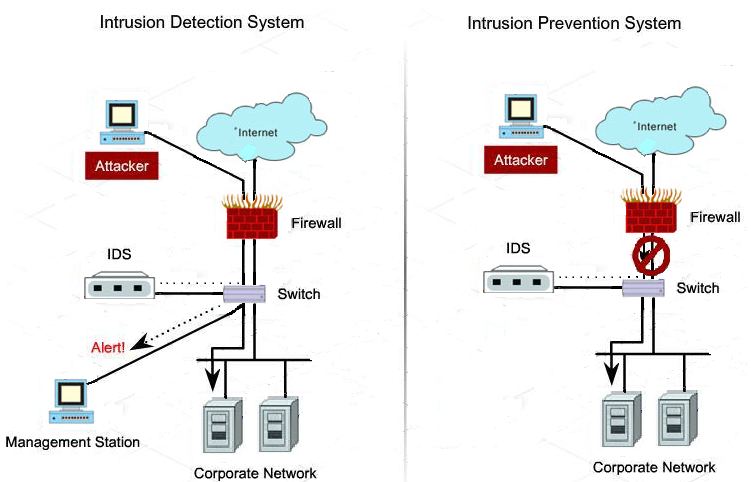
An IDS is like a security camera system. It monitors network traffic for suspicious activity and sends an alert when it finds something. It's a passive system; it doesn't stop the threat, it just reports it.
An IPS is more like a security guard who can intervene. It not only detects malicious activity but can also take action to block or prevent it from succeeding. IPS sits directly in the path of the traffic, allowing it to stop threats in real time.
Incident Management
Despite the best defenses, security incidents happen. A well-prepared organization doesn't just try to prevent incidents; it has a clear plan for what to do when they occur. This process is called incident management or incident response.
The incident response process generally follows a standard lifecycle, ensuring a structured and effective reaction to any event.
Where Physical and Cyber Security Meet
As a security professional, you understand that threats aren't confined to a single domain. The line between physical and information security is increasingly blurred. A holistic security program addresses both in an integrated way.
Consider a server room. It holds critical data, making it a target for cyberattacks. But the servers themselves are physical assets. The security plan must include both network firewalls (cyber) and locked doors with access control (physical). A data breach could be caused by a hacker exploiting a software vulnerability from across the world, or by an unauthorized person simply walking into the server room and plugging in a USB drive.
Similarly, access control systems, which you manage as a physical security measure, are themselves computer systems. They run on networks, store data, and are vulnerable to cyber threats. If the access control system is compromised, the physical perimeter is breached.
This convergence requires a unified approach. Physical security teams need to understand cyber risks, and cybersecurity teams need to appreciate physical vulnerabilities. Protecting an organization's assets requires collaboration and a shared understanding of the entire threat landscape.
A distributed denial-of-service (DDoS) attack overwhelms a company's web server, making its e-commerce site unavailable to customers. Which principle of the CIA Triad has been primarily violated?
What is the primary difference between an Intrusion Detection System (IDS) and an Intrusion Prevention System (IPS)?
By understanding these information security fundamentals, you can better integrate them into a comprehensive protection strategy, ensuring that both physical and digital assets are secure.