Mastering Macbeth
Jacobean Political Context
A New King, A New Era
In 1603, Queen Elizabeth I died without an heir, ending the Tudor dynasty. The throne passed to her distant cousin, James VI of Scotland, who then became King James I of England. This event, known as the Union of the Crowns, brought England and Scotland under a single monarch for the first time.
This was not a smooth transition. The English court was wary of a Scottish king, and deep-seated tensions existed between the two nations. Shakespeare, ever the astute observer, wrote Macbeth around 1606, directly into this politically charged atmosphere. The play is set in Scotland and features a lineage of Scottish kings, a clear nod to the new man in power.
Gunpowder, Treason, and Plot
Just a year before Macbeth was likely first performed, a shocking event rocked England. On November 5, 1605, a group of Catholic conspirators was caught attempting to blow up the Houses of Parliament with King James and his government inside. This was the Gunpowder Plot.
The plot created a storm of paranoia about regicide—the act of killing a king. The conspirators' trial also popularized the idea of 'equivocation', a form of misleading, ambiguous language used to avoid self-incrimination. The Jesuits involved argued one could lie under oath without technically sinning. Shakespeare directly references this in the Porter's scene, where the Porter imagines welcoming an equivocator into hell "who could swear in both the scales against either scale." The play is saturated with the era's anxieties about hidden treason and deceptive appearances.
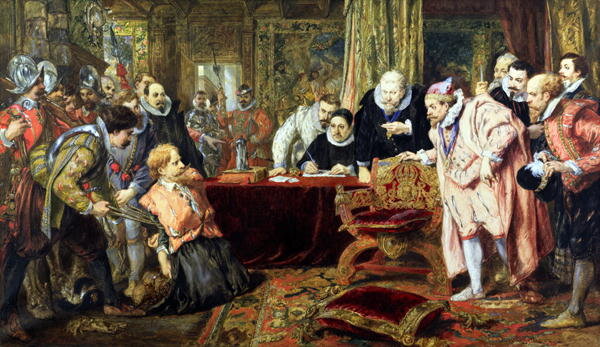
The World Turned Upside Down
To a Jacobean audience, killing a king was more than a political crime. It was a sin against God that would unravel the very fabric of the universe. This belief was rooted in two key concepts: the Great Chain of Being and the Divine Right of Kings.
The Great Chain of Being was the belief that God created a strict, hierarchical order for everything in existence. God was at the top, followed by angels, humans (with the monarch at the peak), animals, plants, and finally minerals. To disturb this chain was to invite chaos. This is why after Macbeth murders King Duncan, the natural world revolts: the sky darkens during the day, a lesser owl kills a mighty falcon, and Duncan’s well-bred horses eat each other. Macbeth's act of regicide has thrown nature itself into disarray.
This leads to the Divine Right of Kings, the doctrine that a monarch is not subject to any earthly authority, deriving the right to rule directly from the will of God. A king was God's chosen representative on Earth. To challenge a king was to challenge God Himself. Macbeth serves as a powerful cautionary tale, dramatizing the catastrophic consequences of usurping a divinely appointed ruler.
Shakespeare warns a Jacobean audience that attacking rightful kingship wrecks the moral and cosmic order.
Witchcraft and Royal Flattery
The prominent role of the witches in Macbeth was also a calculated move. King James was deeply fascinated and terrified by witchcraft. He had personally presided over witch trials in Scotland and had even written a book on the subject, Daemonologie, in 1597. By opening the play with the Weird Sisters, Shakespeare was catering directly to the king's own intellectual interests and obsessions.
Shakespeare's primary source for the plot was Raphael Holinshed's Chronicles of England, Scotland, and Ireland (1587). However, he made crucial changes to flatter his new patron. In Holinshed's version, the historical Banquo was an accomplice in King Duncan's murder. In Shakespeare's play, Banquo is transformed into a noble, loyal, and innocent figure—a foil to the treacherous Macbeth. Why the change? According to legend, King James I was a direct descendant of the historical Banquo. By portraying Banquo as a virtuous man, Shakespeare was complimenting the king's own lineage and validating his right to the throne.
Ready to test your understanding of the world that shaped Macbeth?
How did the political situation in England change in 1603, setting the stage for Shakespeare to write Macbeth?
The failed Gunpowder Plot of 1605 created paranoia about regicide. What related concept, referenced by the Porter in Macbeth, was popularized by the plotters' trial?
Understanding this political and philosophical backdrop is key to unlocking the deeper meanings within the play. Every decision, every supernatural event, and every line spoken is tied to the anxieties and beliefs of the Jacobean age.