Master Your Golf Swing
Refined Setup Essentials
Refining Your Setup for Power
You already know the basic building blocks of a golf setup: grip, stance, posture, and alignment. But knowing what they are is different from knowing how to optimize them. The difference between a decent shot and a great one often lies in the subtle refinements made before the club even moves. Let's move beyond the fundamentals and dial in your setup to unlock more power and consistency.
The grip, stance, and posture are the foundation of a golfer’s swing.
Fine-Tuning Your Grip
Grip pressure is a classic Goldilocks problem: not too tight, not too loose. On a scale of 1 to 10, where 1 is barely holding on and 10 is a white-knuckle death grip, you want to be around a 4 or 5. A common analogy is to hold the club with the same pressure you'd use to hold a full tube of toothpaste without squeezing any out. This light-but-firm pressure allows for a fluid release and maximizes —a key source of clubhead speed.
Check your hand placement. The 'V's formed by the thumb and forefinger on both hands should point roughly toward your trail shoulder (the right shoulder for a right-handed player). This promotes a neutral grip that makes it easier to square the clubface at impact. For your bottom hand, ensure your index finger is slightly separated, creating a 'trigger finger' that adds stability and feel at the top of the swing.
Stance, Posture, and Ball Position
Your stance width should adapt to the club you're holding. For a driver, your feet should be slightly wider than your shoulders to create a stable base for a powerful rotation. As you move to your shorter irons and wedges, narrow your stance progressively. A wedge shot might require a stance just inside your hips. This narrower base makes it easier to control the strike and hit down on the ball.
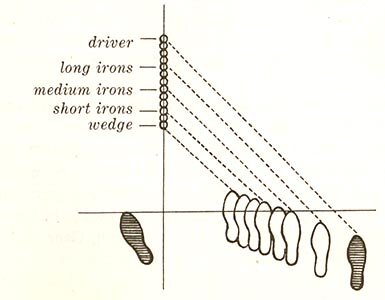
The optimal ball position also changes. With a driver, the ball should be aligned with the inside of your lead heel. This allows you to hit the ball on the upswing, maximizing launch angle and distance. For mid-irons, the ball moves back toward the center of your stance, positioning it at the low point of your swing arc for a crisp, descending strike. Wedges are played even further back from center, promoting a steep angle of attack. This is a crucial adjustment many golfers overlook, leading to inconsistent contact.
Now, let's talk posture. Stand with your feet set, and then hinge forward from your hips, not your waist. Keep your back relatively straight, maintaining what's called the throughout the swing. Your knees should be slightly flexed, and your arms should hang naturally from your shoulders. This creates an athletic, balanced position ready for rotation. Avoid slumping or reaching for the ball, as this destroys your balance and power.
Perfecting Your Alignment
Poor alignment is a silent killer of good golf shots. You can make a perfect swing, but if you're aimed in the wrong direction, the result will be poor. A reliable pre-shot routine is your best defense.
Start by standing a few feet directly behind the ball, looking down your target line. Pick an intermediate target—a discolored blade of grass, a leaf, an old divot—just a few feet in front of your ball that lies on that line. Now, walk into your setup. First, aim the clubface squarely at that intermediate target. This is much easier than aiming at a target 200 yards away. Once the clubface is set, build your stance around it, setting your feet, hips, and shoulders parallel to the clubface and target line.
Aim the clubface first, then take your stance. Never the other way around.
Once you're set, a final glance at the target reinforces your intention. A simple drill is to place two alignment sticks on the ground. One points at your target (this is your ball-to-target line), and the other lies parallel to it, just outside your golf ball, representing your body line. Practice setting up to this visual aid until the feeling of being perfectly square becomes second nature.
Ready to test your knowledge?
On a scale of 1 to 10, what is the recommended grip pressure for a golf club?
When setting up for a shot with a driver, where should the ball be positioned?
Mastering these details transforms your setup from a simple starting position into a dynamic launchpad. A consistent, refined setup is the first step toward a more powerful and repeatable golf swing.