Machine Learning Fundamentals
Historical Development of Machine Learning
The First Seeds
The idea of a machine that could learn isn't new. In the 1950s, pioneers like Alan Turing were already asking, "Can machines think?" This question laid the philosophical groundwork for machine learning. But the first real steps were more practical.
Instead of trying to create a thinking machine from scratch, early computer scientists focused on a simpler goal: could a machine improve at a task through experience, just like a person? This was a major shift from traditional programming, where a computer only follows explicit, pre-written instructions.
The core idea was to let the machine figure out its own strategy by playing against itself or an opponent over and over again.
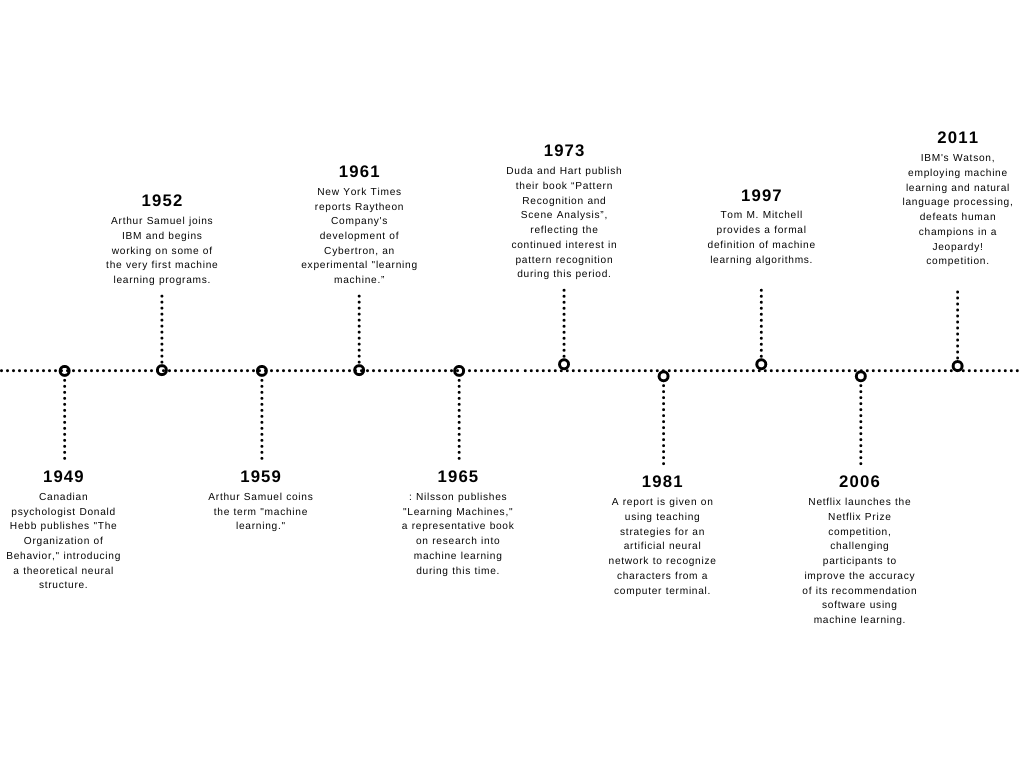
In 1959, an IBM researcher named Arthur Samuel demonstrated this with a checkers-playing program. The program wasn't told the best moves. Instead, it learned by playing thousands of games. Over time, its performance improved until it could challenge respectable amateurs. Samuel's program was a landmark achievement. It showed that a computer could learn to perform a task better than its human programmer, all without being explicitly taught how.
The Brain as a Blueprint
Around the same time, other researchers were inspired by a different model: the human brain. They wondered if they could create an artificial network of "neurons" that could learn in a similar way.
In 1958, psychologist Frank Rosenblatt developed the Perceptron, one of the first artificial neural networks. It was a simple algorithm designed to recognize patterns. Given an image, it could learn to distinguish between, say, a triangle and a square. It was a huge breakthrough, and for a while, it seemed like true artificial intelligence was just around the corner.
But progress stalled. Simple neural networks like the Perceptron had fundamental limits. They could solve some problems, but struggled with more complex ones. At the same time, computing power was still very limited and expensive. Funding dried up, and the field entered a period known as an "AI winter."
The Deep Learning Revolution
The AI winter began to thaw in the late 2000s, thanks to two key developments: a massive increase in available data from the internet and the development of much more powerful computers, especially graphics processing units (GPUs).
Researchers revisited the idea of neural networks, but with a twist. Instead of just one or two layers of artificial neurons, they started building networks with dozens or even hundreds. This approach was called "deep learning."
These deep networks could learn much more complex patterns from data than their predecessors. The breakthrough moment came in 2012 when a deep learning model called AlexNet blew away the competition in a major image recognition challenge. It was far more accurate at identifying objects in photos than any previous system.
AlexNet's success kicked off a revolution. The combination of massive datasets, powerful hardware, and deep neural networks proved to be the recipe for the incredible progress in AI we see today.
Now that you've seen how machine learning has evolved, let's review the key milestones.
Ready to test your knowledge?
What fundamental question, posed by pioneers like Alan Turing in the 1950s, laid the philosophical groundwork for machine learning?
Arthur Samuel's checkers program from 1959 was a landmark achievement because it demonstrated that a machine could:
From early theories to deep learning, the history of machine learning is a story of big ideas, frustrating setbacks, and powerful breakthroughs. This journey has brought us to the current era of AI, built on decades of research and innovation.