Machine Learning Fundamentals
Introduction to Machine Learning
Learning Without Instructions
Think about how you learned to ride a bike. No one gave you a perfect, step-by-step manual. You probably got on, wobbled, fell, and tried again. With each attempt, your brain subtly adjusted. You learned from experience—from data. Machine learning works in a similar way. It's a field of artificial intelligence where computers learn to perform tasks not by being explicitly programmed with rules, but by finding patterns in data.
Instead of writing code to solve a problem, you provide data and let the machine figure out its own solution.
Let's compare this to traditional programming. If you wanted to write a program to convert Celsius to Fahrenheit, you'd give the computer a specific formula.
The computer follows this rule exactly. It doesn't learn; it just calculates. A machine learning approach would be different. You would give the computer a huge list of Celsius temperatures and their Fahrenheit equivalents. The machine's job would be to analyze all these examples and figure out the relationship—the formula—on its own.
The Core Components
Every machine learning system is built on three key ingredients: data, an algorithm, and a model.
Data
noun
The collection of examples, experiences, or information that the system learns from. This could be anything from images and text to numbers in a spreadsheet.
Data is the textbook. The more relevant and high-quality examples you provide, the better the system will learn. For an email spam filter, the data would be thousands of emails, each labeled as "spam" or "not spam."
Algorithm
noun
The learning process or procedure. It's the method the machine uses to analyze the data and find patterns.
If data is the textbook, the algorithm is the study technique. Just as there are different ways to study for a test (making flashcards, taking practice exams), there are many different machine learning algorithms. Each is suited for different kinds of problems.
Model
noun
The output of the algorithm after it has been trained on the data. It's the set of rules, patterns, or structures that represents what the system has learned.
The model is the knowledge you have after studying. For our spam filter, the model is what the computer uses to make a prediction on a new, unseen email. It's the distilled wisdom from all the data it analyzed.
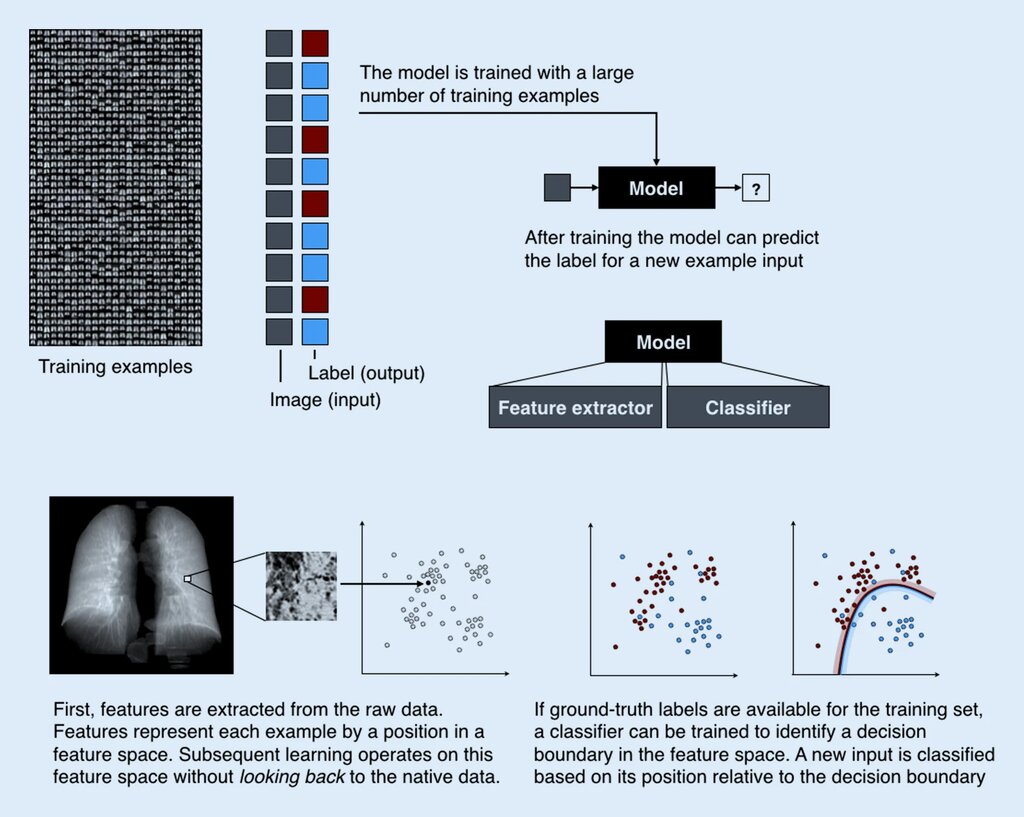
Why Does This Matter
This shift from instruction to learning is powerful. It allows us to solve problems that are too complex for traditional programming. Think about recognizing a cat in a photo. Could you write a set of rules to define "cat"? You might start with "has pointy ears" and "has whiskers," but you'd soon find countless exceptions. A cat might have its ears folded back, or its whiskers might not be visible.
Machine learning sidesteps this. Instead of trying to define "cat" with rules, we show a machine thousands of cat photos (data). The algorithm finds the subtle, complex patterns that we can't easily describe, and it builds a model that can recognize cats. This approach is used for everything from recommending movies and translating languages to identifying diseases from medical scans.
Ready to check your understanding?
What is the fundamental difference between machine learning and traditional programming?
In the analogy provided, if data is the 'textbook' and the model is the 'knowledge' gained, what is the algorithm?
By focusing on learning from data, machine learning opens up a world of possibilities that rigid, rule-based programming can't touch.