Lithium's Float Failure
Introduction to Density
Packing It In
Have you ever wondered why a ship made of steel can float, but a tiny steel pebble sinks? Or why a helium balloon rises while a balloon filled with your own breath falls? The answer to both questions is the same: density.
Density is a fundamental property of matter that tells us how much "stuff" is packed into a given space. Imagine two suitcases of the same size. One is filled with feathers, and the other is packed with rocks. The suitcase with rocks is much heavier because rocks are denser than feathers. More mass is crammed into the same amount of volume.
Density
noun
The measure of mass per unit of volume.
In science, we express this relationship with a simple formula. Density is calculated by dividing an object's mass by its volume.
In this equation:
- (the Greek letter rho) is the symbol for density.
- stands for mass.
- stands for volume.
The standard unit for density in the International System of Units (SI) is kilograms per cubic meter (). However, you'll often see it expressed in grams per cubic centimeter () or grams per milliliter () for smaller objects and liquids. Since one cubic centimeter is equal to one milliliter, is the same as .
A Tale of Two States
Density helps explain everyday phenomena. A classic example is why ice floats on water. Most substances become denser when they freeze, but water is a unique exception. As water cools and turns into ice, its molecules arrange themselves into a rigid, crystalline structure that takes up more space than they did in their liquid form.
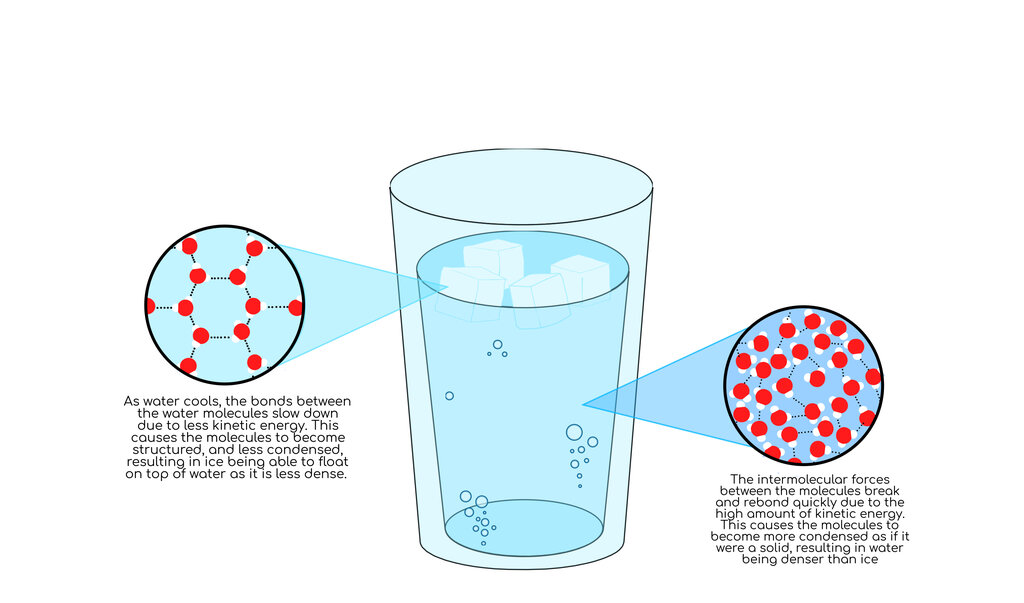
Because the same mass of water molecules occupies a larger volume as ice, its density decreases. This lower density allows icebergs and ice cubes to float on liquid water.
Density is an intrinsic property. A small gold nugget and a large gold bar have the same density, because the ratio of mass to volume is the same for both.
Here’s a look at the densities of a few common substances. Notice how different materials can be, even if they look similar.
| Substance | Density (g/cm³) |
|---|---|
| Air (at sea level) | 0.001225 |
| Oak Wood | 0.75 |
| Water (liquid) | 1.0 |
| Aluminum | 2.7 |
| Steel | 7.85 |
| Lead | 11.34 |
| Gold | 19.3 |
How We Measure Density
To find the density of an object, you need two measurements: its mass and its volume. Finding the mass is straightforward—you just use a scale or a balance.
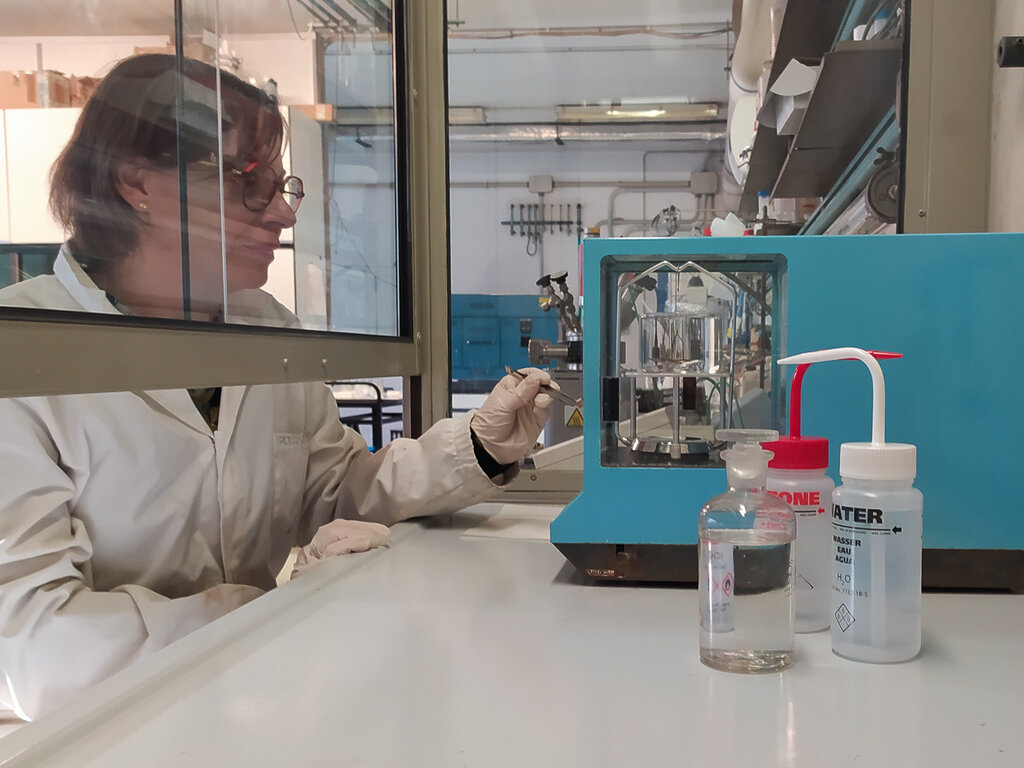
Measuring volume can be simple or tricky, depending on the object's shape. For a regular solid, like a cube or a sphere, you can measure its dimensions and calculate the volume using a geometric formula.
For an irregularly shaped object, like a rock, you can find its volume by measuring the amount of water it displaces. You place the object in a graduated cylinder with a known amount of water and measure how much the water level rises. The difference in volume is the volume of the object.
By combining these two measurements—mass and volume—you can calculate the density of any substance.
Ready to check your understanding? Let's see what you've learned.
Which of the following formulas correctly calculates density?
A large ship is made of steel, which is much denser than water. Why does the ship float?
Understanding density is the first step toward exploring more complex topics in physics and chemistry, from buoyancy to material science.