Linear Algebra for Quantum Physics
Vector Spaces
The Playground for Vectors
You might remember vectors as arrows with a specific length and direction. That's a great starting point. But in linear algebra, we think bigger. Vectors can be anything from arrows on a graph to lists of numbers, or even functions, as long as they follow certain rules.
A vector space is the environment where these vectors live. It's like a playground with two fundamental rules: you can add any two vectors together, and you can multiply any vector by a scalar (a regular number). Crucially, the result of these operations must also be a vector that lives in the same playground.
vector space
noun
A collection of objects called vectors, which can be added together and multiplied by numbers called scalars. For any vectors u, v, w and scalars a, b, the collection must satisfy specific axioms.
Formally, for a set to be a vector space, it must satisfy a few axioms. They might look intimidating, but they just ensure everything behaves predictably. For any vectors , , and in and any scalars and :
- Closure: is in , and is in .
- Addition Rules: Addition is commutative () and associative ().
- Zero Vector: There is a zero vector such that .
- Additive Inverse: For every , there is a such that .
- Scalar Rules: Scalar multiplication is distributive () and compatible ().
- Scalar Identity: There is an identity element such that .
The most common vector space you'll encounter is , which represents all vectors with real-number components. For example, is the familiar 2D Cartesian plane, and is the 3D space we live in.
Building with Vectors
The power of vector spaces comes from combining vectors. A linear combination is what you get when you take a set of vectors, multiply each by a scalar, and add them all up. It's like a recipe: a little bit of this vector, a dash of that one.
In this formula, is a linear combination of the vectors , and the scalars are the weights.
The span of a set of vectors is the set of all possible linear combinations you can make from them. If you have two vectors in that don't point in the same direction, their span is a plane. They can't reach every point in 3D space, but they define a flat surface that cuts through it.
This leads to the idea of a subspace. A subspace is a vector space that is contained within another, larger vector space. Think of that plane: it's a subspace of the full 3D space. For a set to be a subspace, it must meet three simple conditions.
A subset of a vector space is a subspace if:
- It contains the zero vector ().
- It's closed under addition (if and are in , then is in ).
- It's closed under scalar multiplication (if is in and is a scalar, then is in ).
A line or a plane passing through the origin in are perfect examples of subspaces. A plane that doesn't pass through the origin isn't a subspace, because it fails the first condition—it doesn't contain the zero vector.
The Building Blocks of Space
So, how do we describe an entire vector space efficiently? We don't need every vector; we just need a special, minimal set that can build all the others. This set is called a basis.
basis
noun
A set of vectors in a vector space that are linearly independent and span the entire space.
A basis has to satisfy two conditions:
- It must span the space. The vectors in the basis must be able to create any other vector in the space through a linear combination.
- It must be linearly independent. This means no vector in the basis can be created from a combination of the others. Each vector adds something new and unique.
Think of it like primary colors. With red, yellow, and blue, you can mix any color imaginable, but you can't make red by mixing yellow and blue. The primary colors are a basis for the space of all colors.
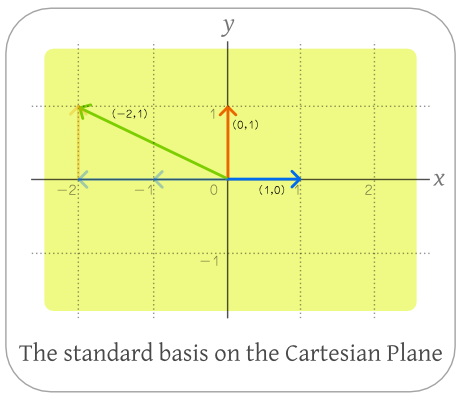
The number of vectors in a basis is the dimension of the vector space. This confirms what we intuitively know: is two-dimensional because its basis requires two vectors. is three-dimensional because it needs three. Every basis for a given vector space has the same number of vectors.
Understanding these fundamentals—vector spaces, span, and basis—is the first step toward grasping the mathematical language of quantum mechanics, where quantum states are represented as vectors in a special kind of vector space.
Which of the following is a fundamental requirement for a set of elements to be considered a vector space?
The set of ALL possible linear combinations of a set of vectors is known as its what?