Introduction to Artificial Intelligence
Future Trends and Challenges in AI
The Next Wave of AI
We are moving beyond the current generation of AI that generates text or images from a prompt. The next frontier involves creating systems that can reason, plan, and learn with greater autonomy and efficiency. One emerging area is creating AI that aligns more closely with human values, not just by learning from direct feedback, but by following a set of core principles. This is sometimes called 'Constitutional AI,' where a model's behavior is guided by a foundational document, much like a constitution guides a government.
Researchers are also exploring entirely new hardware. Instead of relying on traditional silicon chips, some are developing 'neuromorphic' computers. These systems are designed to mimic the brain's structure and function, with interconnected artificial neurons and synapses. The goal is to create AI that can learn continuously and use a fraction of the energy that current models consume.
Imagine an AI that doesn't need massive data centers to operate but can learn and adapt on a small, efficient chip inside a personal device.
AI in Every Corner
Artificial intelligence is becoming a fundamental utility, weaving itself into the fabric of major industries. This integration goes far beyond chatbots and recommendation algorithms.
In healthcare, AI is accelerating the discovery of new drugs by simulating molecular interactions, a process that once took years. It's also analyzing medical scans like X-rays and MRIs to spot signs of disease earlier and with greater accuracy than the human eye. The ultimate goal is personalized medicine, where treatments are tailored to an individual's unique genetic makeup and lifestyle, all guided by AI analysis.
Finance is another area undergoing a quiet revolution. High-frequency trading algorithms already execute trades in microseconds based on complex market signals. On a personal level, AI is being used to create more sophisticated fraud detection systems and to offer tailored financial advice, helping people manage their money more effectively.
This trend is repeating across the board. In agriculture, AI helps optimize crop yields with precision watering and pest detection. In manufacturing, it powers robots that can adapt to new tasks on the fly. And in science, AI is helping researchers analyze massive datasets to model climate change and understand the universe.
Growing Pains
As AI systems become more powerful, they also face significant hurdles. One of the biggest is scalability. Training a state-of-the-art AI model requires enormous amounts of computational power, which consumes vast quantities of energy and has a real environmental cost. Making these powerful tools more efficient is a critical challenge.
Another issue is generalization. Humans can learn a concept in one context and apply it to another with ease. If you learn to drive a car, you can probably figure out how to drive a van. AI struggles with this. A model trained to identify cats in photos can't use that knowledge to understand the role of cats in ancient Egyptian society. This narrowness, or 'brittleness,' limits AI's real-world usefulness and is a major focus of ongoing research.
The Superintelligence Question
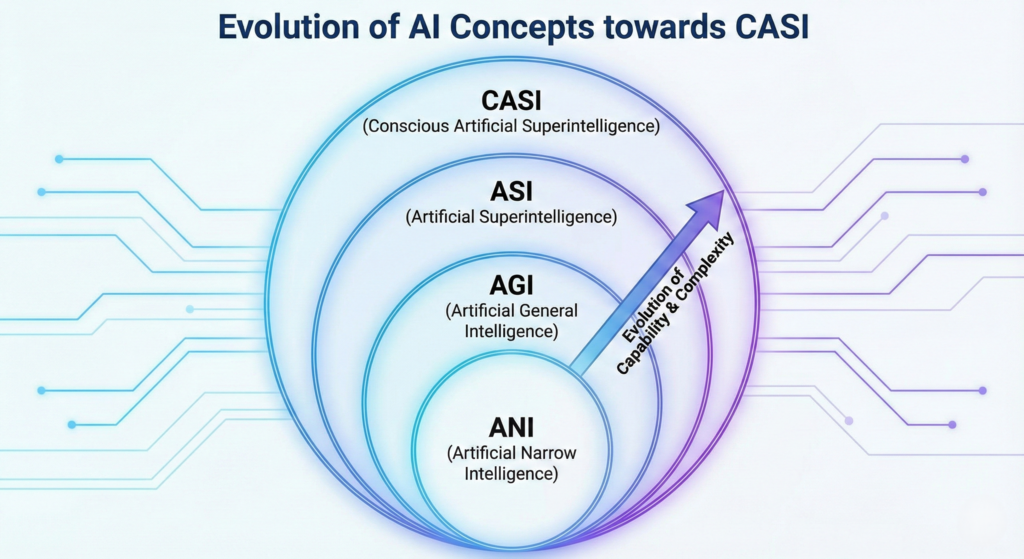
Looking further ahead, some researchers are focused on creating Artificial General Intelligence (AGI), an AI that can understand or learn any intellectual task that a human can. Beyond that lies the concept of Artificial Superintelligence (ASI), a system that would vastly exceed human cognitive performance in virtually all domains of interest.
The potential benefits are staggering. A superintelligent AI could help solve humanity's most complex problems, from curing diseases and ending poverty to mitigating climate change and enabling interstellar travel.
However, the risks are just as profound. The primary concern is the 'control problem': how can we ensure that a system far more intelligent than ourselves will act in ways that are beneficial to humanity? Ensuring that an ASI's goals are aligned with our own is a complex technical and philosophical challenge that experts are grappling with today. International summits and policy discussions are becoming more common as we begin to plan for this future.

The work being done now, from developing ethical guidelines to researching technical safety measures, is crucial for navigating the path toward more advanced AI responsibly. The goal is to reap the immense rewards while carefully managing the unprecedented risks.
What is the primary goal of "Constitutional AI"?
What is the key design principle behind neuromorphic computers?
Ultimately, AI's future isn't just about technology. It's about the choices we make today to steer its development toward a future that is safe, equitable, and beneficial for everyone.