Introduction to Artificial Intelligence
Introduction to Artificial Intelligence
What Is Artificial Intelligence?
Artificial intelligence, or AI, is the science of making machines that can perform tasks that typically require human intelligence. This includes abilities like learning, reasoning, problem-solving, perception, and understanding language. It's not about creating robots that look and act exactly like humans, but about building systems that can think and adapt in smart ways.
You interact with AI every day. When a streaming service suggests a movie you might like, that's AI. When you ask a virtual assistant on your phone for directions, that's AI. It powers everything from spam filters in your email to the complex systems that help doctors diagnose diseases. The goal is to create tools that can handle complex data and make useful predictions or decisions.
AI gives computers the ability to learn and reason, much like a person does, but on a massive scale.
The Core Engine: Machine Learning
Machine learning (ML) is a core part of modern AI. Instead of giving a computer a detailed set of instructions for every possible situation, machine learning allows the system to learn directly from data. It finds patterns and makes decisions on its own, improving with more experience.
Think about teaching a child to recognize a cat. You don't list out rules like "if it has pointy ears, whiskers, and a long tail, it's a cat." Instead, you show them many pictures of cats. Eventually, the child learns to identify cats on their own. Machine learning works in a similar way, feeding an algorithm vast amounts of data until it can recognize patterns and make accurate predictions.
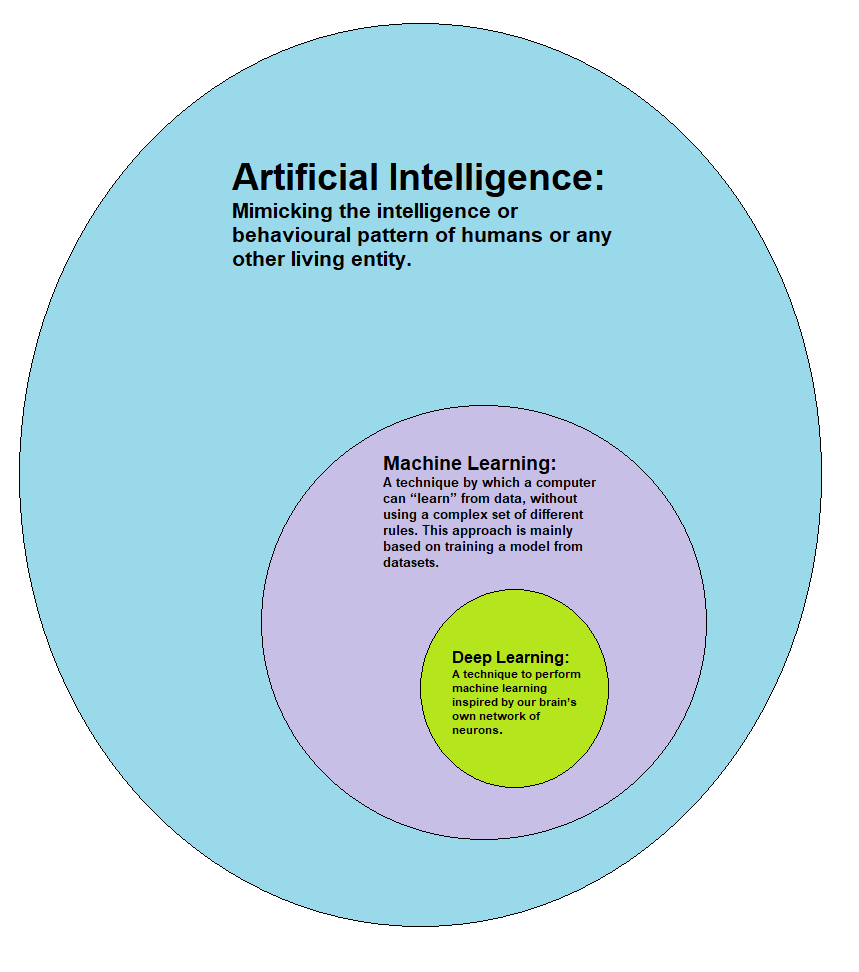
There are a few main ways machines learn:
- Supervised Learning: The AI learns from data that is already labeled. For example, you feed it thousands of emails labeled as "spam" or "not spam" to teach it how to classify new emails.
- Unsupervised Learning: The AI works with unlabeled data and tries to find hidden patterns or structures on its own, like grouping customers with similar purchasing habits.
- Reinforcement Learning: The AI learns by trial and error. It's rewarded for correct actions and penalized for incorrect ones, similar to training a dog with treats.
The Brain of AI: Neural Networks
Neural networks are a key tool in machine learning, inspired by the structure of the human brain. They are made up of layers of interconnected nodes, or "neurons." Each neuron receives input, processes it, and passes a signal to the neurons in the next layer.
Imagine a neural network trying to recognize a handwritten number. The first layer might look at the raw pixels of the image. The next layer could use that information to identify simple edges and curves. A further layer might combine those edges to recognize loops and straight lines. Finally, the output layer puts all that information together to decide which digit, from 0 to 9, was written.
This layered approach allows neural networks to learn incredibly complex patterns, making them powerful enough for tasks like image recognition and medical diagnostics. The more layers a network has, the more complex the patterns it can learn. This is the core idea behind "deep learning."
Understanding Human Language
Natural Language Processing (NLP) is a field of AI that gives machines the ability to read, understand, and generate human language. It's the bridge between human communication and computer understanding.
When you use a translation app, a chatbot for customer service, or a grammar checker, you are using NLP. These tools have to do more than just recognize words; they have to understand context, slang, and sentiment. For example, an NLP model can perform sentiment analysis, determining whether a product review is positive or negative based on the language used. It's a complex task, but it’s essential for making AI feel more natural and intuitive to interact with.
Now, let's test your understanding of these core AI concepts.
Which of the following best describes the core principle of machine learning?
An e-commerce website suggests products to you based on your previous purchases and the browsing history of customers with similar tastes. This is an example of what kind of machine learning?
These building blocks—machine learning, neural networks, and natural language processing—are the foundation of the powerful AI tools that are becoming more integrated into our world every day.