Applied Quantum Physics
Quantum Sensing Technologies
Beyond Computation
The same quantum properties that promise to revolutionize computing also open the door to a completely different technology: sensors of incredible precision. While quantum computers are designed to be isolated from the outside world, quantum sensors do the exact opposite. They embrace their environment.
A quantum sensor works by using a quantum system—like a single atom, a photon, or a tiny flaw in a diamond—as a probe. These systems are prepared in a delicate quantum state. Because states like superposition and entanglement are so fragile, they are extremely sensitive to the slightest disturbances. Any change in a magnetic field, a gravitational pull, or even temperature can alter the state in a predictable way.
This extreme sensitivity, which is a major challenge for building stable quantum computers, becomes the greatest strength of a quantum sensor. By measuring the change in the quantum state, we can measure the external influence with a precision far beyond what classical sensors can achieve.
How They Work
Think of a quantum sensor as a perfectly balanced spinning top. Even a tiny nudge from a gentle breeze will cause its spin to wobble. A quantum system is similar, but its “spin” is a quantum property that can be influenced by incredibly subtle forces.
One of the most promising types of quantum sensors uses something called a nitrogen-vacancy (NV) center in a diamond. This is a specific defect in the diamond's crystal lattice where a nitrogen atom sits next to an empty spot. This tiny flaw behaves like a single, trapped atom whose quantum state is sensitive to magnetic fields, electric fields, and temperature. Scientists can use lasers to set the NV center's quantum state and then read it out again, checking for tiny changes.
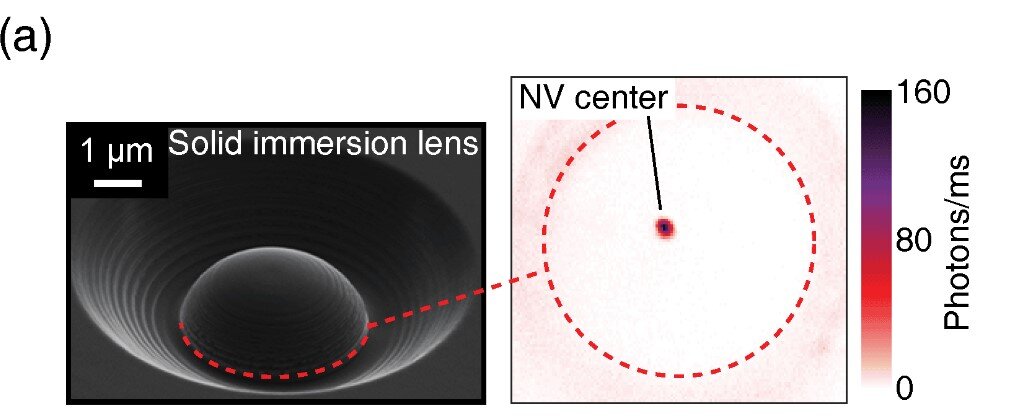
The process is essentially a three-step dance:
- Initialize: Prepare the quantum system in a known starting state.
- Sense: Let the system interact with the environment. The quantity being measured—like a magnetic field—perturbs the state.
- Readout: Measure the system's final state. The difference between the start and end states reveals the strength of the influence.
Real-World Impact
This technology isn't just theoretical; it's already creating new possibilities in healthcare, navigation, and environmental science.
In healthcare, quantum sensors are poised to provide non-invasive diagnostics with unprecedented detail. By measuring the faint magnetic fields produced by the human brain and heart, they can offer new insights into neurological disorders like epilepsy or dementia. This could lead to earlier diagnoses and more effective treatments.
For navigation, quantum sensors offer a powerful alternative to GPS. Systems that rely on satellite signals can be jammed, spoofed, or simply unavailable underwater or underground. Quantum sensors, specifically accelerometers and gyroscopes, can measure tiny variations in Earth's gravitational field to track position with extreme accuracy, no external signal required. This could provide ultra-reliable navigation for submarines, aircraft, and autonomous vehicles.
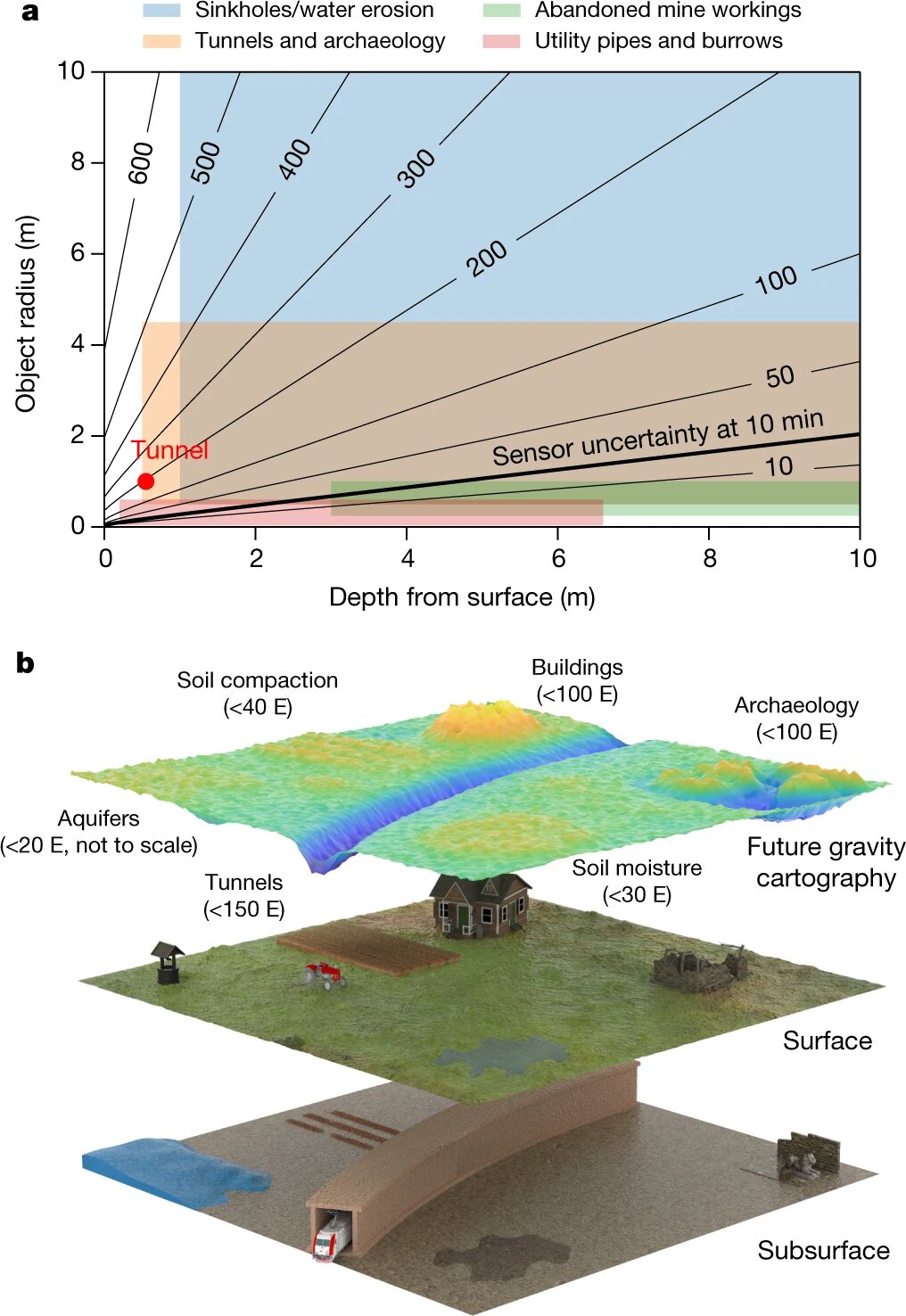
Environmental monitoring is another area where this precision is invaluable. Quantum sensors can detect minute traces of pollutants in the air and water or measure changes in groundwater levels from the surface. They could even be used for volcanic monitoring by detecting the subtle gravitational shifts caused by magma moving deep underground.
Let's test your understanding of how these powerful devices work.
What fundamental principle makes quantum systems exceptionally effective for sensing?
A key difference between a quantum computer and a quantum sensor is that a quantum computer is designed to be ______, while a quantum sensor is designed to ______.
From mapping the brain to navigating without satellites, quantum sensors are turning the quirks of quantum mechanics into powerful tools for discovery and innovation.