Applied Quantum Physics
Quantum Computing Applications
Cracking Codes and Building New Ones
Much of our digital world is protected by a lock called RSA encryption. It keeps everything from your bank details to private messages safe. This lock works because it's built around a mathematical problem that's incredibly difficult for regular computers to solve: finding the prime factors of a very large number. For a classical computer, this could take thousands of years.
A quantum computer running Shor's algorithm could solve it in hours.
Shor's algorithm is a quantum algorithm for integer factorization. Its discovery showed that a quantum computer, if built, could break many of the cryptographic systems we use today.
This sounds alarming, but the story doesn't end there. The same quantum principles that can break codes are also being used to build new, more secure ones. This field is called quantum cryptography.
One of the most promising techniques is Quantum Key Distribution (QKD). In QKD, two parties can create a secret key to encrypt and decrypt information. The key is sent using photons, which are particles of light. Because of the laws of quantum mechanics, if a third party tries to eavesdrop and measure these photons, their quantum state is disturbed. The two original parties will immediately know their communication has been compromised, allowing them to discard the key and create a new one. It's like having a security system where the lock tells you if someone tried to pick it.
Solving Enormous Puzzles
Many of the world's toughest challenges are optimization problems. These are puzzles where you need to find the best possible solution out of a mind-boggling number of options. Think of a shipping company trying to find the most efficient routes for its entire fleet of trucks, or a financial firm trying to create the perfect investment portfolio with the best balance of risk and reward.
Classical computers often have to check possibilities one by one, which can be impossibly slow for complex problems. Quantum computers can explore a vast landscape of potential solutions all at once. Using techniques like quantum annealing and algorithms like the Quantum Approximate Optimization Algorithm (QAOA), they can find high-quality solutions much more quickly.
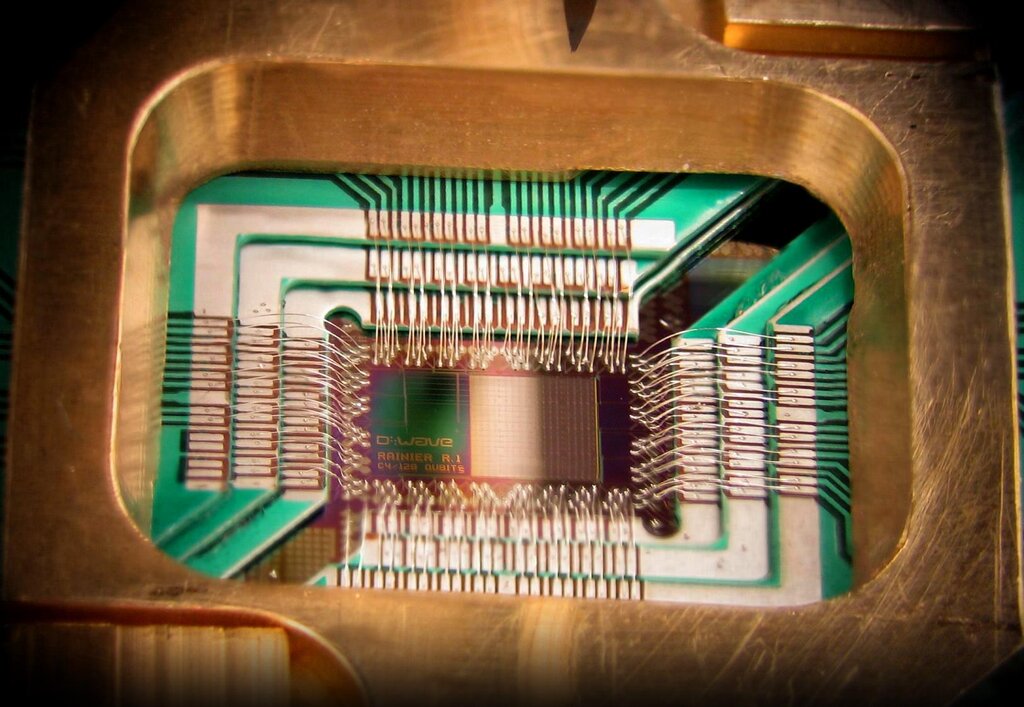
This has huge implications for many industries:
- Drug Discovery: Simulating how molecules will interact to design new drugs is a massive optimization problem. A quantum computer could find the most stable and effective molecular structures for new medicines.
- Manufacturing: Factories could optimize their production lines in real time to reduce waste and energy consumption.
- Climate Change: Scientists could use quantum computers to discover new catalysts for carbon capture, helping to remove CO₂ from the atmosphere more efficiently.
Smarter Machine Learning
Machine learning is already changing our world, but it relies on processing enormous amounts of data. Quantum machine learning (QML) aims to supercharge this process. Because qubits can hold complex information, quantum computers can analyze patterns in data that are far too complex for classical machines.
Imagine trying to find a tiny needle in a colossal haystack. A classical computer might have to inspect every piece of straw. A quantum algorithm could, in a sense, look at the entire haystack at once to spot the patterns that reveal the needle's location.
Combining AI and quantum computing in new solutions will advance the efficiency and effectiveness of new applications of these powerful technologies.
Early applications are focused on enhancing specific machine learning tasks, such as classification and clustering. For example, a QML model could analyze complex medical scans to identify diseases earlier and more accurately than ever before. It could also help design new materials with specific properties by learning from vast datasets of molecular simulations.
The State of the Art
While the potential is enormous, we're still in the early days of quantum computing. The current generation of machines is known as Noisy Intermediate-Scale Quantum (NISQ) devices. They are powerful but also delicate and prone to errors caused by their environment, like tiny vibrations or temperature fluctuations.
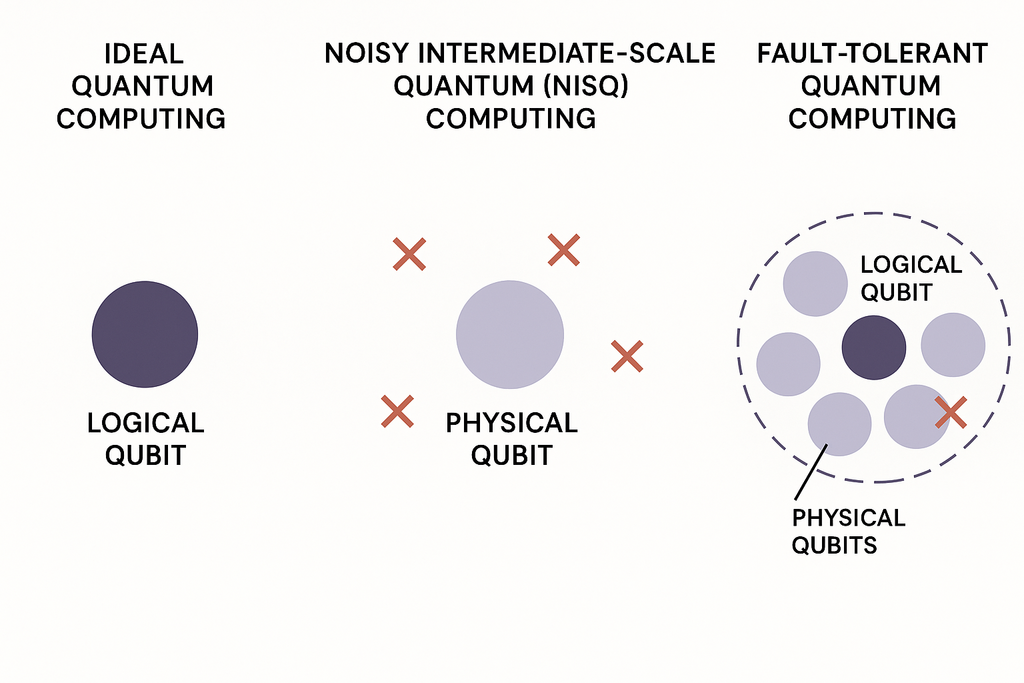
The ultimate goal is to build a fault-tolerant quantum computer, which can automatically correct these errors. This is a massive engineering challenge that researchers at companies like IBM, Google, and many startups are working to solve. Every year brings new breakthroughs, with processors containing more and higher-quality qubits. We aren't in the era of widespread quantum advantage yet, but the progress is rapid and the path forward is becoming clearer.
Time to test what you've learned about the applications of quantum computing.
What specific mathematical problem, currently very difficult for classical computers, does Shor's algorithm solve to break modern RSA encryption?
In Quantum Key Distribution (QKD), how are the communicating parties alerted to an eavesdropper?
From breaking codes to designing new medicines, quantum computing promises to reshape technology and science by tackling problems we once thought were unsolvable.