Algorithmic Trading Without Code
Building and Backtesting Strategies
From Idea to Algorithm
Every trading strategy starts with an idea. Maybe you've noticed that a certain stock tends to rise after a positive earnings report, or that a market sector performs well during a specific time of year. The first step is to turn that general idea into a precise set of rules.
Start by defining your objectives. What is the goal of this strategy? Are you aiming for small, frequent gains, or larger, long-term growth? How much risk are you willing to take? Your answers will shape the parameters of your algorithm.
These parameters are the specific conditions that trigger a buy or sell order. For a trend-following strategy, your parameters might be:
- Entry signal: Buy when the 50-day moving average crosses above the 200-day moving average.
- Exit signal: Sell when the 50-day moving average crosses back below the 200-day moving average.
- Risk management: Automatically sell if the position loses 5% of its value (a stop-loss).
Clear, simple, and specific rules are the foundation of a successful automated strategy. An algorithm can't interpret vague ideas; it can only execute precise commands.
Building with Blocks
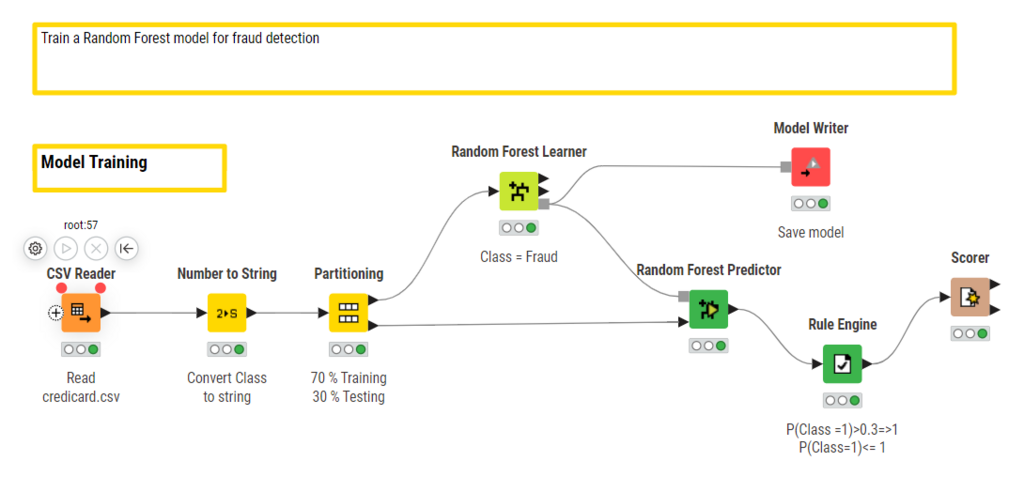
Once you have your rules, it's time to build the algorithm. No-code platforms transform this process from a complex coding challenge into a visual design task. Instead of writing lines of code, you'll use a graphical interface to connect logical blocks that represent your strategy's parameters.
Think of it like building with LEGOs. You have different blocks for different functions: one for market data, one for a technical indicator like a moving average, and another for executing a buy or sell order. You simply drag, drop, and connect these blocks to create the logical flow of your strategy. The platform handles the underlying code, allowing you to focus entirely on the trading logic itself.
Testing on Past Data
Before you risk any real money, you need to know if your strategy has potential. This is where backtesting comes in. Backtesting is the process of simulating your trading strategy on historical market data to see how it would have performed in the past.
A good backtest will give you a wealth of information. You'll see not just the potential profit or loss, but also other critical metrics. Interpreting these results is key to refining your approach.
| Metric | What It Tells You |
|---|---|
| Net Profit | The total profit or loss over the test period. |
| Max Drawdown | The largest peak-to-trough decline in portfolio value. A high drawdown signals high risk. |
| Win Rate | The percentage of trades that were profitable. |
| Sharpe Ratio | A measure of risk-adjusted return. A higher ratio is generally better. |