Advanced Expectation Values
Complex Random Variables
Beyond Real Numbers
So far, we've dealt with random variables that take on real number values, like the outcome of a dice roll or the height of a person. But what if a random process has characteristics that can't be captured by a single real number? This is common in fields like signal processing, where a signal has both an amplitude and a phase.
This is where complex random variables come in. They are simply random variables that can take on complex values. Instead of mapping outcomes to the real number line, they map them to the complex plane.
Complex Random Variable
noun
A function that assigns a complex number to each outcome in a sample space.
The easiest way to think about a complex random variable, let's call it , is to break it into its real and imaginary parts. We can write as the sum of two real random variables, and .
and are jointly distributed real random variables. Their behavior and potential correlation determine the properties of . This representation allows us to use what we already know about real random variables to analyze complex ones.
Calculating Expectations
Finding the expected value of a complex random variable is straightforward. Thanks to the linearity of expectation, a property we've covered before, we can treat the real and imaginary parts separately. The expectation of is simply the expectation of its real part plus times the expectation of its imaginary part.
The result, , is a complex number that represents the “center of mass” of the probability distribution of in the complex plane.
Properties and Applications
While we can break down complex random variables, they have unique properties when considered as a whole, especially regarding variance and covariance. For a complex random variable , the variance is defined as the expectation of the squared magnitude of the deviation from its mean.
This definition is different from the real-valued case and captures the 2D spread of the variable. Another key concept is the pseudo-variance, , which is a complex number and provides information about the asymmetry of the distribution.
These concepts are crucial in modern engineering and physics.
In Communications: Wireless signals travel from a transmitter to a receiver, bouncing off buildings and other objects. This creates a complex pattern at the receiver's antenna. The received signal is modeled as a complex random variable, where the magnitude represents the signal's strength and the phase represents its delay. Analyzing these variables helps engineers design reliable communication systems.
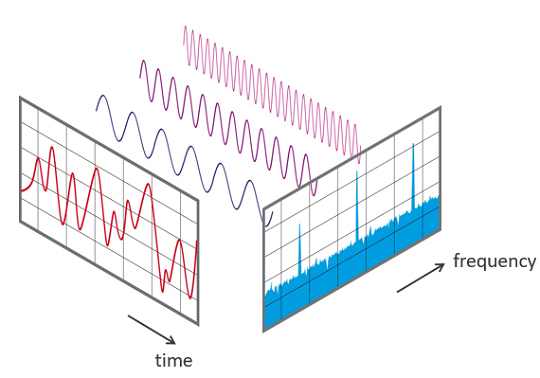
In Signal Processing: In radar or medical imaging, we often work with signals in the frequency domain using the Fourier transform. The output of a Fourier transform is a set of complex numbers. Because the input signal contains noise (a random process), the Fourier coefficients are complex random variables. Understanding their statistics helps in filtering out noise and reconstructing a clearer image or signal.
How is a complex random variable, , typically represented in terms of real random variables and ?
Given a complex random variable , what is the formula for its expected value, ?
By representing multi-faceted random phenomena on the complex plane, we gain a powerful tool for analysis in many advanced fields.