Zoll EMV+ Clinical and Tactical Operation
Tactical Mode Selection
Tactical Mode Selection
In a combat environment, managing a trauma patient's breathing is a dynamic challenge. The decisions you make on the Zoll EMV+ ventilator must adapt as the patient's condition evolves and your environment changes. Selecting the right mode isn't a one-time choice; it's a continuous process of assessing clinical trade-offs.
ACV vs. SIMV for Trauma
Your first major decision often comes down to two primary modes: (ACV) and Synchronized Intermittent Mechanical Ventilation (SIMV). While both deliver mandatory breaths, their approaches to patient-initiated breaths are fundamentally different, carrying distinct advantages for trauma casualties.
ACV is the mode for total respiratory support. Every time the patient attempts to take a breath, the ventilator delivers a full, preset tidal volume. This is ideal for a heavily sedated or apneic patient, as it completely takes over the work of breathing, allowing the body to conserve energy for healing. However, if a patient becomes more awake and breathes rapidly, ACV can lead to breath stacking and respiratory alkalosis.
SIMV provides a set number of mandatory breaths but allows the patient to take their own spontaneous breaths in between. These spontaneous breaths are unsupported unless you add Pressure Support (PS). This mode is an excellent bridge for patients whose sedation is lightening or who are beginning to regain respiratory drive. It helps maintain respiratory muscle tone, which is crucial for eventual weaning from the ventilator. The trade-off is a potentially higher work of breathing for the patient compared to ACV, especially if their own breaths are weak.
Use ACV for complete respiratory rest in deeply sedated patients. Use SIMV to support patients with some spontaneous breathing effort, helping to maintain muscle tone.
Adapting Modes During Evacuation
The evacuation chain is rarely static. A patient's needs can change dramatically from the point of injury to the surgical facility. Your ventilation strategy must be just as flexible.
Consider a soldier with a chest injury who is intubated in the field. Initially, under deep sedation for transport, ACV provides the necessary full support. As you move through the echelons of care, sedation may be reduced to assess neurological status. At this point, the patient might begin to trigger breaths on their own, sometimes fighting the controlled rhythm of ACV. This is your cue to switch.
Transitioning to SIMV with pressure support allows the patient to participate in their own ventilation, making them more comfortable and reducing the risk of ventilator-patient asynchrony. As they stabilize further, you might decrease the mandatory SIMV rate, shifting more work to the patient and preparing them for liberation from the ventilator. Constant reassessment is key.
Optimizing CPAP and Triggers
Continuous Positive Airway Pressure (CPAP) is an invaluable tool for the spontaneously breathing patient who needs help keeping their airway open, but doesn't require full ventilation. This could be a patient with crush injuries, mild pulmonary contusion, or even high-altitude pulmonary edema. On the EMV+, you can enhance CPAP with pressure support (PS) to help overcome the resistance of the circuit and reduce the patient's work of breathing with each breath.
For non-invasive ventilation with a mask, activating the 'Mask CPAP' setting is critical. This engages the device's leak compensation algorithm, which adjusts flow to maintain the target pressure even with an imperfect mask seal, a common issue in moving vehicles. Without this setting active, frequent alarms and loss of pressure can render the therapy ineffective.
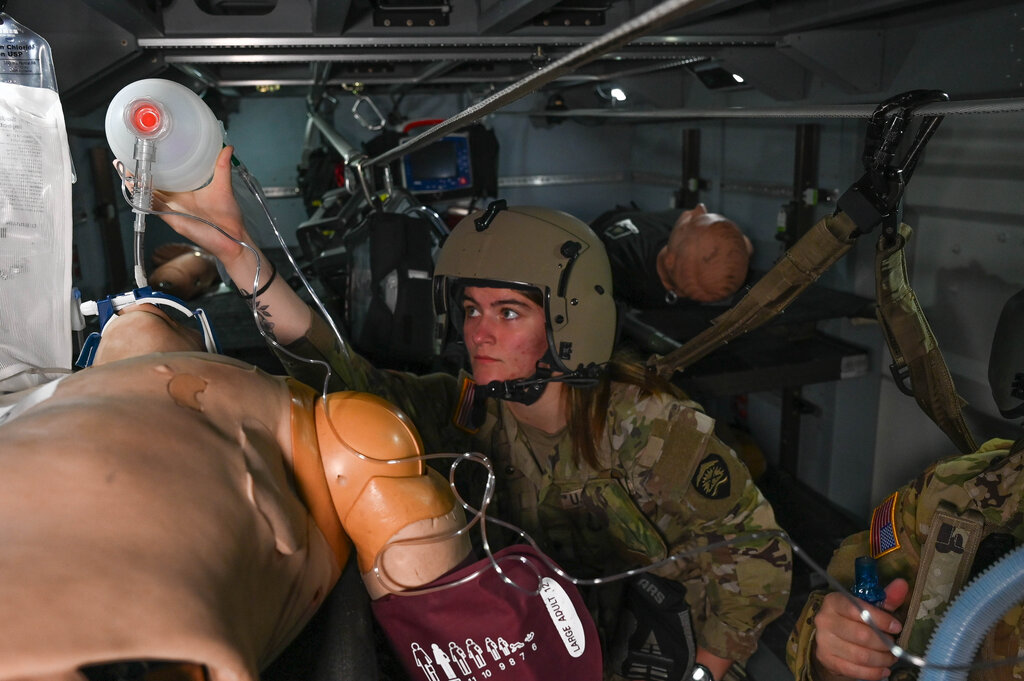
Finally, fine-tuning the trigger sensitivity is essential, especially in high-vibration environments like a helicopter or ground vehicle. The standard trigger setting may be too sensitive, causing the ventilator to auto-cycle from the vibrations. Adjusting the trigger to be slightly less sensitive, such as to -1.0 or -1.5 cm H2O, can prevent this. Conversely, for a weak patient, a more sensitive trigger of ensures their feeble inspiratory efforts are detected and supported.
The choice of lung protective ventilation settings for mechanical ventilation has a considerable impact on patient outcome, yet identifying optimal ventilatory settings for individual patients remains highly challenging due to the inherent inter- and intra-patient pathophysiological variability.
Mastering these modes and their tactical application allows you to provide sophisticated, adaptive respiratory support, improving patient outcomes in the most demanding settings.