Zero Point Energy Explained
Introduction to Quantum Mechanics
A Different Set of Rules
In our everyday world, things are predictable. A thrown ball follows a clear path. A car is either parked in the driveway or it isn't. But when we zoom down to the level of atoms and the particles inside them, these familiar rules break down. This is the quantum realm, and its rulebook is called quantum mechanics.
At this tiny scale, particles like electrons don't behave like miniature billiard balls. Instead, they exist in a hazy state of possibilities, governed by probability. It's a world where things can be in multiple places at once and where the very act of looking at something changes what it's doing.
Particle or Wave?
One of the most mind-bending ideas in quantum mechanics is that particles can also act like waves. This isn't just an analogy; they literally have wave-like properties. Think of an electron. If you shoot it at a target, it arrives as a single particle at a specific point. But how it gets there is a different story.
The classic demonstration of this is the double-slit experiment. Imagine a wall with two thin, parallel slits in it. If you shoot tiny paintballs at the wall, you'd expect to see two lines of paint on the screen behind it, corresponding to the two slits. Simple enough.
Now imagine sending waves, like ripples in water, toward the same barrier. The waves pass through both slits at once and interfere with each other. Where crest meets crest, they create a bigger wave. Where crest meets trough, they cancel out. The result on the screen is an interference pattern, a series of bright and dark stripes.
Here’s the strange part. When physicists fire electrons one by one at the double slits, they don't get two simple lines. Over time, the individual electron impacts build up to create the exact same interference pattern as the waves. It’s as if each electron, traveling alone, somehow passes through both slits simultaneously and interferes with itself. This is wave-particle duality in action.
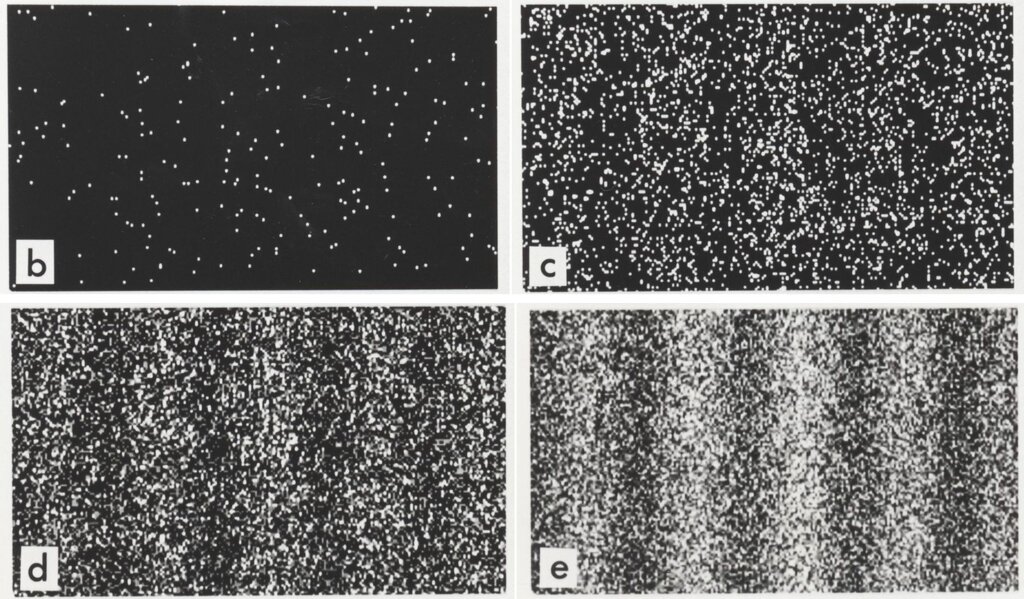
This leads to another core concept: superposition. Before it's measured (by hitting the screen), the electron isn't in one specific state. It's in a superposition of all possible states, a combination of all potential paths. In the double-slit experiment, its state is "went through slit 1" AND "went through slit 2" at the same time. Only when it interacts with the screen does its state "collapse" into a single, definite position.
The Uncertainty Principle
If a particle is a spread-out wave of possibilities, how can we pin down its exact properties? The German physicist Werner Heisenberg realized that we can't. There's a fundamental limit to how much we can know.
The Heisenberg Uncertainty Principle states that you cannot simultaneously know certain pairs of a particle's properties with perfect accuracy. The most famous pair is position () and momentum (), which is mass times velocity. The more precisely you measure a particle's position, the less precisely you can know its momentum, and vice versa.
It’s not a limitation of our instruments. It's an inherent property of the universe. The very act of measuring a particle's position with high precision disturbs its momentum in an unpredictable way.
Here, is the uncertainty in position, is the uncertainty in momentum, and (h-bar) is a tiny fundamental constant of nature. This formula shows that the product of the two uncertainties can never be zero.
Describing the Quantum World
So how do physicists work with all this uncertainty and wave-like behavior? They use a powerful mathematical tool called the Schrödinger equation. It's the master equation of quantum mechanics, playing a role similar to Newton's laws of motion in classical physics.
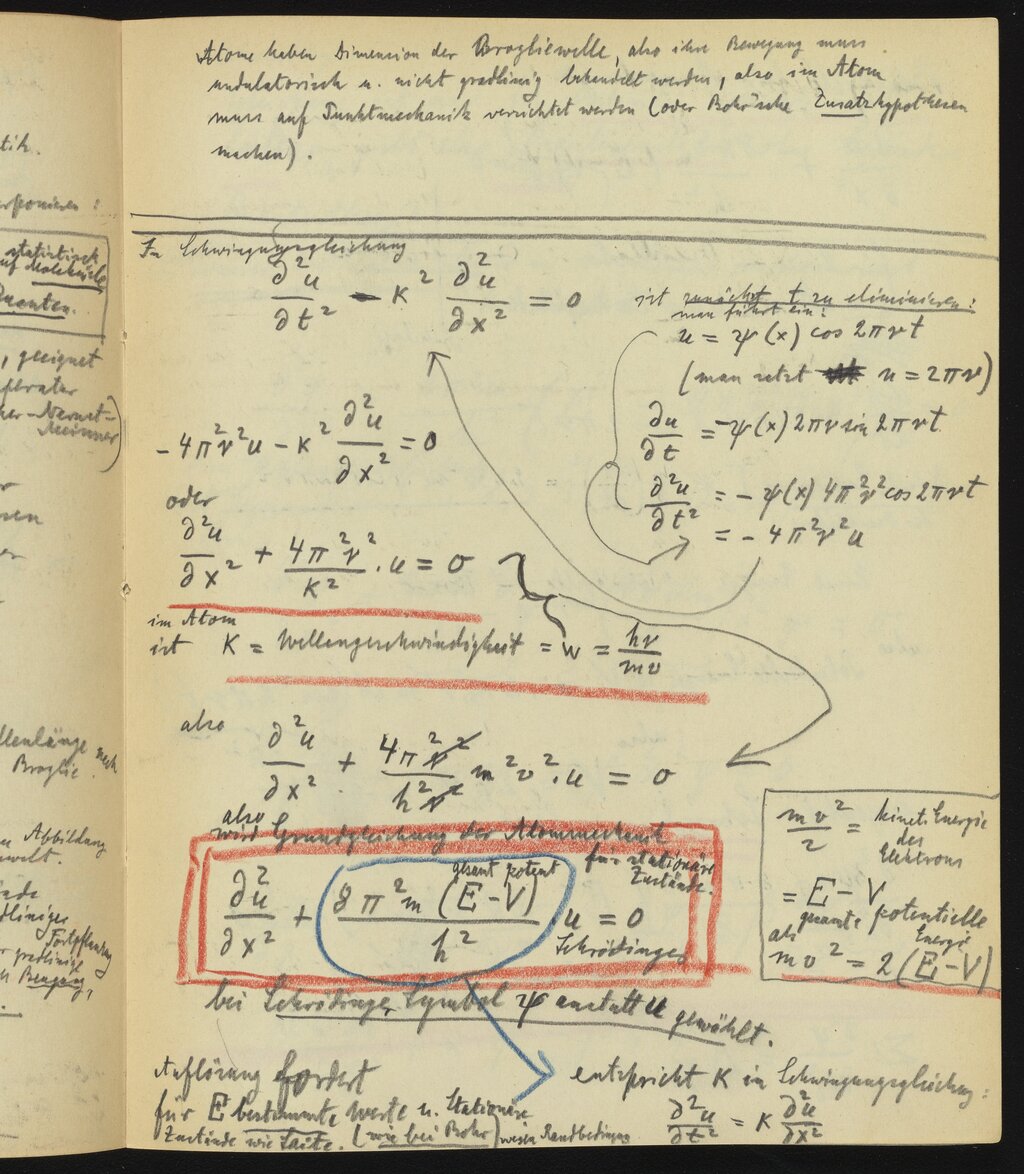
The Schrödinger equation describes a particle's wave function, usually represented by the Greek letter Psi (). The wave function contains all the information about a quantum system. But the wave function itself isn't a physical wave; it's a wave of probability.
The square of the wave function's amplitude at any point in space tells you the probability of finding the particle at that location if you were to measure it. Where the wave is tall, the probability is high. Where it's flat, the probability is low.
This is a common form of the equation. It says that when a certain operator () acts on the wave function (), it returns the total energy () of the system multiplied by the same wave function. Solving this equation for a given situation, like an electron in an atom, reveals the specific wave functions and allowed energy levels—its possible quantum states.
These concepts, from wave-particle duality to the probabilistic nature of the wave function, form the foundation of our understanding of the subatomic world. They show us that reality at its smallest scale is fundamentally different from our everyday experience.