Zeckhauser Decision Trees Explained
Introduction to Decision Trees
A Visual Guide to Decisions
Life is full of choices. Should you take the new job? What should you make for dinner? Most decisions are small, but some have big consequences. A decision tree is a simple tool that helps you map out your options and their potential outcomes, much like a flowchart.
Think of it as a road map for your thinking process. It starts with a single big decision and branches out into a series of smaller choices and chance events, until you arrive at a final result. This structure makes it easy to see all the possible paths and weigh your options clearly.
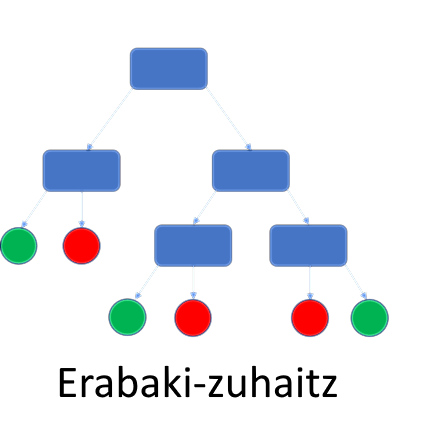
Every decision tree has three main parts: nodes, branches, and leaves.
- Nodes are the points where you make a choice or where a chance event happens. The very first one is called the root node.
- Branches are the lines connecting the nodes. Each branch represents a possible choice or outcome.
- Leaves are the endpoints of the branches. They represent the final outcome of a particular path.
Building a Simple Tree
Let's build a tree to decide whether to play a game of tennis. The first question, our root node, is about the weather.
| Outlook | Humidity | Windy | Decision |
|---|---|---|---|
| Sunny | High | False | Don't Play |
| Sunny | Normal | True | Play |
| Overcast | High | False | Play |
| Rain | High | False | Play |
| Rain | Normal | True | Don't Play |
This table shows past decisions. We can turn this logic into a tree. The most important factor seems to be the Outlook, so that's our root. From there, we can add more decision nodes for Humidity and Wind until we reach a final decision to play or not.
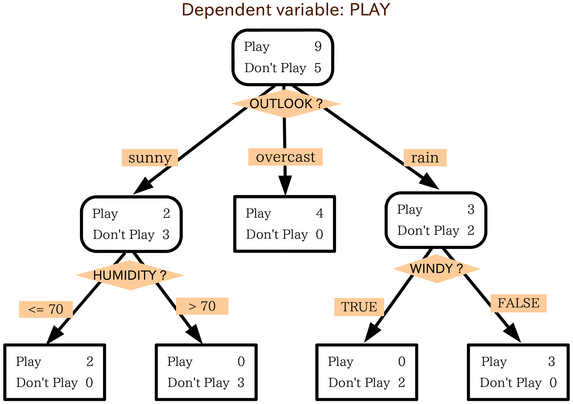
To interpret this tree, you start at the top and follow the branches down. If the outlook is Overcast, the path leads directly to a "Play" decision. If it's Sunny, you then check the Humidity. If humidity is High, you don't play. If it's Normal, you play. Each path from root to leaf represents a rule learned from the data.
Why Use a Decision Tree
The power of a decision tree is its simplicity. It turns complex, multi-step problems into a format that's easy to follow and explain to others. You don't need a Ph.D. in statistics to understand how the final decision was reached.
This clarity makes them useful everywhere. Doctors use them to diagnose illnesses. Banks use them to decide if a loan is risky. And in machine learning, decision trees are a foundational model for predicting outcomes, from classifying emails as spam to forecasting customer behavior.
Decision trees are simple to interpret and can handle both numerical and categorical data.
By mapping out choices and their consequences, you can bring structure to complicated situations and make more confident, well-reasoned decisions.