YouTube Video Review Masterclass
Understanding Educational Video Analysis
What Makes a Video Educational?
Watching a video is easy. But understanding how it teaches is a different skill. That’s the core of educational video analysis. It’s like looking under the hood of a car to see how the engine works, instead of just driving it.
We’re not talking about fancy camera work or special effects. We’re focusing on the teaching itself. A truly effective educational video isn’t just a collection of facts; it’s a structured experience designed to help someone learn. The first step is to figure out its purpose.
Finding the 'Why'
Every good educational video has a goal. This is its learning objective, which is a clear statement of what you should know or be able to do after watching. It’s the promise the video makes to its viewer.
To find it, ask yourself: “What is this video trying to teach me?” Sometimes the creator states it directly at the beginning. Other times, you have to infer it from the content. For example, a video that walks you through changing a tire has a clear objective: you should be able to change a tire by the end. A video explaining the water cycle wants you to be able to describe the stages of evaporation, condensation, and precipitation.
When integrating video content into your curriculum, it’s essential to start with clear learning objectives.
Spotting the objective is your first and most important task. If you can't figure out the video's main goal, it’s a sign that the video may not be very effective. A clear objective acts as a roadmap for both the creator and the learner.
Who Is This For?
Once you know the 'what,' you need to figure out the 'who.' Who is the target audience? A video's effectiveness depends heavily on whether it’s a good fit for its intended viewers.
The language, pacing, and examples should all match the audience's age, background knowledge, and goals. A video explaining photosynthesis to a third-grader will use simple analogies and colorful animations. One for a college biology student will use precise terminology and detailed diagrams. Neither is better than the other, but they are effective for different people.
| Feature | Elementary Schooler | High School Student |
|---|---|---|
| Language | Simple, analogies | More technical terms |
| Pace | Slow, repetitive | Faster, assumes some knowledge |
| Visuals | Cartoons, bright colors | Diagrams, real footage |
| Examples | "Plants eat sunlight" | Chemical equation for photosynthesis |
When you analyze a video, consider if the content is too simple, too advanced, or just right for its likely viewers. A mismatch here can cause boredom or confusion, and learning comes to a halt.
How Does It Teach?
Instructional strategies are the methods a creator uses to present information. Think of them as a teacher's toolkit. Does the video just show a person talking at the camera? Or does it use other techniques to make the content easier to understand and remember?
Here are a few common strategies to look for:
- Demonstration: Showing how to do something, step-by-step. This is perfect for skills like cooking, fixing things, or using software.
- Analogy: Explaining a complex idea by comparing it to a simpler, more familiar one. For instance, comparing a computer's RAM to a workbench where you keep the tools you're currently using.
- Storytelling: Using a narrative to illustrate a point. Stories make abstract concepts more concrete and memorable.
- Worked Examples: Solving a problem on screen to show the process. This is common in math and science videos.
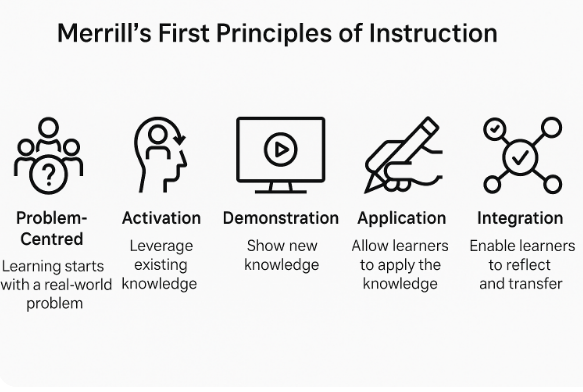
Great educational videos often mix several strategies. They might start with a story to grab your attention, use an analogy to explain a key concept, and then demonstrate how to apply it. The final piece of the puzzle is checking if all these elements work together to meet the learning objective.
Putting It All Together
The final step is to assess the alignment. Do the instructional strategies and content actually help achieve the stated learning objective for the target audience? This is the ultimate test of an educational video's quality.
Imagine a video with the objective “teach beginners how to play the C major scale on piano.” The target audience is new musicians. If the video uses jargon like “tonic” and “dominant” without explanation and flashes complex sheet music on screen, it's poorly aligned. The content doesn't match the audience's needs.
A well-aligned video for this objective would show a close-up of the keys, use simple language, and move slowly. The strategy (demonstration) and content (simple visuals) directly serve the objective for that specific audience.
Strong alignment means every element—the objective, the audience, and the strategy—works together toward a single goal: learning.
Now you have a basic framework for analyzing any educational video. By looking for these key components, you can move from being a passive viewer to an active, critical learner.