Your French Adventure Begins
French Pronunciation
The French Alphabet
The French alphabet uses the same 26 letters as English, but how they're named and pronounced is quite different. Think of it as a familiar cast of characters playing entirely new roles. For example, the letter 'e' in French can have multiple sounds, and 'h' is almost always silent, a quiet guest that never makes a sound.
| Letter | French Name | English Sound-alike |
|---|---|---|
| A | ah | 'a' as in car |
| B | bé | 'bay' |
| C | cé | 'say' |
| D | dé | 'day' |
| E | euh | 'uh' |
| F | effe | 'eff' |
| G | gé | 'jhay' |
| H | ache | 'ash' |
| I | ee | 'ee' as in see |
| J | ji | 'jhee' |
| K | ka | 'kah' |
| L | elle | 'ell' |
| M | emme | 'em' |
| N | enne | 'en' |
| O | o | 'oh' |
| P | pé | 'pay' |
| Q | ku | 'koo' |
| R | erre | 'air' (with a guttural R) |
| S | esse | 'ess' |
| T | té | 'tay' |
| U | u | (no English equivalent) |
| V | vé | 'vay' |
| W | double vé | 'doobluh vay' |
| X | ixe | 'eeks' |
| Y | i grec | 'ee grek' |
| Z | zède | 'zed' |
The letter 'u' is a classic French sound. To make it, say "ee" but round your lips as if you're about to whistle. It takes practice, but it's a key part of sounding authentic.
The Power of Accents
In French, accent marks, or diacritics, aren't just for decoration. They are essential instructions that tell you how to pronounce a letter or distinguish one word from another. Ignoring them can change the entire meaning of a sentence.
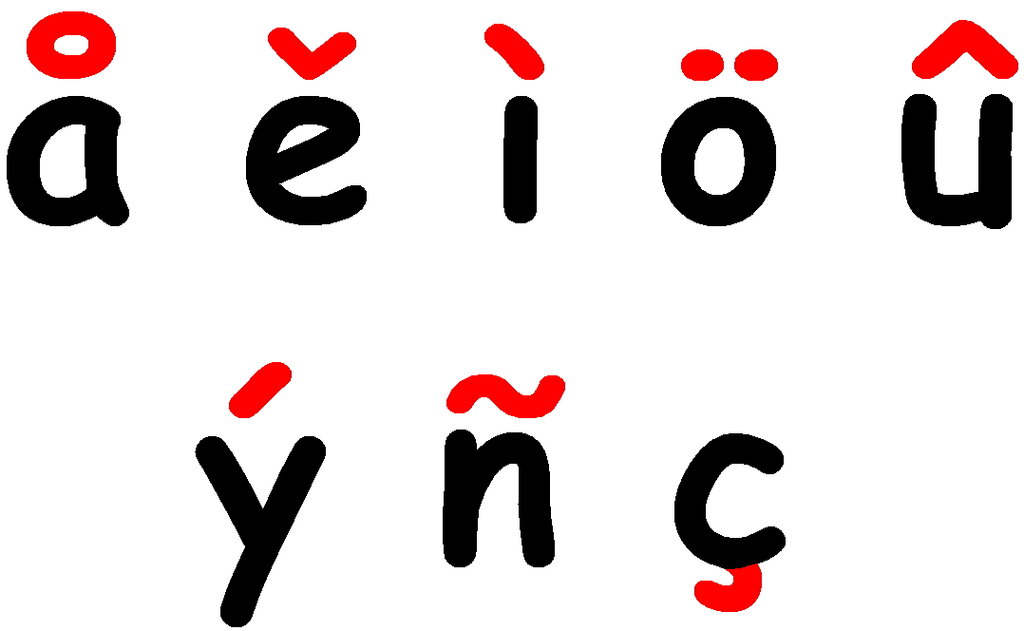
Here are the five accent marks you'll need to know:
| Accent Name | Mark | Letters | Purpose | Example |
|---|---|---|---|---|
| Acute Accent | é | E | Changes 'e' to an "ay" sound. | école (school) |
| Grave Accent | è, à, ù | E, A, U | Makes 'e' sound like "eh". On 'a' and 'u', it distinguishes words. | là (there), où (where) |
| Circumflex | â, ê, î, ô, û | A, E, I, O, U | Lengthens the vowel sound. Often indicates a letter 's' that has disappeared from Old French. | forêt (forest) |
| Cedilla | ç | C | Softens 'c' to an "s" sound before 'a', 'o', or 'u'. | français (French) |
| Trema | ë, ï, ü | E, I, U | Shows that two adjacent vowels are pronounced separately. | Noël (Christmas) |
A common mix-up is ou versus où. Without the accent, ou means "or". With the accent, où means "where". One little mark makes a big difference.
Nasal Vowels
One of the most characteristic features of French pronunciation is the nasal vowel. These sounds are made by passing air through both the mouth and the nose. They occur when a vowel is followed by 'n' or 'm' in the same syllable, and the 'n' or 'm' itself isn't pronounced. The combination simply transforms the vowel into a nasal sound.
To feel the vibration of a nasal vowel, try saying the French word bon (good) and gently pinch your nose. You should feel a slight buzz.
Here are the four main nasal sounds to listen for:
Found in words like *maman* (mom) and *vent* (wind).
The sound is similar to the "on" in the English word "song" but more open.
Found in words like *vin* (wine), *pain* (bread), and *plein* (full).
This sound doesn't have a direct English equivalent, but it's like a nasal version of the "a" in "pan."
Found in words like *bon* (good) and *monde* (world).
This is similar to the nasal an/en sound but with more rounded lips.
Found in words like *un* (one) and *brun* (brown).
For many speakers, this sound is merging with the in/ain/ein sound, but it's traditionally a distinct nasal vowel.
The French R
The French 'r' is often a source of anxiety for learners, but it doesn't have to be. Unlike the English 'r', which is formed with the tip of the tongue, the French 'r' is produced in the back of the throat. It's a guttural sound, similar to the sound you make when clearing your throat lightly or gargling.
A good way to practice is to try gargling with a small amount of water. The place in your throat where you feel the vibration is where the French 'r' is made.
Another method is to say the English sound "k" or "g". Notice where the back of your tongue touches the roof of your mouth. The French 'r' is made by creating a slight friction in that same area, but without fully stopping the airflow. Try saying a word like merci (thank you) by starting with a soft "k" sound that you don't fully close, letting the air vibrate in your throat.
Don't worry about perfecting it immediately. The goal is to be understood, and even a softer, less pronounced 'r' is better than the hard English one.
Ready to test what you've learned about French pronunciation?
In most French words, how is the letter 'h' pronounced?
A vowel in French is most likely to become a nasal sound when it is followed by which letters in the same syllable?
Mastering these core sounds is a huge step toward speaking French clearly and confidently. Keep listening and practicing, and you'll build the muscle memory needed for authentic pronunciation.