Your First Steps in English
English Sounds
Letters vs. Sounds
When you learn a language, you start with the alphabet. But in English, letters can be tricky. A single letter can represent multiple sounds. Think about the letter 'a' in 'cat,' 'father,' and 'able.' They all sound different.
To talk about sounds accurately, linguists use a special system called the International Phonetic Alphabet, or IPA. Each symbol in the IPA represents exactly one sound. This way, we can write down pronunciation clearly, without the confusion of English spelling.
Those symbols are the International Phonetic Alphabet (IPA), and learning to read them is one of the best ways to improve your English pronunciation.
Think of it like a code for sounds. Once you know the symbols, you can pronounce any word you see in a dictionary. Let's start by looking at the two main types of sounds: consonants and vowels.
Consonant Sounds
Consonants are sounds made by blocking air as it leaves your mouth. You use your tongue, teeth, or lips to create this obstruction. For example, to make the 'p' sound, you press your lips together and then release a puff of air. To make the 's' sound, you press your tongue against the ridge behind your top teeth and let air hiss through.
consonant
noun
A speech sound that is articulated with complete or partial closure of the vocal tract.
Some consonant sounds are straightforward, like /b/ in 'boy' or /m/ in 'man.' But others don't have their own letter. For instance, English has two different 'th' sounds. The IPA helps us tell them apart.
| IPA Symbol | Sound in... |
|---|---|
| /p/ | pat |
| /b/ | bat |
| /t/ | top |
| /d/ | dog |
| /k/ | cat, kid |
| /g/ | go |
| /s/ | sit, cell |
| /z/ | zoo |
| /θ/ | think (voiceless 'th') |
| /ð/ | this (voiced 'th') |
| /ʃ/ | she |
| /tʃ/ | chair |
Try saying 'think' and 'this' out loud. Feel the vibration in your throat when you say 'this'? That vibration means the sound /ð/ is "voiced." The sound /θ/ in 'think' has no vibration, so it's "voiceless."
Vowel Sounds
Vowels are sounds made with an open vocal tract. The air flows freely, and the sound changes based on the shape of your mouth and the position of your tongue. This is why English can squeeze so many vowel sounds out of just five letters: a, e, i, o, and u.
vowel
noun
A speech sound produced by comparatively open configuration of the vocal tract, with vibration of the vocal cords but without audible friction.
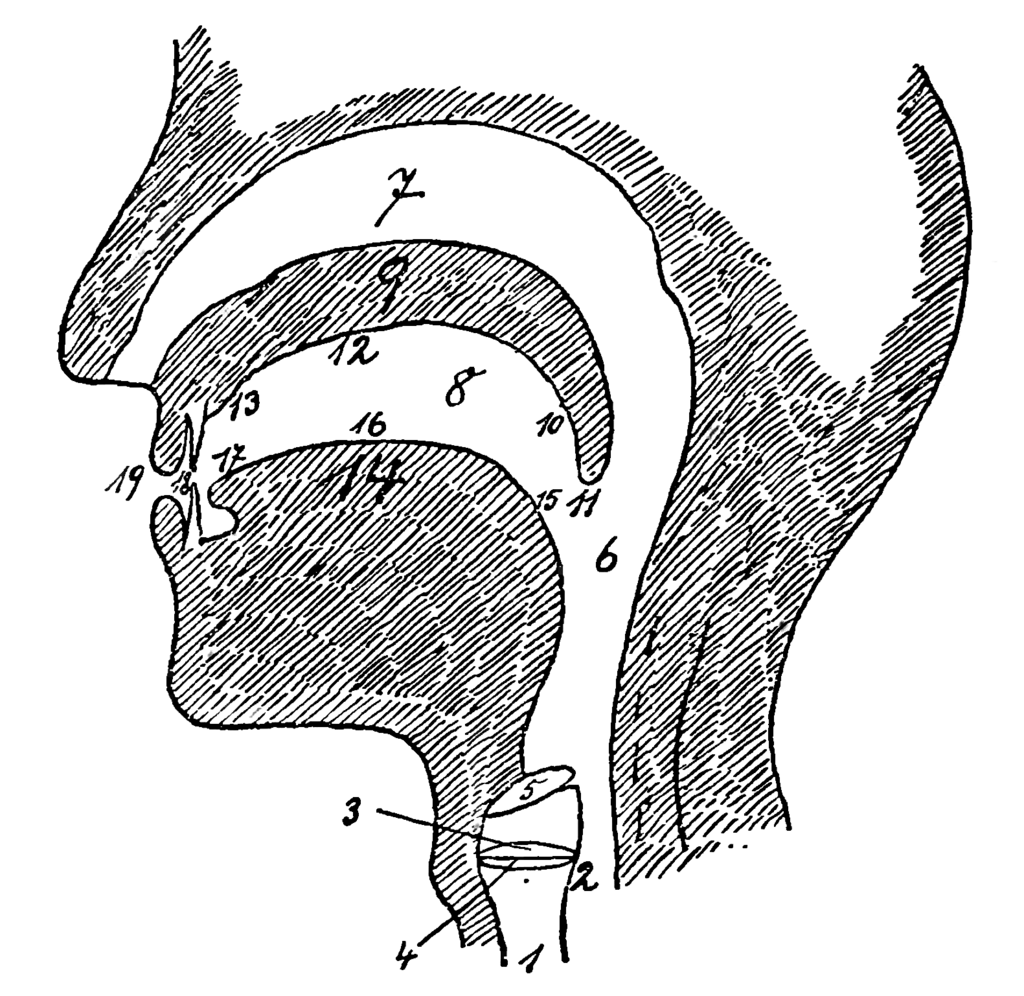
Vowels can be described by how high or low your tongue is, and how far forward or back it is in your mouth. For example, for the sound /iː/ in 'see,' your tongue is high and at the front of your mouth. For the sound /uː/ in 'blue,' your tongue is high and at the back.
| IPA Symbol | Sound in... |
|---|---|
| /iː/ | see, meet |
| /ɪ/ | sit, him |
| /ɛ/ | bed, met |
| /æ/ | cat, had |
| /ɑː/ | father, car |
| /ɔː/ | saw, door |
| /ʊ/ | put, book |
| /uː/ | blue, food |
| /ə/ | about, sofa (This is the 'schwa' sound) |
The schwa /ə/ is the most common vowel sound in English. It's a quick, relaxed sound that often appears in unstressed syllables.
Learning these individual sounds is the first step toward clearer pronunciation. As you practice, you'll start to hear the difference between sounds like /ɪ/ in 'ship' and /iː/ in 'sheep.'
Being able to recognize these phonemes will make both your speaking and your listening more precise.