Your First Steps in a New Language
Introduction to Language Sounds
The Building Blocks of Speech
Every language is built from a unique set of sounds. When we learn a new language, our ears and mouths are often trained for the sounds of our native tongue. Mastering a new language starts with mastering its individual sounds.
Think of sounds as the basic ingredients in a recipe. If you use the wrong ones, the final dish just won't be right. In linguistics, the smallest unit of sound that can distinguish one word from another is called a phoneme. For example, the words 'pat' and 'bat' are separated by just one phoneme: the /p/ and /b/ sounds.
Phoneme
noun
The smallest unit of sound in a language that can convey a distinct meaning.
English has around 44 phonemes, but this number varies by accent. Some languages have as few as 11, while others have over 100. Learning to hear and produce these distinct sounds is the first major step toward clear communication.
A Universal Alphabet for Sounds
How can we write down sounds consistently? The normal alphabet doesn't always work. The letter 'a' sounds different in 'cat', 'father', and 'able'. To solve this, linguists created the International Phonetic Alphabet, or IPA. The IPA provides a unique symbol for every single sound in human language.
It might look intimidating at first, but it's an incredibly useful tool. Each symbol has only one pronunciation. Once you learn the symbols for your target language, you can pronounce any word correctly just by looking at its phonetic transcription.
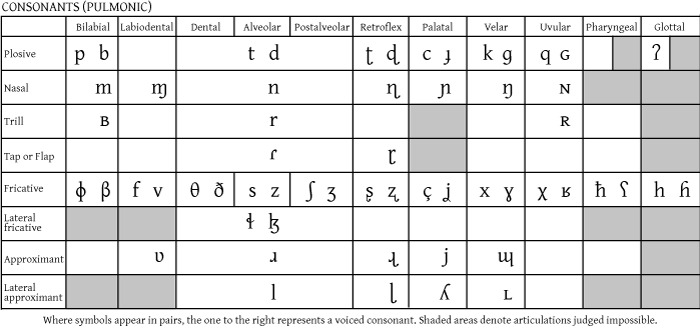
You don't need to memorise the entire chart. Focus only on the sounds present in the language you're learning. Many dictionaries and language learning apps include the IPA transcription next to new vocabulary words.
Using the IPA is like having a universal pronunciation guide for any language.
How to Practise
Knowing the theory is one thing, but producing the sounds is another. Your mouth, tongue, and lips are used to moving in certain ways. Learning new sounds involves a bit of physical training.
Start by isolating sounds you find difficult. For English speakers learning French, the 'u' sound (as in 'tu') can be tricky. For Spanish speakers learning English, the short 'i' (as in 'sit') can be a challenge.
Here are some effective techniques:
| Technique | Description |
|---|---|
| Minimal Pairs | Practise words that differ by only one sound, like 'ship' and 'sheep'. This trains your ear to notice subtle differences. |
| Listen and Repeat | Use audio from native speakers. Listen to a word or sound, then record yourself saying it. Compare your recording to the original. |
| Tongue Twisters | These are great for drilling specific sounds in a fun way. For example, 'She sells seashells by the seashore' helps with /s/ and /ʃ/ sounds. |
| Watch a Speaker | Pay close attention to a native speaker's mouth and jaw movements. Mimicking their articulation can help you find the right position. |
Consistency is more important than intensity. A little practice each day will build muscle memory and train your ear more effectively than one long session per week.
Listen to native speakers, practise key sounds, use phonetic transcriptions, and break words into syllables.
Time to check what you've learned.
What is a phoneme?
What is the primary purpose of the International Phonetic Alphabet (IPA)?
Great job. Getting comfortable with the fundamental sounds of a language sets a strong foundation for everything else.