Your First Musical Instrument
Choosing the Right Instrument
Finding Your Musical Match
Choosing your first musical instrument is a bit like dating. You're looking for the right fit, something that clicks with your personality and lifestyle. There's no single "best" instrument for an adult to learn. The best one is the one you'll be excited to practice.
Key Things to Consider
Before you get caught up in the romance of a cello or the energy of a drum kit, let's get practical. Thinking through a few key areas will help you narrow down the options and find an instrument you'll stick with.
Your Musical Taste What kind of music do you listen to? If you love folk songs, a ukulele or acoustic guitar might be a natural choice. If you're drawn to classical pieces, the piano might be calling your name. While you can play almost any genre on any instrument, some are just a more natural fit for the sounds you love.
Physical Fit Every instrument requires a different kind of physical effort. A guitar requires building up calluses on your fingertips. A flute requires steady breath control. A piano demands coordination between both hands, which will be doing different things at the same time. Be honest with yourself about any physical limitations or what kind of dexterity you're willing to develop.
Lifestyle and Logistics This is where reality sets in. Do you have space for a full-sized digital piano, or do you need something you can store in a closet? Do you live in an apartment with thin walls? A drum kit might not make you popular with the neighbors, but a keyboard with headphones is perfectly quiet. Also, consider your budget. You can start with a decent ukulele for under $100, while a good quality saxophone will cost significantly more.
| Instrument | Learning Curve | Avg. Starter Cost | Portability | Best For Genres |
|---|---|---|---|---|
| Piano/Keyboard | Moderate | $150 - $500 | Low | Classical, Pop, Jazz |
| Acoustic Guitar | Moderate | $150 - $400 | Medium | Folk, Pop, Rock, Country |
| Ukulele | Low | $50 - $150 | High | Folk, Pop |
| Harmonica | Low | $20 - $60 | High | Blues, Folk, Country |
The table gives a quick overview, but let's look at a few of these popular beginner instruments a little more closely.
Great Starter Instruments
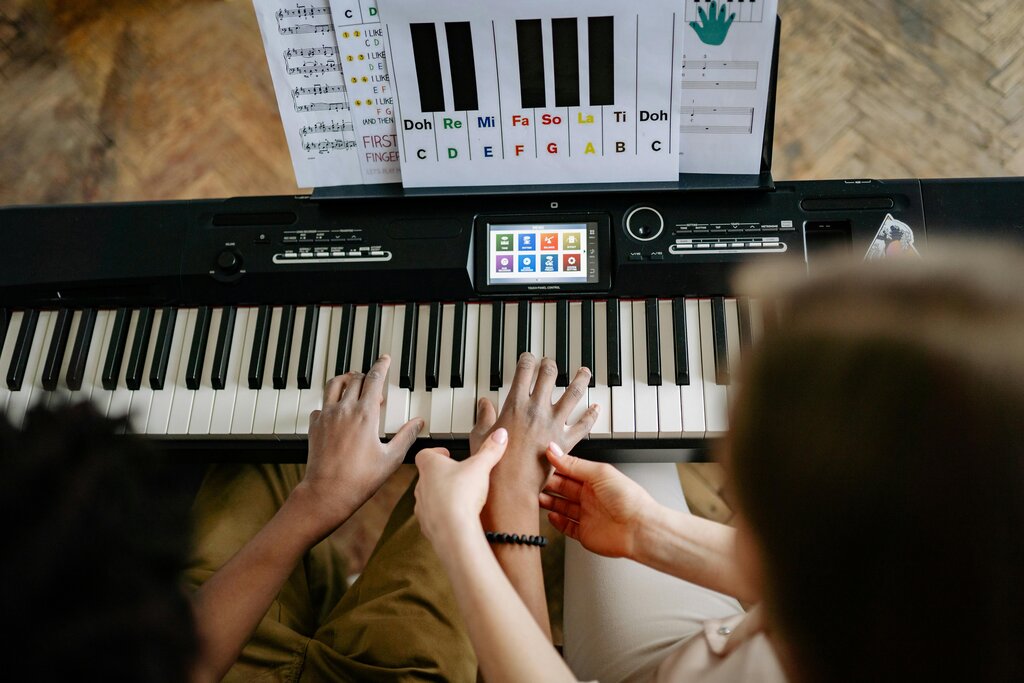
The piano or a digital keyboard is a fantastic starting point. One of its biggest advantages is how visual it is. All the notes are laid out in a logical line, which can make understanding music theory concepts like scales and chords much easier. You don't have to worry about proper embouchure (mouth position) or finger pain, just learning to coordinate your hands.
The acoustic guitar is incredibly versatile and social. It's the centerpiece of countless campfires and singalongs for a reason. There's a bit of a hurdle at the beginning with sore fingertips, but that passes as you build calluses. Once you learn a few basic chords, you can play thousands of popular songs.

If the guitar seems intimidating, consider its smaller cousin, the ukulele. It's often called one of the easiest instruments to learn. With only four nylon strings, it's gentle on the fingers and the chord shapes are simpler than a guitar's. Its small size makes it extremely portable and affordable, offering a low-risk way to start your musical journey.

Finally, don't overlook the humble harmonica. It's the most portable and inexpensive instrument on this list. It's central to blues music and fits perfectly in a pocket, meaning you can practice anywhere. It's a great choice if you want to focus purely on melody and rhythm.
Ultimately, the best instrument for you is the one that you'll have the most fun playing. Try visiting a music store to hold a few different options or watch videos of them being played to see which one inspires you.
Now, let's check your understanding of these concepts.
A person lives in a small apartment with thin walls, loves folk music, and wants an instrument that is gentle on the fingers. Which instrument is the most suitable first choice?
Which instrument is often highlighted as being particularly helpful for understanding music theory because of its linear and visual layout of notes?
Thinking through your own preferences and lifestyle is the first and most important step in a rewarding musical adventure.