YOLO Algorithm Explained
Introduction to Object Detection
What Is Object Detection?
Computer vision gives machines the ability to see and interpret the world. A key part of this is object detection, which involves not just identifying what objects are in an image, but also locating their exact position. This is different from simple image classification, which might tell you a picture contains a car, but not where the car is.
Object detection pinpoints objects by drawing a "bounding box" around them and assigning a class label, like "car" or "person." This combination of localization and classification is crucial for many real-world applications. Think of a self-driving car navigating a busy street. It needs to know the precise location of every other car, pedestrian, and traffic light to make safe decisions.

The technology powers everything from automated checkout systems in stores to medical software that locates tumors in scans. By enabling computers to understand the content and layout of a scene, object detection forms a foundation for more complex AI tasks.
The Early Days
Before the rise of modern deep learning, engineers had to create clever, step-by-step methods to detect objects. One of the most influential was the Viola-Jones framework, developed in 2001. It was groundbreaking for its ability to detect faces in real-time, a feature that soon became common in digital cameras.
The framework relied on a few key ideas:
- Haar-like Features: Instead of looking at individual pixels, the algorithm used simple rectangular patterns of black and white areas. It would slide these patterns across an image to find features common to the object of interest, like the bridge of a nose being lighter than the areas around the eyes.
- Integral Image: To calculate the sums of pixel values under these thousands of features quickly, it used a technique called an integral image. This allowed for very fast feature calculation, which was essential for real-time performance.
- AdaBoost: The algorithm couldn't use all possible features, so it used a machine learning algorithm called AdaBoost to select the most effective ones and train classifiers on them.
- Cascading Classifiers: To avoid wasting time on parts of the image that clearly didn't contain a face, it used a cascade of classifiers. The image region had to pass through a series of simple checks. If it failed any check, it was immediately discarded. Only regions that passed all checks were identified as a face.
While effective for specific tasks like face detection, these traditional methods had significant limitations. They were rigid and struggled with variations in object rotation, scale, and lighting. Furthermore, designing the right features for a new object was a difficult and time-consuming process that required expert knowledge. The performance was good for its time, but it couldn't match the flexibility and accuracy needed for more complex detection tasks.
A Smarter Approach
The game changed with the arrival of deep learning, particularly Convolutional Neural Networks (CNNs). Unlike traditional methods that rely on hand-crafted features, CNNs learn relevant features directly from vast amounts of labeled data.
A CNN processes an image through a series of layers. Early layers might learn to recognize simple edges and colors. Deeper layers combine these to identify more complex patterns like textures, shapes, and eventually, whole objects or parts of objects. This hierarchical learning process allows the network to build a rich, robust understanding of what makes an object unique.
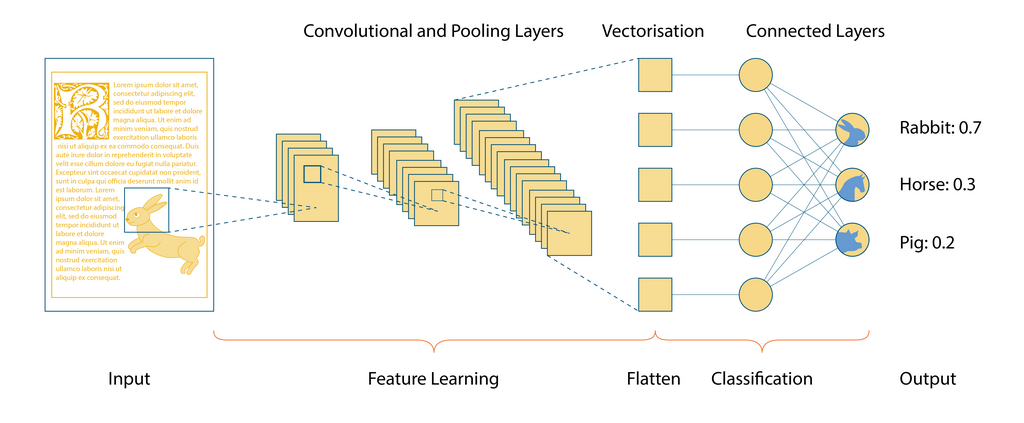
This ability to learn from data is what makes deep learning so powerful for object detection. A single, well-trained model can detect many different types of objects with high accuracy, even when they appear in different sizes, angles, and lighting conditions. This leap in performance paved the way for modern, real-time object detection systems, which we will explore next.
Ready to test your knowledge?
What is the primary difference between object detection and image classification?
What was the main purpose of using a "cascade of classifiers" in the Viola-Jones framework for face detection?
Now that we've covered the basics, you have a solid foundation for understanding how modern object detection works.