Year 7 Math Essentials
Number Systems
Beyond Counting Numbers
We learn to count almost as soon as we can talk: 1, 2, 3, and so on. These are the whole numbers. But the world isn't always that simple. What about temperatures below freezing, or owing someone money? For that, we need a bigger system.
Integers include all the whole numbers, their negative counterparts, and zero. Think of a number line. Zero is in the middle. Positive numbers stretch out to the right, getting bigger. Negative numbers stretch to the left, getting smaller.
Moving left is subtraction. Moving right is addition. So, if you're at 3 and you subtract 5, you move 5 steps to the left and land on -2. If you add a negative number, it's the same as subtracting. For example, $4 + (-3)$ is the same as $4 - 3$, which equals 1. Subtracting a negative is like removing a debt, which is a gain. So, $5 - (-2)$ becomes $5 + 2$, which equals 7.
Parts of a Whole
Integers are great for counting whole things, but what about when we need to split things up? That's where fractions and decimals come in. They both represent parts of a whole.
A fraction, like $3/4$, tells us two things: the bottom number (denominator) says how many equal parts the whole is split into, and the top number (numerator) says how many of those parts we have.
A decimal is another way to write a fraction, but one where the denominator is always a power of 10 (like 10, 100, 1000). The number $0.75$ is just a shorthand for $75/100$.
For instance, if you and three friends share a pizza cut into eight slices, and you eat two slices, you've eaten 2/8 (or 1/4) of the pizza.
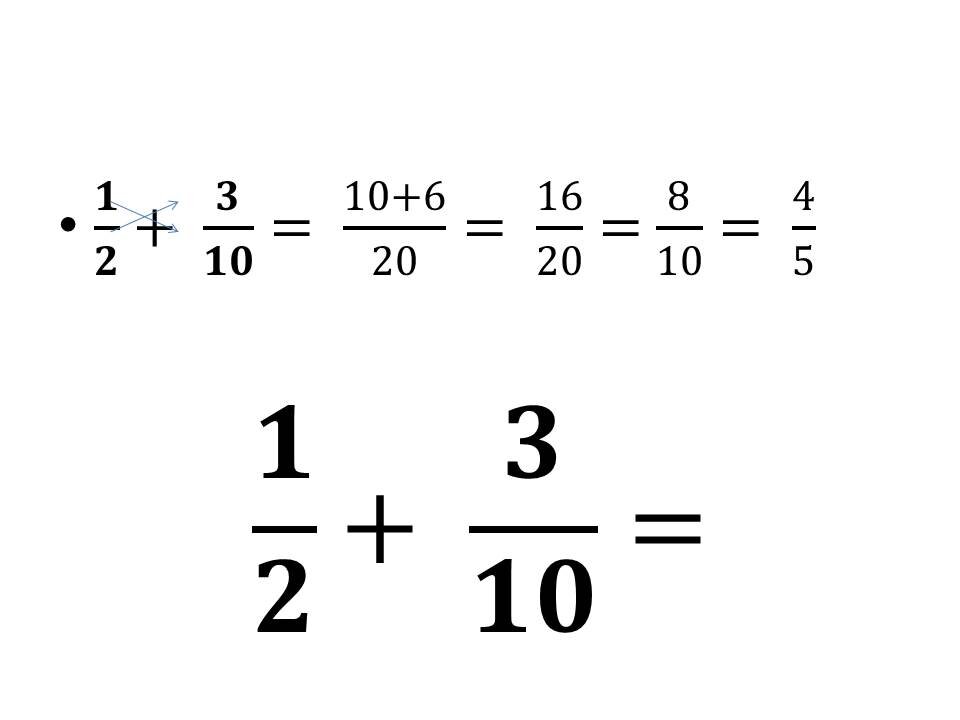
When you add or subtract fractions, you need a common denominator. You can't add thirds and fourths directly, just like you can't add apples and oranges. You have to find a common unit. To add $1/3$ and $1/4$, you can convert them to twelfths. $1/3$ is $4/12$, and $1/4$ is $3/12$. Now you can add them: $4/12 + 3/12 = 7/12$.
Multiplying fractions is simpler: just multiply the numerators together and the denominators together. To divide, you flip the second fraction and multiply. Working with decimals is even more straightforward. You just line up the decimal points and add, subtract, multiply, or divide as you would with whole numbers.
Speaking the Same Language
Fractions, decimals, and percentages are three different ways of expressing the same value. Knowing how to convert between them is essential.
Fraction to Decimal: Divide the numerator by the denominator. For example, .
Decimal to Percent: Move the decimal point two places to the right and add a percent sign. So, becomes . 'Percent' literally means 'per hundred'.
Percent to Fraction: Put the number over 100 and simplify. For instance, is , which simplifies to .
| Fraction | Decimal | Percent |
|---|---|---|
| 1/2 | 0.5 | 50% |
| 1/4 | 0.25 | 25% |
| 3/4 | 0.75 | 75% |
| 1/5 | 0.2 | 20% |
| 1/10 | 0.1 | 10% |
Distance from Zero
Absolute value
noun
A number's distance from zero on a number line, regardless of direction. It is always a non-negative value.
The absolute value of a number is its distance from zero on the number line. Since distance is always positive, the absolute value is too. We use two vertical bars to denote it. For example, the absolute value of -5 is written as .
This concept is useful in many real-world situations. If you're calculating the difference in temperature, you're interested in the magnitude of the change, not whether it went up or down. If a stock price drops by $3, the absolute change is $3. It's also used to describe the margin of error in measurements or to calculate distances between two points.
Understanding these number systems is the foundation for almost all of mathematics. Whether you're balancing a budget, following a recipe, or measuring a room, you're using rational numbers.
Ready to test your knowledge? Let's see what you've learned.
What is the result of the calculation ?
To add or subtract fractions, you must first find a common denominator.