Year 1 Math Foundations
Number Sense
The Building Blocks of Numbers
Everything in math starts with counting. It’s how we make sense of the world, from counting toys in a box to friends at a party. Counting is simply matching a number name, like 'one', 'two', or 'three', to each item in a group. This gives us a total quantity.
We start with the familiar numbers one through ten. After that, we use patterns to build bigger numbers. Once you can count to 100, going to 120 is just a few more steps. A number chart is a great way to see all these numbers laid out and spot the patterns they make.
Look at the chart. Notice how the numbers in each column end with the same digit? And how going down a row is like counting by tens? These patterns make counting big numbers much easier.
From Counting to Writing
When we write numbers down, we use special symbols called numerals. Each number we say has a numeral that represents it. You already know many of them!
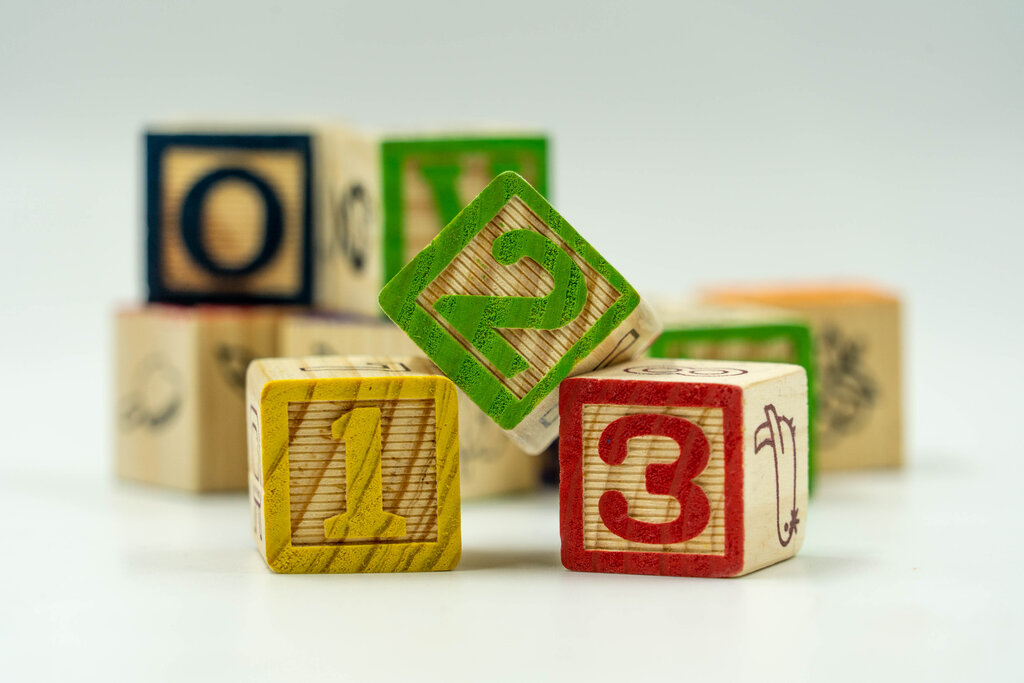
Numeral
noun
A symbol or figure that stands for a number.
The numerals 0, 1, 2, 3, 4, 5, 6, 7, 8, and 9 are the only symbols we need. We can combine them to write any number imaginable. The way we combine them is the key to understanding their value.
Grouping for a Better Count
Imagine you have a huge pile of pebbles. Counting them one by one would take forever, and it's easy to lose track. What if you grouped them? A much better way is to make small piles of ten. This is the main idea behind place value.
Our number system is based on groups of ten. When we write a two-digit number, we're really talking about a certain number of tens, and a certain number of ones. The position, or 'place', of a numeral tells us its value.
In the number 34, the '3' isn't just three. Because it's in the tens place, it means three groups of ten, or 30. The '4' is in the ones place, so it means four ones. So, 34 is 3 tens and 4 ones.
This is why 34 is different from 43. The number 43 has 4 tens and 3 ones. Same numerals, but different places mean different values.
Which Number Is Bigger?
Once you understand place value, comparing numbers becomes simple. To see which of two numbers is bigger, first look at the digit in the tens place.
Let's compare 52 and 39. The number 52 has a 5 in the tens place (5 tens). The number 39 has a 3 in the tens place (3 tens). Since 5 is bigger than 3, we know that 52 is greater than 39. It doesn't matter that 39 has a 9 in the ones place.
What if the tens place is the same? Then, you look at the ones place. To compare 74 and 78, we see they both have a 7 in the tens place. So we look at the ones. Since 8 is bigger than 4, we know that 78 is greater than 74.
This skill also helps us put numbers in order, from least to greatest. A number line is a great tool for picturing this.
On the number line, numbers get bigger as you move to the right. This gives you a clear picture of how numbers relate to each other.
What does counting help us find?
In the number 57, what does the '5' represent?
Understanding numbers, how to write them, and how they are built is the first big step in your math journey. With these skills, you're ready for whatever comes next.