WWII Pacific Air Combat
Introduction to Pacific Theater
A War Across an Ocean
When we think of World War II, images of European land battles often come to mind. But halfway across the world, another conflict raged across a vast expanse of water dotted with thousands of islands. This was the Pacific Theater, a battlefield so immense it dwarfed the whole of Europe.
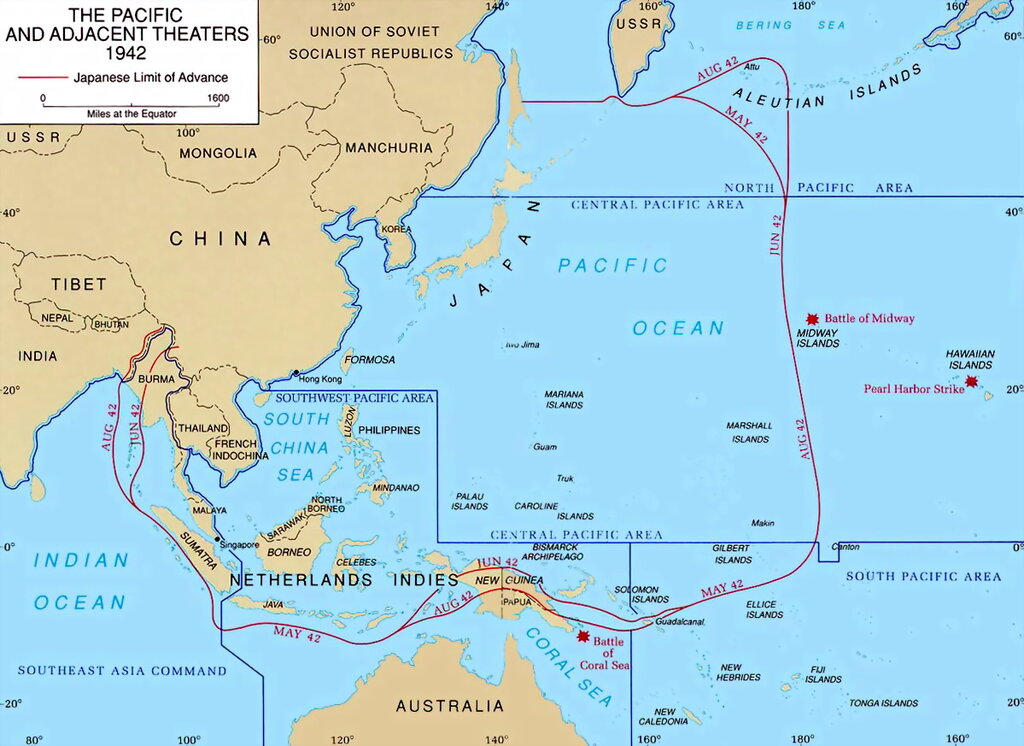
The theater stretched from the Aleutian Islands off Alaska down to Australia, and from the shores of Hawaii to the borders of India. Unlike the European front, which was dominated by massive armies and tank divisions, the war in the Pacific was fundamentally a naval and air conflict. Control of the sea and the sky was everything.
Clashing Ambitions
The conflict in the Pacific was driven by the expansionist goals of the Empire of Japan. Lacking natural resources like oil and rubber, Japan sought to create a self-sufficient empire, which it called the 'Greater East Asia Co-Prosperity Sphere.' This ambition put it on a direct collision course with the Allied powers, primarily the United States, which had significant interests and territories in the region, including the Philippines and Hawaii.
Japan's strategy was to deliver a swift, crippling blow to the U.S. Pacific Fleet at Pearl Harbor. They hoped this would shatter American morale and give them time to fortify a defensive perimeter across the Pacific, making any counter-attack too costly for the Allies to attempt.
The Allied objective was twofold. First, they had to halt the relentless Japanese advance. Second, they needed to push Japanese forces back across the Pacific, island by island, all the way to Japan itself. This required a completely new kind of warfare.
Island Hopping and Air Power
Because the distances were so vast, the Allies couldn't simply invade and retake every single Japanese-held island. Instead, they adopted a strategy called 'island hopping.' The idea was to bypass heavily fortified Japanese strongholds and instead capture smaller, less-defended islands. These captured islands would then become forward bases, complete with airfields, to support the next leap toward Japan.
This strategy made air power the most crucial element of the Pacific War. Aircraft carriers replaced battleships as the new queens of the sea. Fleets were built around them, projecting power across hundreds of miles of ocean. Air superiority was essential. Without it, fleets were vulnerable to attack, and ground troops couldn't be landed or resupplied. Major battles like Midway, Coral Sea, and Leyte Gulf were decided not by ships firing on each other, but by waves of carrier-based aircraft.
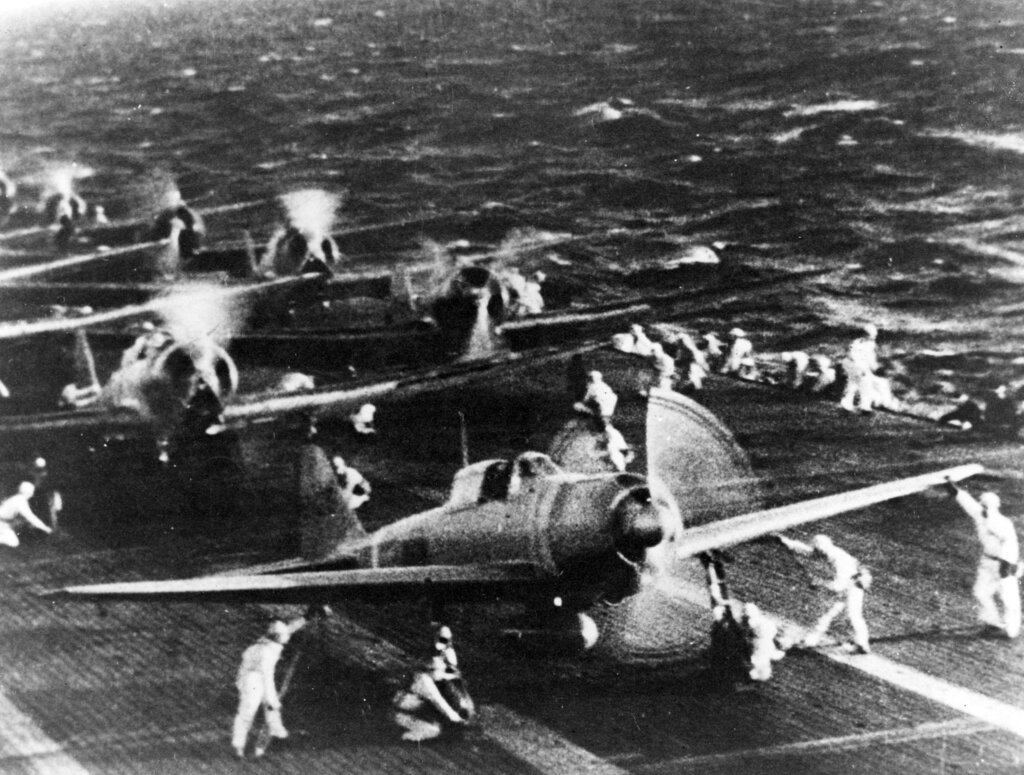
Pilots operated in a uniquely challenging environment. They flew long missions over open water with few landmarks, facing tropical weather and battling for control of small, strategically vital airfields on remote islands. The Pacific Theater was a new kind of war, and it demanded a new kind of warrior in the sky.