Writing Ionic Compound Formulas
Ion Formation
Atoms with a Charge
Atoms are normally neutral. They have an equal number of positively charged protons in their nucleus and negatively charged electrons orbiting that nucleus. The positive and negative charges cancel each other out, leaving the atom with no overall charge.
But this balance can change. Sometimes, an atom can gain or lose one or more electrons. When this happens, the atom is no longer neutral. It becomes an ion—an atom with a net positive or negative electrical charge.
Think of it like a seesaw. Protons on one side, electrons on the other. In a neutral atom, the seesaw is perfectly balanced. In an ion, one side is heavier, and the seesaw is tilted.
The Drive for Stability
Why would an atom gain or lose electrons? It comes down to a quest for stability. Atoms are most stable when their outermost electron shell, called the valence shell, is completely full. The electrons in this shell are known as valence electrons.
Think of the noble gases, like Neon or Argon. They are famously unreactive. Why? Because their valence shells are already full. They have achieved the ideal, stable electron configuration.
Other atoms strive for this same stability. They achieve it by gaining or losing valence electrons until their outermost shell resembles that of a noble gas. This process is what forms ions.
Giving and Taking Electrons
Atoms take one of two paths to stability: they either give away electrons or they take them from another atom.
cation
noun
A positively charged ion formed when a neutral atom loses one or more valence electrons.
Cations are typically formed from metal atoms. Take sodium () again. It has just one valence electron. To achieve a full outer shell, it's far easier to lose that one electron than to find and gain seven more. When it loses that negatively charged electron, the balance is broken. The sodium atom now has 11 positive protons but only 10 negative electrons, giving it a net charge of +1. It has become a sodium cation, written as .
anion
noun
A negatively charged ion formed when a neutral atom gains one or more valence electrons.
Anions, on the other hand, are usually formed from nonmetal atoms. Chlorine (), for example, has seven valence electrons. It's just one electron short of a full shell. It's much easier for chlorine to gain one electron than to lose all seven. When it gains an electron from another atom, it now has 17 protons and 18 electrons. This gives it a net charge of -1. It has become a chloride anion, written as .
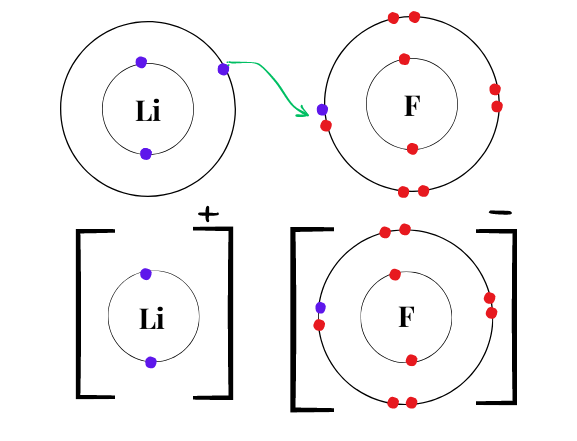
The charge of an ion depends on how many electrons are gained or lost. Magnesium (), with two valence electrons, loses both to form an cation. Oxygen (), needing two electrons to complete its shell, gains them to form an anion. The number of valence electrons an atom has is the key to predicting the ion it will form.
What is an ion?
Why do atoms form ions?
This tendency of atoms to gain or lose electrons is the foundation of a major type of chemical bond, which we'll explore next.