Worship Guitar Essentials
Guitar Basics
Know Your Instrument
Before you can play a song, you need to get familiar with the tool in your hands. A guitar might seem complex, but its parts are straightforward. Understanding what each piece does will make learning everything else much easier.
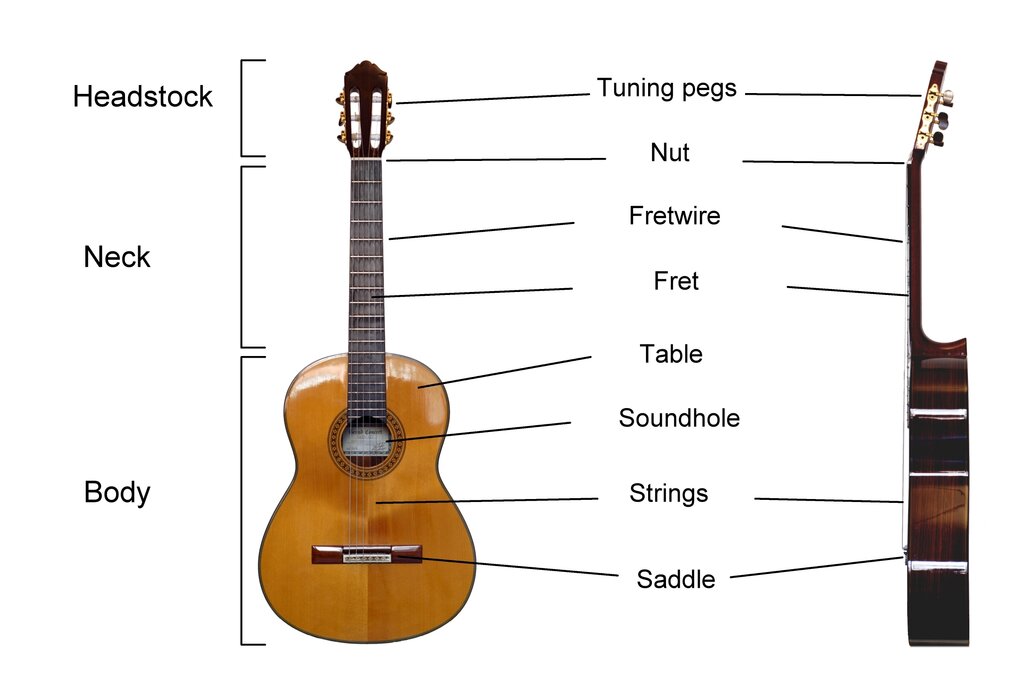
Let's break down the main components you see in the image.
- Body: This is the large, hollow wooden part that amplifies the sound of the strings. The shape and size affect the guitar's tone and volume.
- Neck: The long piece of wood extending from the body. You'll press strings against it to change notes.
- Headstock: Located at the top of the neck, it holds the tuning pegs.
- Tuning Pegs (or Tuners): These are the knobs on the headstock. You turn them to tighten or loosen the strings, which changes their pitch.
- Fretboard (or Fingerboard): The flat piece of wood on the front of the neck where you place your fingers.
- Frets: The metal strips embedded in the fretboard. They divide the neck into specific pitches. When you press a string down behind a fret, you shorten its vibrating length, creating a new note.
- Nut: A small grooved piece, usually made of plastic or bone, that guides the strings from the headstock onto the fretboard.
- Bridge: Mounted on the body, the bridge holds the strings in place at the other end.
- Saddle: A thin strip on the bridge that the strings rest on, similar to the nut. It sets the string height (action) and intonation.
- Soundhole: The circular opening in the body of an acoustic guitar that helps project the sound.
How to Hold the Guitar
Comfort is key. If you're tense or hunched over, you won't play well and could develop bad habits or even strain your muscles. The goal is to be relaxed but stable.
Start by sitting on a chair without arms. Your back should be straight, and your feet should be flat on the floor.
For right-handed players, rest the indented curve of the guitar's body on your right thigh. The guitar should be angled slightly upward so you can see the fretboard without leaning over. If you're left-handed, you'll do the opposite.
Your fretting hand (usually the left) should be relaxed. Place your thumb on the back of the neck, roughly opposite your middle finger. Your fingers should curve naturally over the fretboard, ready to press down on the strings. Avoid letting the palm of your hand touch the bottom of the neck.

Your other hand (the strumming or picking hand) rests over the soundhole. Your forearm should drape comfortably over the top of the guitar's body. This position allows you to strum the strings easily without tension in your shoulder or wrist.
Getting in Tune
Playing an out-of-tune guitar is one of the fastest ways to get discouraged. Tuning should be the very first thing you do every single time you pick up your instrument. Strings can go out of tune due to temperature changes, humidity, or just from playing.
The strings are named from thickest (closest to you) to thinnest (closest to the floor). The standard tuning is E-A-D-G-B-E.
A good mnemonic to remember the string names is Eddie Ate Dynamite, Good Bye Eddie.
The easiest way to tune is with an electronic tuner. You can use a clip-on tuner that attaches to the headstock, a smartphone app, or a website with a built-in tuner. These tools listen to the pitch of each string and tell you if it's too low (flat) or too high (sharp).
Here's the process:
- Pluck a single string. The tuner will show you what note it's playing.
- If the note is flat (too low), slowly turn the corresponding tuning peg to tighten the string. The pitch will go up.
- If the note is sharp (too high), slowly loosen the string to lower the pitch.
- Adjust until the tuner indicates the note is correct, usually by turning a light green or showing a checkmark.
- Repeat this for all six strings.
Basic Care
Taking care of your guitar will ensure it lasts a long time and plays well. You don't need to be a professional technician; just a few simple habits make a big difference.
Cleaning: After you play, wipe down the strings, fretboard, and body with a clean, dry microfiber cloth. This removes oils and sweat from your hands, which can corrode the strings and damage the wood's finish over time.
Changing Strings: Guitar strings don't last forever. They eventually get dull, lose their tone, and can even break. How often you need to change them depends on how much you play, but a good rule of thumb for a beginner is every 2-3 months. New strings will make your guitar sound bright and vibrant.
Storage: When you're not playing your guitar, it's best to store it in a case or on a guitar stand. This protects it from dust, accidental bumps, and extreme changes in temperature or humidity, which can warp the wood.

Getting these fundamentals right—from knowing the parts of your guitar to keeping it in tune and clean—builds a strong foundation. It sets you up for success as you move on to learning chords and songs.