Worlds of Fire and Ice The Galilean Satellites
Orbital Resonance and Tides
A Gravitational Dance
The moons of Jupiter don't move in isolation. Three of the largest—Io, Europa, and Ganymede—are locked in a precise, rhythmic pattern. For every single orbit Ganymede completes around Jupiter, Europa completes exactly two, and Io completes exactly four. This 4:2:1 orbital relationship is known as a Laplace resonance and it keeps the moons tethered in a gravitational partnership.
This resonance isn't just a neat cosmic coincidence. The repeated, predictable gravitational tugs from this alignment prevent the moons' orbits from settling into perfect circles. Instead, their paths are forced to remain slightly elliptical, or eccentric.
A Constant Squeeze
An elliptical orbit means a moon’s distance from Jupiter constantly changes. At one point in its orbit, it’s closer to the gas giant; at another, it's farther away. Jupiter’s immense gravity pulls more strongly on the near side of a moon than its far side. When the moon is closer to Jupiter, this gravitational difference is more extreme, stretching the moon into an elongated shape. As it moves farther away, the pull weakens, and the moon relaxes back into a more spherical form.
This continuous cycle of stretching and relaxing is called tidal flexing . It's a relentless, planet-scale workout imposed by Jupiter, made possible by the eccentric orbits maintained by the resonance.
Heating from Within
Imagine bending a paper clip back and forth. The metal quickly gets hot from the internal friction. The same principle applies to these moons. The energy from their orbital motion is converted into heat through tidal flexing. This process, known as tidal heating , generates enormous amounts of thermal energy within the moons' interiors.
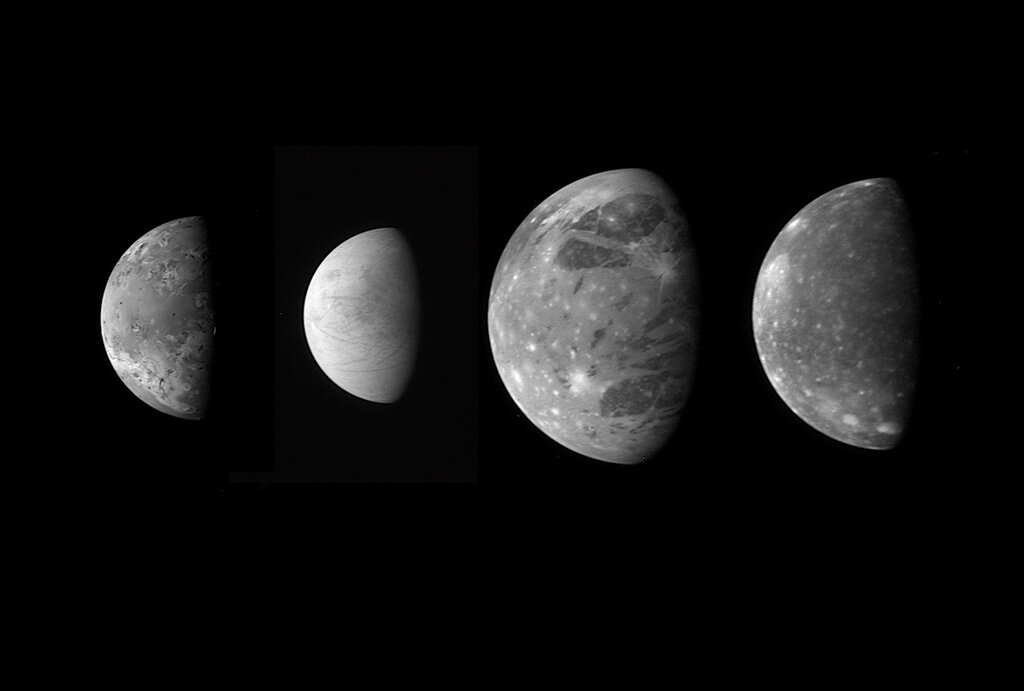
This internal heat is the engine driving the geology of the inner Galilean moons. It’s why Io is the most volcanically active body in the solar system, constantly resurfacing itself with lava. It’s also the leading theory for what keeps a liquid water ocean sloshing beneath Europa’s icy shell.
Commensurability
noun
A state where the orbital periods of two or more celestial bodies are in a simple integer ratio, leading to a stable, resonant gravitational interaction.
The amount of heat generated depends on the moon's proximity to Jupiter and the degree of its orbital eccentricity. Io, being the closest and most flexed, gets the most intense heating. Europa gets less, and Ganymede even less. But what about the fourth major moon, Callisto?
Callisto orbits much farther out and is not part of the Laplace resonance. Its orbit is nearly circular, so it experiences very little tidal flexing and almost no tidal heating. This is why its surface is ancient and heavily cratered, a quiet relic compared to its geologically active siblings.
The dance between Jupiter and its inner moons is a perfect example of how gravity can create complexity and activity in the solar system. The simple integer ratios of their orbits lead directly to the dramatic forces that shape these distant worlds.
What is the term for the precise 4:2:1 orbital relationship between Jupiter's moons Io, Europa, and Ganymede?
What is the direct consequence of the Laplace resonance on the orbits of these moons?