World War I Explained
Origins of World War I
A Tense Continent
By the early 1900s, Europe was a continent holding its breath. Decades of shifting power, new technologies, and swelling national pride had created a tense and fragile peace. On the surface, nations were bound by intricate treaties and royal family ties. Underneath, however, deep-seated rivalries simmered. It wouldn't take much to set the whole thing off. The main ingredients for this combustible mix were a web of military alliances, a surge in aggressive nationalism, and a fierce competition for global empires.
A Web of Alliances
Imagine a schoolyard where every kid has promised to back up their friends in a fight. A small disagreement between two people could quickly escalate into a massive brawl. This was the situation in early 20th-century Europe. The major powers had organized themselves into two competing teams.
The goal of these alliances was to create a balance of power, theoretically making it too costly for any nation to start a war. In reality, they created a tripwire for continent-wide conflict.
On one side was the Triple Alliance, formed by Germany, Austria-Hungary, and Italy. Germany, a relatively new but powerful nation, worried about being surrounded by enemies. It allied with the sprawling, multi-ethnic Austro-Hungarian Empire to its south. Italy joined them, though its commitment was less certain.
On the other side was the Triple Entente. France, still bitter about its defeat by Germany in 1871, allied with the massive Russian Empire. Great Britain, concerned about Germany's growing naval power, eventually joined them, forming an understanding, or 'entente.'
With these teams in place, any conflict involving one member threatened to drag in all the others. A dispute in a remote corner of the continent could trigger a domino effect, leading to a general European war.
Pride, Power, and a Shot
Two other forces were pushing Europe toward the brink: nationalism and imperialism. Nationalism, the belief in one's country's superiority and interests, was a powerful motivator. In established nations like Britain, France, and Germany, it fueled patriotism and a desire for prestige. But in empires like Austria-Hungary and the Ottoman Empire, it was a force of rebellion, as ethnic groups like Serbs, Poles, and Czechs dreamed of creating their own independent nations.
This desire for national glory was closely tied to imperialism. The major European powers competed fiercely for colonies in Africa and Asia, seeing them as sources of raw materials, new markets, and military power. This “scramble for empire” created constant friction and near-misses with war, especially as a newly unified Germany sought its own "place in the sun" to rival the vast empires of Britain and France.
The most volatile region was the Balkans, often called the "powder keg of Europe." Here, the weakening Ottoman Empire was losing its grip, while both Russia and Austria-Hungary tried to expand their influence. At the same time, a powerful Serbian nationalist movement aimed to unite all South Slavic peoples into a single state, a direct threat to the multi-ethnic Austro-Hungarian Empire, which ruled over millions of Slavs.
It was into this powder keg that the heir to the Austro-Hungarian throne, Archduke Franz Ferdinand, traveled in June 1914.
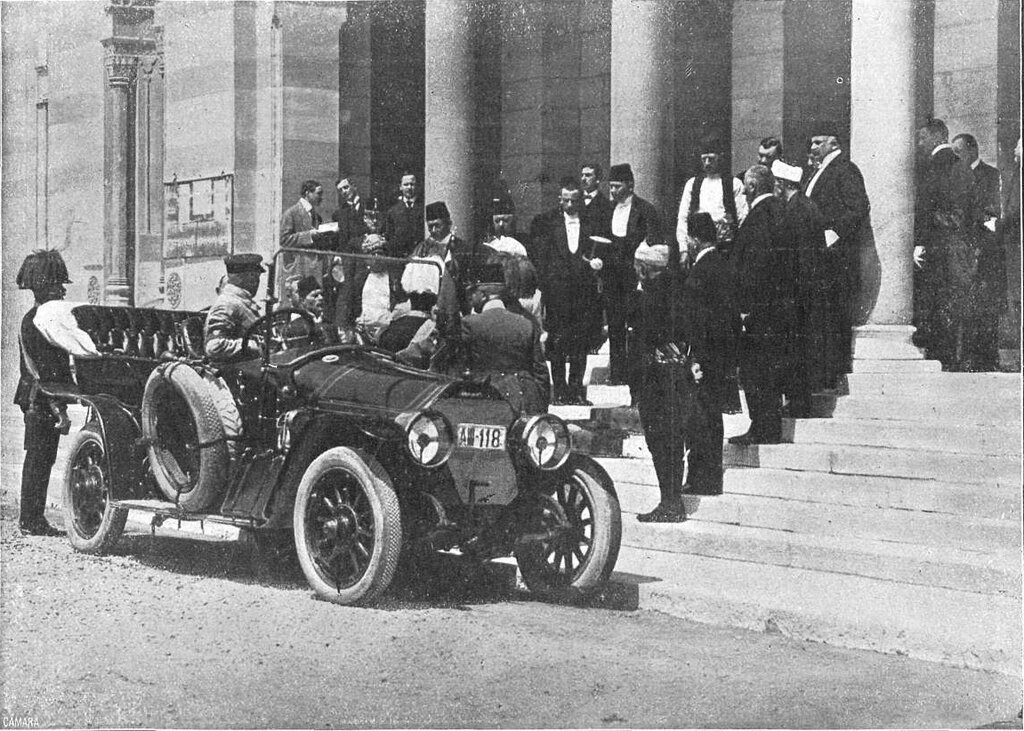
On June 28, 1914, in the city of Sarajevo, the capital of the recently annexed province of Bosnia, a young Bosnian Serb nationalist named Gavrilo Princip stepped out of a crowd and fired two shots. The Archduke and his wife, Sophie, were killed. Princip was a member of a nationalist group that wanted to free Bosnia from Austro-Hungarian rule and unite it with Serbia.
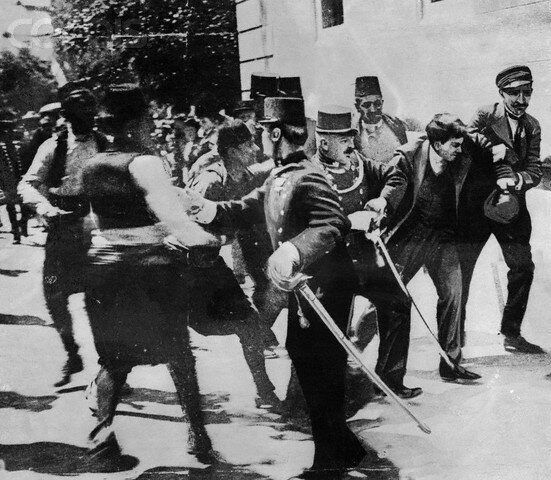
The assassination was the spark. Austria-Hungary, outraged and backed by its powerful ally Germany, saw an opportunity to crush Serbian nationalism once and for all. It issued a harsh ultimatum to Serbia, a list of demands so severe that they were impossible to accept fully without sacrificing independence.
How could the death of one man, Archduke Franz Ferdinand, who was assassinated on 28 June 1914, lead to the deaths of millions in a war of unprecedented scale and ferocity?
Serbia, backed by its Slavic patron Russia, refused to comply with all the demands. On July 28, 1914, exactly one month after the assassination, Austria-Hungary declared war on Serbia. The dominoes began to fall. Russia mobilized its massive army to defend Serbia. Germany, seeing Russian mobilization as a threat, declared war on Russia. Then, following its long-held war plan, Germany invaded Belgium to attack France, Russia's ally. This invasion of a neutral country brought Great Britain into the conflict. Within a week, the great powers of Europe were at war. The tangled alliances, fueled by years of nationalist pride and imperial rivalry, had dragged the continent into a conflict that would become known as the Great War.
Which three nations formed the Triple Alliance before the start of World War I?
The immediate spark that ignited the 'powder keg' and started the chain of events leading to World War I was...