World Rivers Geography
Introduction to River Systems
The Journey of Water
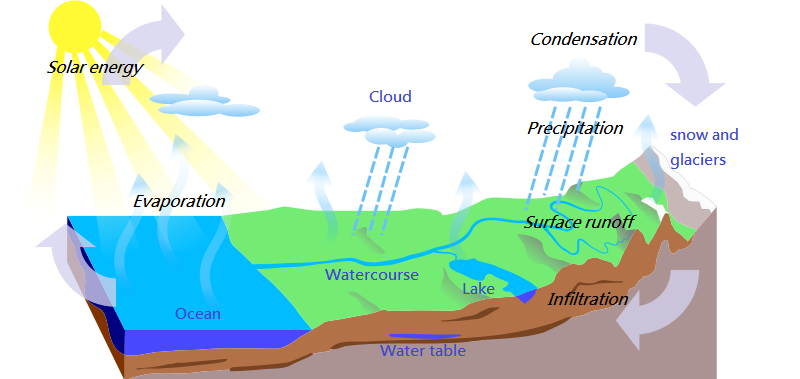
Every river begins with a single drop of rain, or a single snowflake. But where does that water come from? It's all part of a massive, planet-sized system called the hydrological cycle, or the water cycle. It’s the continuous journey water takes from the sky to the land and back again.
Key words in the discussion of the water cycle are evaporation, transpiration, condensation, precipitation, surface runoff (transportation), and percolation.
It starts with evaporation. The sun heats up water in oceans, lakes, and even puddles, turning it into a gas called water vapor, which rises into the atmosphere. Plants also release water vapor in a process called transpiration.
As this vapor rises, it cools and turns back into tiny liquid water droplets, forming clouds. This is condensation. When enough of these droplets clump together, they become too heavy to stay in the air and fall back to Earth as precipitation—rain, snow, sleet, or hail.
Once on the ground, the water has a few paths. Some of it soaks into the earth, becoming groundwater. The rest flows over the land as runoff, collecting in small channels. These channels merge, growing larger and larger, until they form a river. This is how nearly every river on Earth is born.
A River's Anatomy
A river can be broken down into three main parts: its beginning, its middle, and its end.
The source, or headwaters, is where the river begins. It's often high in the mountains, fed by melting snow or a spring bubbling up from the ground. Here, the river is usually small, cold, and fast-flowing, tumbling down a steep slope.
The main body of the river is its course. Geographers often divide the course into the upper, middle, and lower sections. As the river flows from its source, it carves through the land, joined by other smaller rivers and streams called tributaries. The landscape flattens, the river slows down, and it gets wider and warmer.
Finally, the river reaches its mouth, where it empties into a larger body of water like a lake or an ocean. The journey is over, but the water's role in the hydrological cycle is not. It will eventually evaporate and start the process all over again.
The Shape of a River
Rivers are powerful forces of nature that constantly sculpt the landscape. As water flows, it erodes soil and rock from its banks and carries this material, called sediment, downstream.
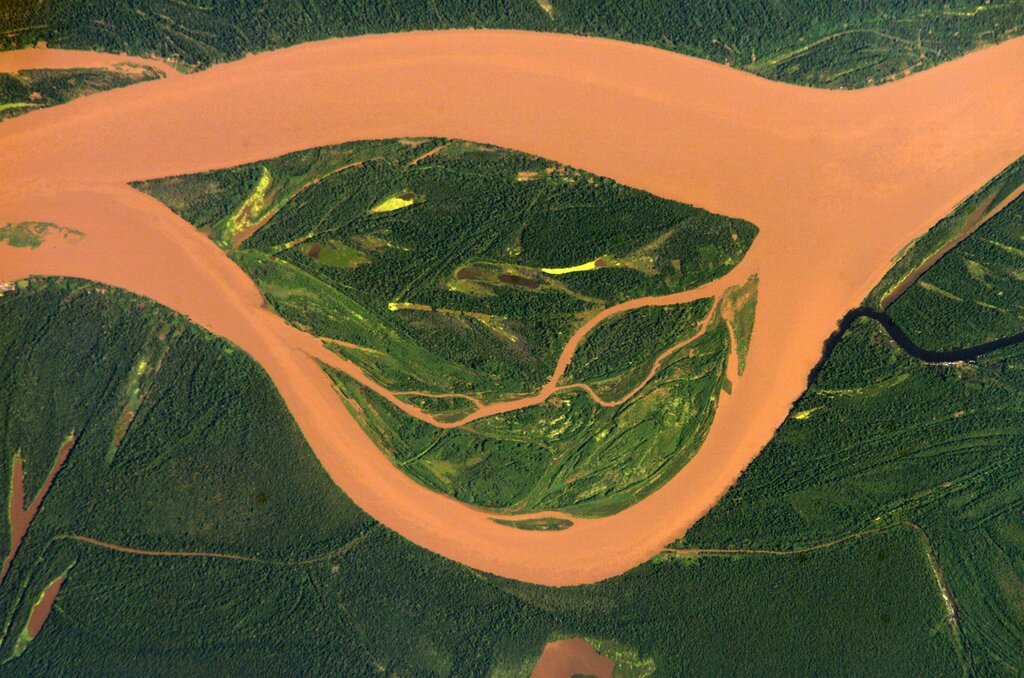
In the flatter, middle and lower courses of a river, the flow slows down and begins to snake across the land in wide loops. These curves are called meanders. The water on the outside of a meander flows faster, eroding the bank. On the inside of the curve, the water is slower, and it deposits sediment, building up the bank.
Over many years, this process makes the meanders more and more extreme. Eventually, the river might cut a new, shorter path, abandoning the old loop. The cut-off meander becomes a crescent-shaped body of still water called an oxbow lake.
When a river reaches its mouth, it slows down dramatically. It no longer has the energy to carry its sediment, so it drops it. This deposited sediment builds up over time, creating a fan-shaped landform called a delta. Deltas are often incredibly fertile areas, rich with nutrients carried by the river.
Rivers on the Clock
Not all rivers flow year-round. We can classify them based on their consistency.
Perennial rivers flow continuously throughout the year. They are usually found in climates with steady rainfall or are fed by reliable sources like large springs or melting glaciers.
Intermittent rivers, or seasonal rivers, only flow during certain times of the year, typically the rainy season. During the dry season, their riverbeds may be completely dry.
Ephemeral rivers are even more fleeting. They flow only for a very short period after a heavy rainfall. They are common in deserts and other arid regions where rain is rare and unpredictable.
| River Type | Flow Characteristics |
|---|---|
| Perennial | Flows all year round. |
| Intermittent | Flows seasonally, like during a rainy season. |
| Ephemeral | Flows only briefly after a major rainfall. |
Now, let's review these core concepts about the life and structure of rivers.
Ready to test your knowledge? Take this short quiz on the fundamentals of river systems.
The process by which water vapor in the atmosphere cools and turns back into tiny liquid water droplets, forming clouds, is called:
What is the name for the fan-shaped landform created by the deposition of sediment at the mouth of a river?
From the water cycle that births them to the deltas they build at their mouths, rivers are dynamic systems. Understanding their components and how they shape the land is the first step to appreciating these vital waterways.