World Class Product Management Mastery
Advanced Strategic Frameworks
Aligning Action with OGSM
Once you have a high-level strategy, you need a way to translate it into concrete action. The OGSM framework provides a simple but powerful structure for this. It connects your big-picture vision to the day-to-day work of your team. The acronym stands for Objective, Goals, Strategies, and Measures.
OGSM creates a clear, one-page document that links what you want to achieve with how you'll do it, and how you'll track progress.
Let's break it down:
- Objective: This is your primary mission. It's a qualitative, inspiring statement about what you're trying to accomplish. For example, “Become the leading mobile app for personal finance management among millennials.”
- Goals: These are the specific, measurable outcomes that prove you've met your objective. They should be quantifiable and time-bound. A goal might be, “Achieve 5 million monthly active users by the end of the fiscal year.”
- Strategies: These are the choices you make about how you will achieve your goals. They describe the path you'll take. A strategy for the goal above could be, “Expand into three new international markets with localized content and currency support.”
- Measures: These are key performance indicators (KPIs) that track the effectiveness of your strategies. For the international expansion strategy, measures could include, “New user sign-ups per region per month” and “App Store rating in new markets.”
The power of OGSM lies in its cascading logic. The objective informs the goals, the goals define the strategies, and the strategies are monitored by the measures. Everything is connected.
Mapping Growth with Ansoff
When your objective is growth, you need to decide where that growth will come from. Will you sell more of your existing products? Enter new markets? Create new products? The Ansoff Matrix helps you systematically think through these options.
It's a 2x2 grid that outlines four primary growth strategies based on whether you're focusing on existing or new products, and existing or new markets.
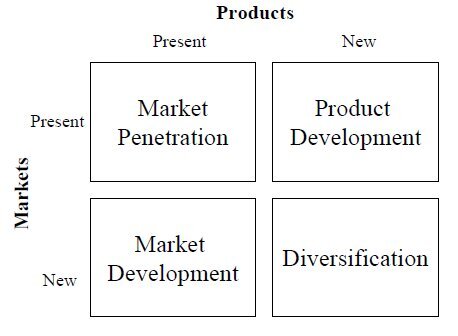
Here’s how to understand the four quadrants:
-
Market Penetration (Existing Product, Existing Market): This is the lowest-risk strategy. The goal is to gain more market share with your current products in your current market. Tactics might include increasing marketing spend, adjusting prices, or running loyalty programs.
-
Product Development (New Product, Existing Market): Here, you create new products to sell to your existing customer base. This is a good strategy if you have strong brand loyalty. A coffee shop might start selling its own branded mugs and coffee beans.
-
Market Development (Existing Product, New Market): This strategy involves taking your existing products into new markets. The “new market” could be a new geographic area (expanding from the US to Europe) or a new customer segment (a high-end enterprise software company releasing a version for small businesses).
-
Diversification (New Product, New Market): This is the riskiest strategy, as it involves developing a new product for a market you don't know. A successful tech company might diversify by acquiring a startup in a completely different industry, like healthcare.
By mapping your options on the Ansoff Matrix, you can evaluate the risks and potential rewards of different growth paths, making your strategic choices more deliberate.
Setting Goals with OKRs
While OGSM provides a complete strategic picture, sometimes you need a more focused, agile framework for setting and tracking ambitious goals. This is where Objectives and Key Results (OKRs) come in. Popularized by tech companies like Google, OKRs are a way to align teams around measurable outcomes.
OKR
noun
A goal-setting framework that helps organizations define objectives and track their outcomes.
The structure is simple:
- Objective: An ambitious, qualitative goal. It should be inspiring and challenging. For instance: “Deliver a world-class onboarding experience for new users.”
- Key Results: 3-5 quantitative outcomes that measure progress toward the objective. They must be measurable and verifiable. If you hit your key results, you've achieved your objective. No debate.
For the objective above, the key results might be:
- KR1: Increase the user activation rate from 40% to 60%.
- KR2: Reduce support tickets related to setup by 50%.
- KR3: Achieve a Net Promoter Score (NPS) of 9 or higher on the first-time user survey.
OKRs are typically set quarterly and are meant to be aspirational. The goal isn't necessarily to hit 100% on every key result. Achieving 70% is often considered a success, as it shows the team set a sufficiently ambitious target. This encourages calculated risks and prevents teams from setting easy, unambitious goals they know they can hit.
By using frameworks like OGSM, the Ansoff Matrix, and OKRs, you can move beyond vague strategic statements. You create a clear line of sight from your highest-level vision to the specific outcomes that define success.
Time to test your knowledge of these strategic frameworks.
A company's objective is to 'Become the most trusted provider of sustainable pet food.' Which of the following is the best example of a Goal for this objective?
A popular US-based clothing brand decides to start selling its existing line of apparel in Japan. According to the Ansoff Matrix, which growth strategy is this?
These tools help ensure that every decision and action is purposeful and aligned with the larger business mission.