Working with Artificial Intelligence
Introduction to AI
What Is AI?
Artificial Intelligence is the science of making machines that can think like humans. This doesn't mean creating robots with feelings. It's about designing systems that can perform tasks that typically require human intelligence, like learning from experience, solving problems, and understanding language.
intelligence
noun
The ability to acquire and apply knowledge and skills.
At its core, AI is about pattern recognition. An AI system is trained on vast amounts of data, learning to identify connections and make predictions. Think of a spam filter in your email. It has learned to recognize the patterns of junk mail from looking at millions of examples, allowing it to automatically sort new messages.
A Brief History
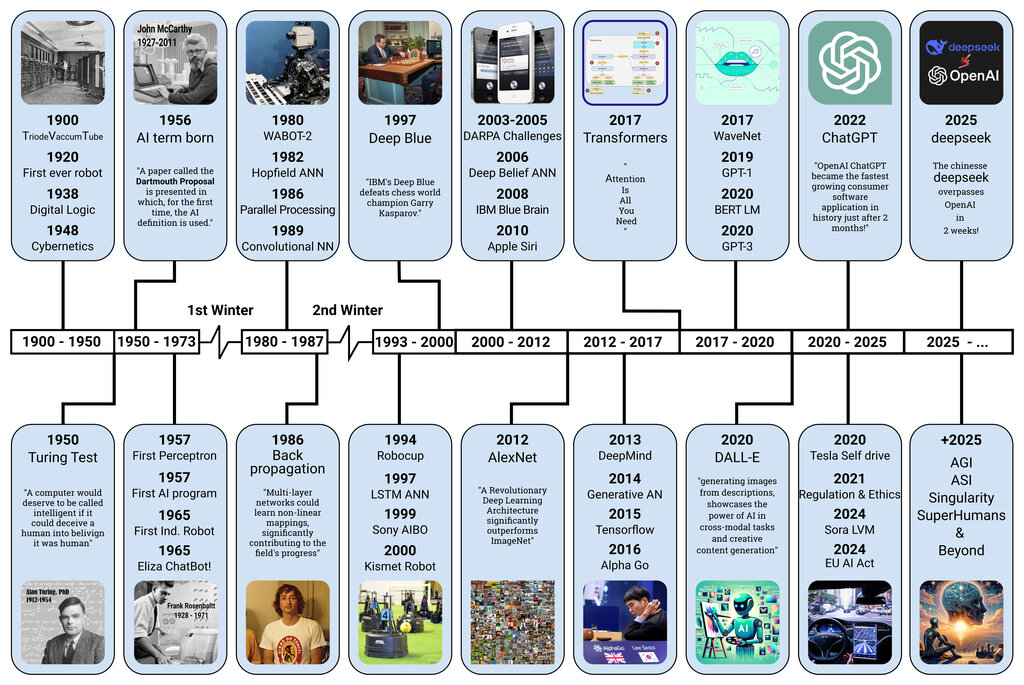
The idea of artificial minds has been around for centuries, but the field of AI really began in the 1950s. Early researchers were optimistic, believing that a machine with human-like intelligence was just a few decades away. They created programs that could solve algebra problems and play checkers.
Progress wasn't always a straight line. The field went through periods known as "AI winters," when funding dried up and public interest faded. But breakthroughs in computing power and the availability of massive datasets led to a resurgence. Today, AI is more integrated into our lives than ever before, from the recommendation algorithms on streaming services to the navigation apps on our phones.
The Branches of AI
AI isn't a single technology; it's a broad field with many specialized branches. You can think of it like an umbrella, with several key areas of study underneath it. Three of the most significant subfields are machine learning, natural language processing, and computer vision.
Machine Learning (ML) is the engine that drives most modern AI. Instead of being explicitly programmed with rules, an ML system learns directly from data. It finds patterns and makes decisions with minimal human intervention. For example, a bank's fraud detection system uses ML to learn the patterns of normal and fraudulent transactions to flag suspicious activity.
Natural Language Processing (NLP) gives machines the ability to understand, interpret, and generate human language. It's the technology behind virtual assistants like Siri and Alexa, as well as translation apps. When you speak to your phone, NLP is what translates your words into a command the device can execute.
Computer Vision aims to give computers the ability to see and interpret the visual world. This involves processing images and videos to identify objects, people, and scenes. Self-driving cars rely heavily on computer vision to understand their surroundings, from reading traffic signs to identifying pedestrians.
Ethics and Impact
As AI becomes more powerful, it's crucial to consider its ethical implications. Questions about fairness, accountability, and privacy are at the forefront of the conversation. For example, if an AI system used for hiring is trained on biased data, it might unfairly discriminate against certain groups of people.
An AI system is only as good, or as fair, as the data it's trained on. Bias in the data can lead to biased outcomes.
There are also significant societal impacts to consider. AI has the potential to automate many jobs, which could lead to economic disruption. On the other hand, it can also solve major challenges in fields like medicine and climate science by finding patterns that humans might miss. For instance, AI is being used to analyze medical images to detect diseases earlier and more accurately than ever before.
Navigating the future of AI requires careful thought. We need to build systems that are not only intelligent but also responsible and aligned with human values.
Ready to check your understanding?
What is the fundamental capability at the core of most modern AI systems?
A virtual assistant like Siri or Alexa understands your spoken commands primarily through which subfield of AI?
Thinking about these concepts is the first step toward understanding how AI works and its role in our world.