Wittgenstein's Language Games and the Augustinian Critique
The Augustinian Picture
The Limits of Labeling
Ludwig Wittgenstein opens his masterpiece, Philosophical Investigations, not with his own voice, but with a quote from someone else: 's Confessions. Augustine describes how he learned to speak as a child. He watched adults point at objects and say words. He concluded that words were essentially names, and the meaning of a word was the object it stood for. This is what we call the 'Augustinian picture' of language.
When they (my elders) named some object, and accordingly moved towards something, I saw this and I grasped that the thing was called by the sound they uttered when they meant to point it out.
This idea is incredibly intuitive. You point at a table and say "table." The word "table" means that physical object. This theory, where meaning is based on reference to an object, is known as It treats language as a vast system for naming things. Wittgenstein starts here because this view, while seeming like common sense, is the very target he wants to dismantle. He believes it oversimplifies language and leads to philosophical confusion.
Beyond the Shopping List
To show the limits of this naming model, Wittgenstein gives a simple example. Imagine sending someone to a grocer with a slip of paper that reads: "five red apples."
If the Augustinian picture were correct, the shopkeeper would simply retrieve the objects corresponding to these names. "Apples" works fine; it's a physical thing. But what about "red"? Is there an object called "red" in the shop? No, "red" is a property of the apples. And what about "five"? The shopkeeper doesn't fetch an object called "five." Instead, he performs an action: counting. The word "five" gets its meaning from its role in the activity of counting and fetching.
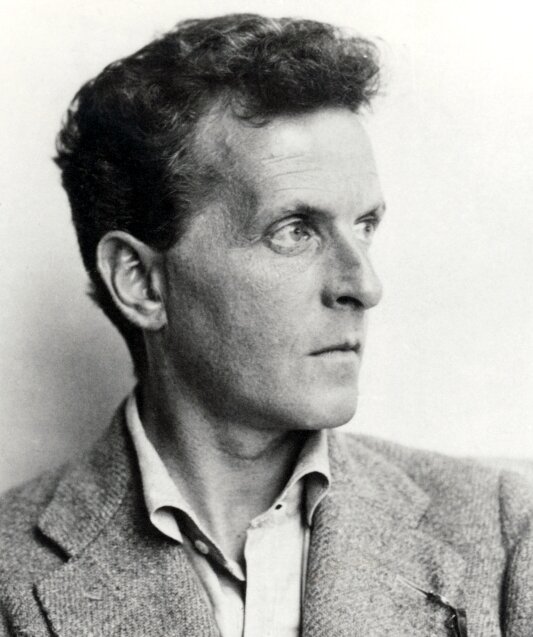
This simple shopping trip reveals a profound truth. Different types of words function in radically different ways. Thinking that all words are names is like thinking all the tools in a toolbox are hammers. A screwdriver, a wrench, and a measuring tape all have different uses. So do words like "ouch," "hello," "if," and "maybe." Their meaning isn't an object they point to, but the job they do within a specific context, or what would later call a "language-game."
To know the meaning of a sign, one must observe the situations in which that sign is employed and examine the ways in which its usage is taught.
Thought Before Words?
The Augustinian picture also carries a hidden assumption: that thought exists before and separate from language. In this view, a child has a concept or a thought (e.g., the idea of their mother) and simply learns the sound-label to attach to it. Language becomes a tool for translating these pre-existing, private thoughts into public sounds.
Wittgenstein challenges this notion. He suggests that we don't just learn labels for thoughts we already have; rather, learning a language is learning how to think in new ways. The structure of our language shapes the structure of our thought. The relationship isn't a simple one-way street from a name to an object, but a complex, intertwined system of practices, behaviors, and social contexts.
By starting with this simple, intuitive, but ultimately flawed picture of language, Wittgenstein sets the stage for his entire investigation. He forces us to question our most basic assumptions about what it means for a word to have meaning, shifting our focus away from static labels and toward the dynamic, living use of words in our everyday lives.
Ready to check your understanding?
According to the text, what is the central idea of the 'Augustinian picture' of language?
Why does Wittgenstein use the example of a shopping list with "five red apples"?
Next, we'll dive deeper into what Wittgenstein proposes as an alternative: the idea of language-games.