Wireless Security and Penetration Testing
802.11 Protocol Vulnerabilities
The Rules of the Air
Wireless communication isn't magic; it's a highly structured conversation governed by the 802.11 protocol. Every interaction between your device and a Wi-Fi access point uses specific message types called frames. Think of them like different kinds of mail. There are three main categories.
| Frame Type | Purpose | Analogy |
|---|---|---|
| Data | Carries your actual information, like website content, emails, or video streams. | A sealed letter containing your message. |
| Control | Manages the flow of conversation, ensuring data arrives correctly. | A delivery confirmation slip (like an ACK frame) or a 'please wait' signal. |
| Management | Handles the logistics of joining, leaving, and discovering networks. | Postcards for administrative tasks: joining a network, announcing its presence, or disconnecting. |
For a long time, security efforts focused almost entirely on encrypting the Data frames. This makes sense; you want to protect the contents of your letters. However, Control and Management frames were often sent in plain text, completely unprotected. This is like sending all your logistical requests on open postcards for anyone to read and, more dangerously, to forge.
Forged Administrative Orders
When management frames aren't cryptographically protected, they create a significant vulnerability. One of the most common exploits is the deauthentication attacks. In this scenario, an attacker can simply send a fake deauthentication frame to a connected device, spoofing the MAC address of the access point. The client device, believing the request is legitimate, immediately disconnects.
This doesn't require cracking any passwords. The attacker can forcibly kick any user off the network, creating a denial-of-service (DoS) condition. The same principle applies to disassociation frames, which also terminate a connection. An attacker can repeatedly send these frames, preventing a user from ever maintaining a stable connection.
Other management frames are also vulnerable. An access point broadcasts to announce its existence and details, like its name (SSID). An attacker can spam the airwaves with thousands of fake beacon frames, creating a confusing list of non-existent networks. This can be used to set up an "evil twin" network, a malicious hotspot that mimics a legitimate one to trick users into connecting and revealing their credentials.
Protecting the Postcards
The vulnerabilities in management frames were so fundamental that a specific solution was needed. The IEEE introduced the 802.11w amendment, also known as Management Frame Protection (MFP). This feature is now mandatory for WPA3-certified networks.
802.11w protects certain management frames by ensuring they are sent by a legitimate device in the network, not an imposter.
MFP doesn't encrypt the entire management frame, as some information needs to be public for discovery. Instead, it adds a (MIC) to critical frames like deauthentication, disassociation, and action frames. The MIC is a cryptographic hash calculated using a key shared between the client and the access point. When a device receives a protected management frame, it recalculates the MIC. If its calculation doesn't match the MIC in the frame, it knows the frame has been tampered with or forged and simply discards it.
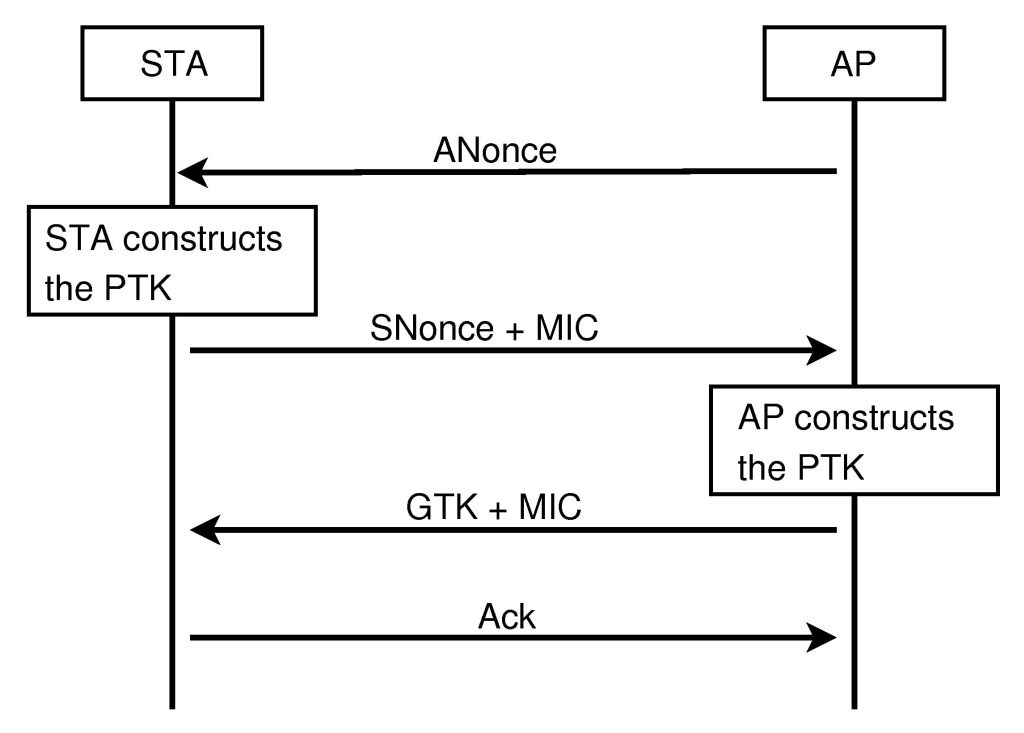
By adding this layer of authentication to management frames, 802.11w effectively neutralizes many common Wi-Fi attacks. Deauthentication floods become useless because the forged packets lack a valid MIC. This makes the network far more resilient and is a key reason why upgrading to WPA3-enabled hardware and settings is a critical security practice.
Enabling 802.11w ensures that deauth and disassociation frames are cryptographically protected, preventing attacker forgeries.
Understanding these protocol-level flaws and their solutions is the first step toward building truly secure wireless networks.