Wireless Propagation and Signal Encoding
Ground Wave Propagation
Following the Curve
Radio signals don't always need a direct line of sight. At frequencies below 2 MHz, a special type of signal called a ground wave can follow the curvature of the Earth, traveling far beyond the horizon. This isn't reflection; it's a phenomenon called diffraction.
Imagine a wave in water hitting the side of a dock. The wave doesn't just stop; it bends around the edge and continues into the space behind it. Radio waves do the same thing when they encounter the curve of the Earth. The wavefront essentially drags along the surface, tilting forward and propagating along the planet's contour. This creates what is known as a surface wave.
The Right Way Up
For a ground wave to work, its must be just right. Electromagnetic waves have both an electric and a magnetic field, and polarization refers to the orientation of the electric field. Ground waves must be vertically polarized, meaning the electric field is perpendicular to the Earth's surface.
If the wave were horizontally polarized, the electric field would be parallel to the ground. Since the ground is conductive to some degree, it would effectively short-circuit the electric field, absorbing its energy almost immediately. A vertically polarized wave avoids this. It induces electrical currents in the ground that travel along with it, helping to sustain the wave and guide it along the surface. This interaction is essential for the wave to follow the Earth's curvature.
Losing Steam
Ground waves don't travel forever. Their signal strength weakens, or attenuates, as they move. The two main culprits are ground conductivity and frequency.
Conductivity measures how well the ground conducts electricity. Seawater is an excellent conductor, so it absorbs very little energy from the wave. This allows ground waves to travel vast distances over the ocean. Dry, sandy, or rocky soil, on the other hand, is a poor conductor. It absorbs much more energy, severely limiting the signal's range.
Frequency also plays a huge role. The higher the frequency, the more rapidly the ground absorbs the wave's energy. This is why ground wave propagation is only effective at lower frequencies. At Very Low Frequency (VLF) and Low Frequency (LF), signals can travel for thousands of kilometers. In the Medium Frequency (MF) band, home to AM radio, the range is reduced to hundreds of kilometers. Above about 2 MHz, the attenuation becomes so high that ground waves are no longer a practical mode of long-distance communication.
| Frequency Band | Range | Primary Use Cases |
|---|---|---|
| VLF (3–30 kHz) | >1000 km | Submarine communication, navigation |
| LF (30–300 kHz) | ~1000 km | Time signals and navigation (Loran-C) |
| MF (300–3000 kHz) | <500 km | AM broadcasting, maritime radio |
These factors combined explain the practical uses of ground waves. Reliable, long-range communication over seawater makes it ideal for shipping and naval operations. For AM radio broadcasters, the ground wave provides consistent, stable coverage to a local metropolitan area during the daytime.
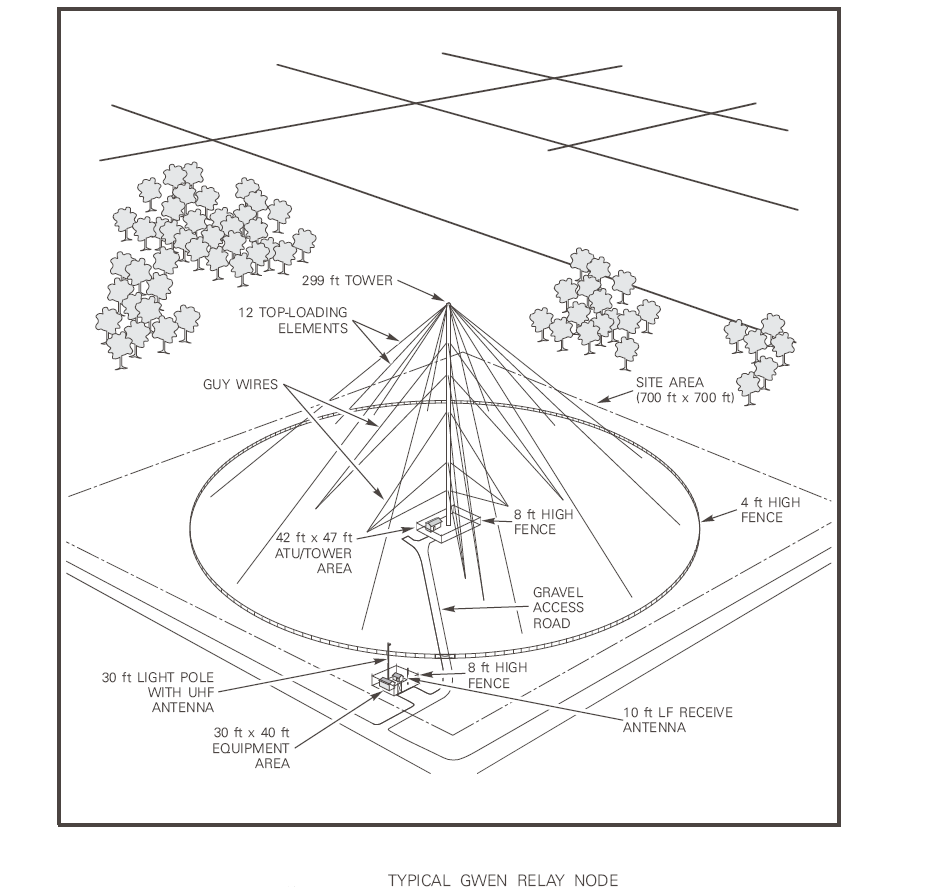
So, while not suitable for high-bandwidth data, the ground wave remains a robust and essential method for long-distance communication and broadcasting, all thanks to its clever use of the Earth itself as part of the transmission path.