Wireless Power Transmission Explained
Introduction to Wireless Power Transmission
Power Without Wires
Wireless power transmission is exactly what it sounds like: sending electrical energy from a power source to a device without any physical cables. The idea is to cut the cord, freeing our devices from the wall socket.
Imagine charging your phone just by walking into a room, or an electric car that recharges while parked in a garage. This technology isn't just about convenience. It can power medical implants inside the human body or deliver energy to remote sensors where running wires would be impossible. The core goal is to make power as accessible as wireless data.
A Spark of Genius
The dream of wireless power is over a century old. Its most famous pioneer was Nikola Tesla, an inventor who envisioned a global system to transmit electricity through the air and the earth itself. Around the turn of the 20th century, he built massive coils, like the one at his Colorado Springs lab, that could generate millions of volts and create spectacular artificial lightning.
Tesla successfully lit lamps from a distance and dreamed of broadcasting power to the entire planet. While his grand vision for a worldwide power grid never came to be, his experiments laid the theoretical and practical groundwork for all modern wireless power technologies.
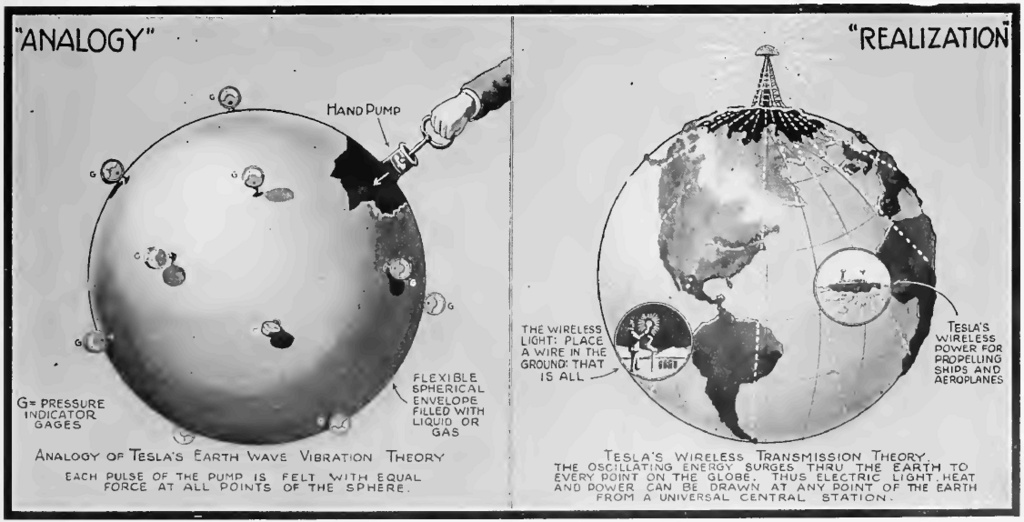
After Tesla, the focus of wireless technology shifted heavily toward communication, like radio. But the fundamental principles he explored never went away. In recent decades, with the explosion of portable electronics, interest in wireless power has surged, leading to new methods and refinements of old ideas.
An Overview of Methods
There isn't just one way to send power through the air. Different methods work best for different distances and applications. They generally fall into two categories: near-field (for short distances) and far-field (for long distances).
Here are the most common approaches:
Inductive Coupling
other
Uses magnetic fields to transfer energy between two coils over a very short distance. It’s the technology used in most wireless charging pads for smartphones and electric toothbrushes.
Think of it like a transformer with its two halves separated. The charging base creates a magnetic field, and a coil in the device converts that field back into electricity.
Resonant Inductive Coupling works on the same principle but adds resonance to the mix. By tuning the transmitter and receiver to oscillate at the same frequency, it can transfer power more efficiently over a few feet. This could allow for charging multiple devices within a small area, like a tabletop.
Capacitive Coupling uses electric fields instead of magnetic ones. It transfers energy between two metal plates. While less common, it's effective over very short distances and can be useful in specific electronic applications.
Microwave Transmission is a far-field technique for sending power over long distances, from meters to kilometers. A transmitter converts electricity into microwaves and beams them to a receiver, which converts them back. This is explored for applications like powering drones in flight or beaming solar power from space to Earth.
Laser-based Transmission is another long-distance method. It converts electricity into a highly focused beam of light, which is aimed at a solar cell on the receiving device to convert it back into electricity.
| Method | Range | Key Feature |
|---|---|---|
| Inductive Coupling | Very Short (mm to cm) | Simple and common in consumer devices |
| Resonant Inductive Coupling | Short (up to a few meters) | Improved distance and flexibility |
| Capacitive Coupling | Very Short (mm to cm) | Uses electric fields instead of magnetic |
| Microwave Transmission | Long (meters to kilometers) | Power beaming for large-scale uses |
| Laser-based Transmission | Long (meters to kilometers) | Highly focused and directional |
To get started with wireless power transmission, it is helpful to have a solid understanding of these foundational concepts.
What is the fundamental goal of wireless power transmission?
Which inventor is most famous for his pioneering, large-scale experiments with wireless power transmission around the turn of the 20th century?
Each of these methods has unique strengths and challenges, which we'll explore in more detail as we go. For now, understanding these basic categories gives you a map of the wireless power landscape.