Wireless Networking Research Review
Understanding Wireless Networking
From Sparks to Signals
Wireless communication feels modern, but its roots go back over a century. In the late 1800s, scientists like Heinrich Hertz and Guglielmo Marconi experimented with sending signals through the air using radio waves. Marconi’s first transatlantic wireless signal in 1901 was a huge leap, proving that messages could travel long distances without physical connections. This discovery paved the way for radio, television, and eventually, the wireless networks we use today.
Early wireless was all about broadcasting—sending one signal out for many to receive. The real shift toward personal wireless networking began in the 1970s with a network called ALOHAnet in Hawaii. It used radio waves to connect computers across the islands, introducing early concepts of how devices could share a wireless channel. This project was a key inspiration for Ethernet and, later, for Wi-Fi.
The 1990s saw the birth of the standards that define modern Wi-Fi. The Institute of Electrical and Electronics Engineers (IEEE) created the 802.11 standard. The first version was slow, but subsequent updates (like 802.11b, 802.11g, 802.11n, and now Wi-Fi 6) brought massive speed and reliability improvements. Each new generation allowed for faster downloads, better streaming, and more connected devices, turning wireless internet from a novelty into a household necessity.
The Language of Wireless
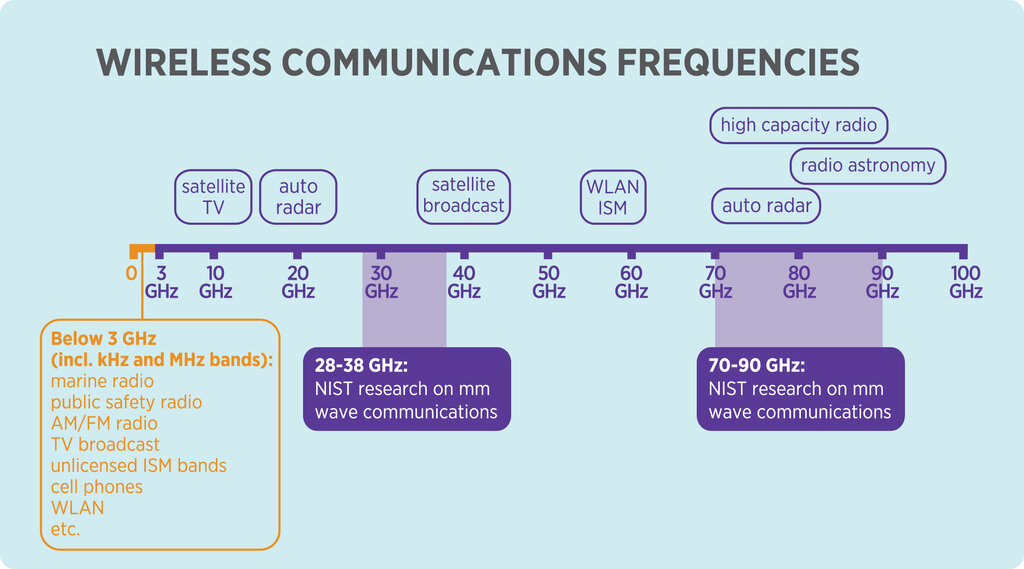
To understand wireless networking, you need to know a few key terms. It all starts with radio waves, a form of electromagnetic radiation. Wireless devices use these waves to transmit data through the air. The rate at which these waves oscillate is called their frequency, measured in hertz (Hz).
Frequency Band
noun
A specific range of frequencies used for communication. Wi-Fi networks commonly use the 2.4 gigahertz (GHz) and 5 GHz bands.
When you connect to a Wi-Fi network, your device is communicating with a wireless access point (AP), which is often built into a router. This device broadcasts a network name, known as the Service Set Identifier or SSID.
Another important concept is bandwidth. Think of it like the width of a highway. A wider highway (higher bandwidth) can handle more cars (data) at once, leading to faster speeds. Latency, on the other hand, is the delay it takes for data to travel from its source to its destination. For activities like video calls or online gaming, low latency is just as important as high bandwidth.
High bandwidth lets you download a large file quickly. Low latency ensures your video call doesn't have a noticeable lag.
How It All Connects
At its core, a wireless network converts digital data—the ones and zeros that make up a file or website—into radio signals. A device's wireless adapter handles this translation. The access point then receives these signals, decodes them back into digital data, and sends them to the internet through a wired connection.
Wireless networks come in different sizes and serve different purposes. You’re probably most familiar with a Wireless Local Area Network (WLAN), which is what you use at home or in an office. It provides internet access within a limited area, like a single building.
Other types of wireless networks exist too:
- Wireless Personal Area Network (WPAN): This is for short-range communication, typically within a few meters. Bluetooth, which connects your headphones to your phone, is a perfect example.
- Wireless Metropolitan Area Network (WMAN): These networks cover a larger area, like a city or a large campus. Cellular networks that provide mobile data are a form of WMAN.
- Wireless Wide Area Network (WWAN): This is the broadest type, covering vast geographic areas. The global mobile network that lets you make calls and use data from almost anywhere is a WWAN.
Each architecture serves a different need, from connecting a simple pair of earbuds to linking entire continents.
Ready to check your understanding?
What was the primary contribution of the ALOHAnet system to the development of wireless networking?
In the context of wireless networks, what is the difference between bandwidth and latency?
Understanding these foundations is the first step to exploring the complex and fascinating world of wireless communication.