Wireless Communication Fundamentals
Introduction to Wireless Communication
Sending Messages Through The Air
Wireless communication seems like magic, but it’s based on a simple idea. Think of dropping a pebble into a still pond. Ripples spread out from the center. Now, what if you could control the pattern of those ripples to send a message to someone on the other side of the pond? That’s the basic principle behind wireless technology.
Instead of water, wireless devices use invisible waves of energy called electromagnetic waves. These waves travel through the air, and even through space, at the speed of light. They're all around us, carrying radio broadcasts, Wi-Fi signals, and cell phone calls.
All wireless communication works by encoding information onto electromagnetic waves, which are then sent from a transmitter to a receiver.
These waves aren't all the same. They vary in their wavelength (the distance between two wave crests) and their frequency (how many waves pass a point per second). The full range of these waves is called the electromagnetic spectrum.
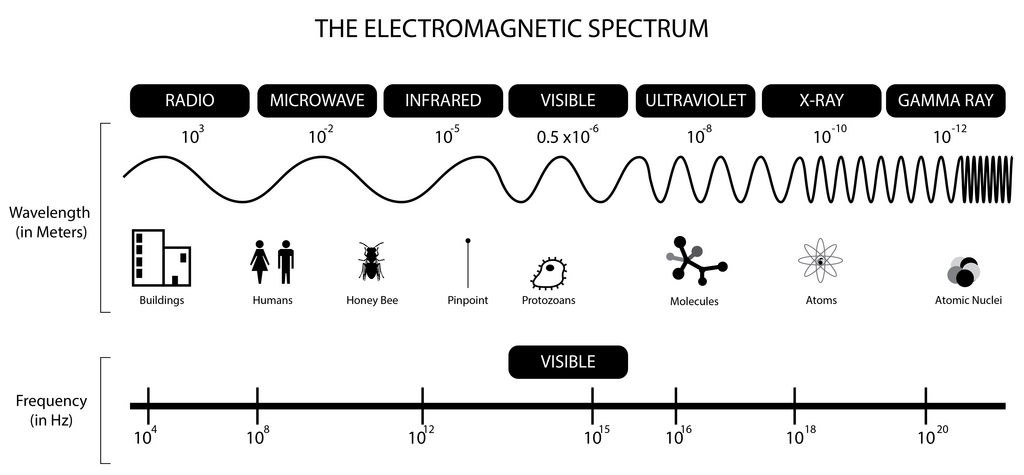
The spectrum is a vast continuum. At one end, you have very long, low-frequency radio waves, which are great for broadcasting over long distances. In the middle, there’s visible light, which is just a tiny sliver of the spectrum that our eyes can detect. At the other end are very short, high-frequency waves like X-rays and gamma rays.
From Theory to Reality
For most of human history, these waves were a complete mystery. In the 1860s, a Scottish physicist named James Clerk Maxwell developed a set of equations that predicted the existence of electromagnetic waves and that they traveled at the speed of light. His work was purely theoretical, but it laid the foundation for everything to come.
It wasn't until the 1880s that a German physicist, Heinrich Hertz, actually proved Maxwell's theory. Hertz built a device that could generate and detect radio waves. He showed they had all the properties of light, including being reflected and refracted. However, he didn't see a practical use for his discovery.
That practical step was taken by Guglielmo Marconi, an Italian inventor. In the 1890s, Marconi began experimenting with Hertz's devices and figured out how to use them to send messages in Morse code. He systematically improved the transmitter and receiver, increasing the distance a signal could travel.
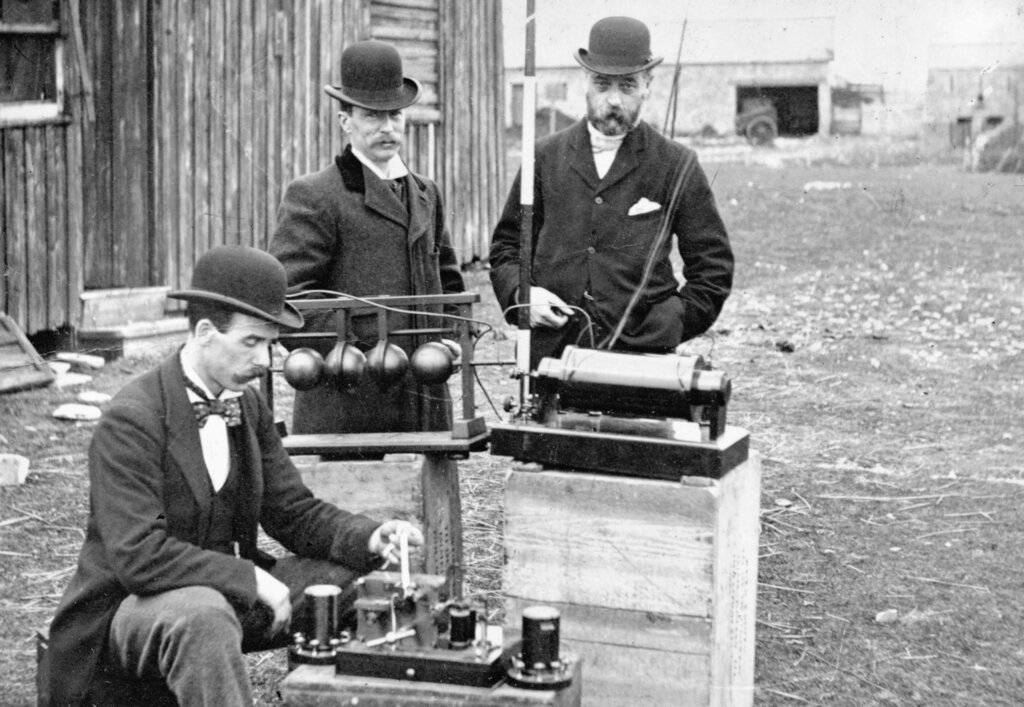
His work culminated in 1901 when he successfully sent the first transatlantic wireless signal, from Cornwall, England, to Newfoundland, Canada. This event proved that wireless communication was not just a laboratory curiosity but a technology that could connect the world. Radio was born, and the age of wireless communication had begun.
Ready to check your understanding?
Which scientist first developed the theoretical equations predicting the existence of electromagnetic waves?
In the electromagnetic spectrum, what is the relationship between wavelength and frequency?
These early breakthroughs paved the way for the complex wireless world we live in today, from global positioning systems to the smartphone in your pocket.