Wind Energy Systems
Onshore Versus Offshore
Onshore versus Offshore Wind: Weighing the Trade-offs
While both onshore and offshore wind energy rely on the same fundamental principles, the environments in which they operate create vastly different engineering and economic challenges. In this section, we will examine why offshore projects command higher capacity factors despite their complex marine logistics, and how onshore developments maintain their competitive edge through mature infrastructure. By the end of this chapter, you will be able to critically assess the logistical, financial, and environmental constraints that dictate the feasibility of a site.
The Superior Ocean Resource
The primary reason developers look toward the horizon is the quality of the wind. On land, airflow is often chaotic. Every hill, building, and forest acts as a element, tripping up the wind and creating turbulence. This friction slows the air down and makes it unpredictable.
At sea, the surface is relatively flat and uniform. This allows for , where layers of air slide smoothly over one another. Without obstacles to create drag, offshore winds reach higher velocities and maintain a much more consistent profile. For a developer, this consistency is the difference between a turbine that stutters and one that hums with steady productivity.
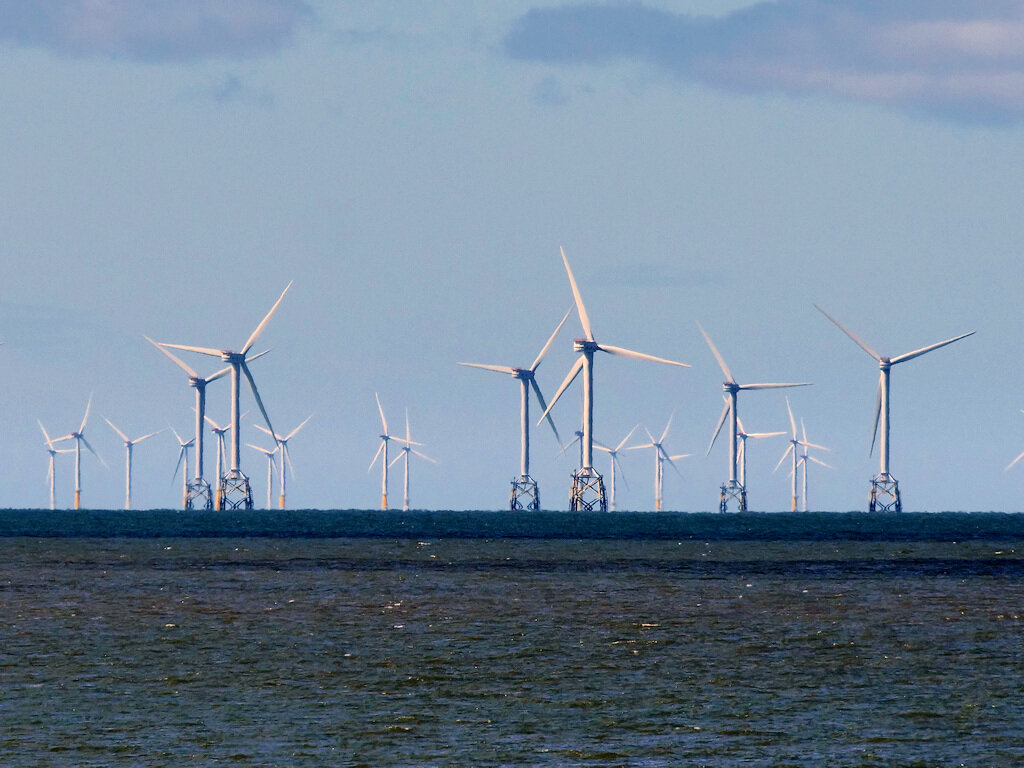
This leads us to the most critical metric in energy economics: the capacity factor. This is the ratio of how much energy a turbine actually produces over time compared to its theoretical maximum if it ran at full power 24/7.
Onshore turbines typically see capacity factors between 25% and 35%. Because sea breezes are stronger and more reliable, offshore projects frequently hit 40% to 55%. In the world of power grids, this reliability is the 'north star'—it determines if a project is a gamble or a stable utility.
Beyond the wind quality, the ocean offers a literal 'blank canvas' for scale. On land, turbine size is capped by what can fit under a bridge or turn a corner on a narrow country road. At sea, we use massive specialized vessels to transport blades that can be longer than a football pitch. This scaling potential allows a single offshore unit to generate significantly more power than its terrestrial cousin.
However, these massive resource gains come with a heavy price tag. While the wind is 'better' offshore, the environment is far more hostile. Every gain in energy yield is a hard-won battle against saltwater corrosion and the logistical nightmare of maintaining a machine in the middle of a choppy sea. This tension between superior resources and extreme costs is the central theme of the offshore industry.