Wi-Fi Fundamentals Demystified
Introduction to Radio Waves
The Unseen Waves
Our world is filled with invisible signals. The music from your car radio, the data on your phone, and the connection to your Wi-Fi router all travel through the air using radio waves. But what are they?
Radio waves are a type of electromagnetic radiation, just like visible light, X-rays, and microwaves. They are all part of a continuous range called the electromagnetic spectrum. The only real difference between them is their energy level, which we measure using wavelength and frequency.
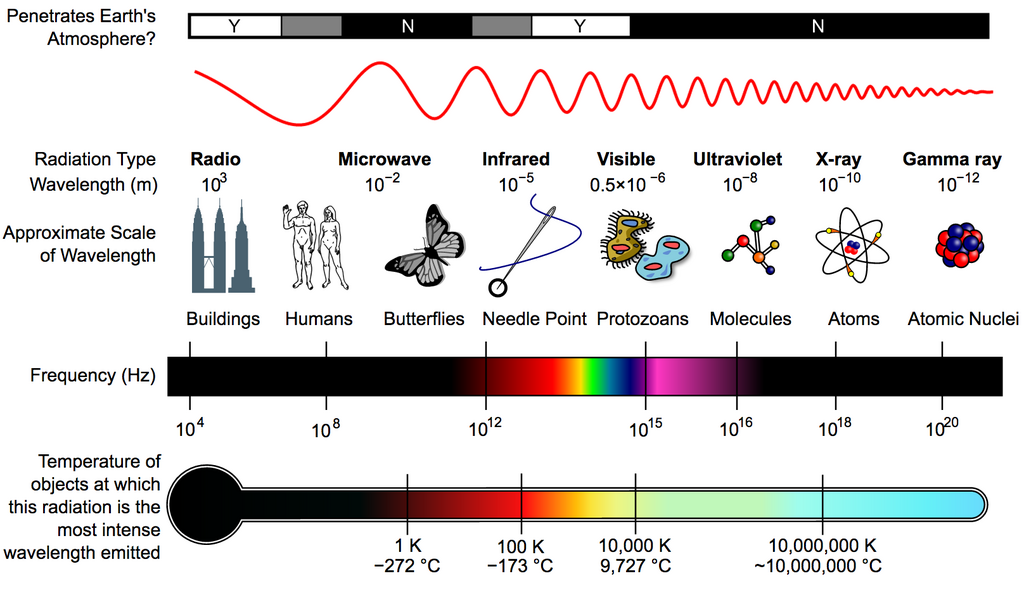
Think of the spectrum as a vast lineup of waves. On one end, you have high-energy waves with very short wavelengths, like gamma rays. On the other end are low-energy waves with very long wavelengths. That's where you'll find radio waves. They have just the right properties to be excellent for communication.
Wavelength and Frequency
Every wave has two fundamental properties: wavelength and frequency. Imagine dropping a pebble into a calm pond. The distance between the peaks of two consecutive ripples is the wavelength. If you count how many ripples pass a floating leaf each second, that's the frequency.
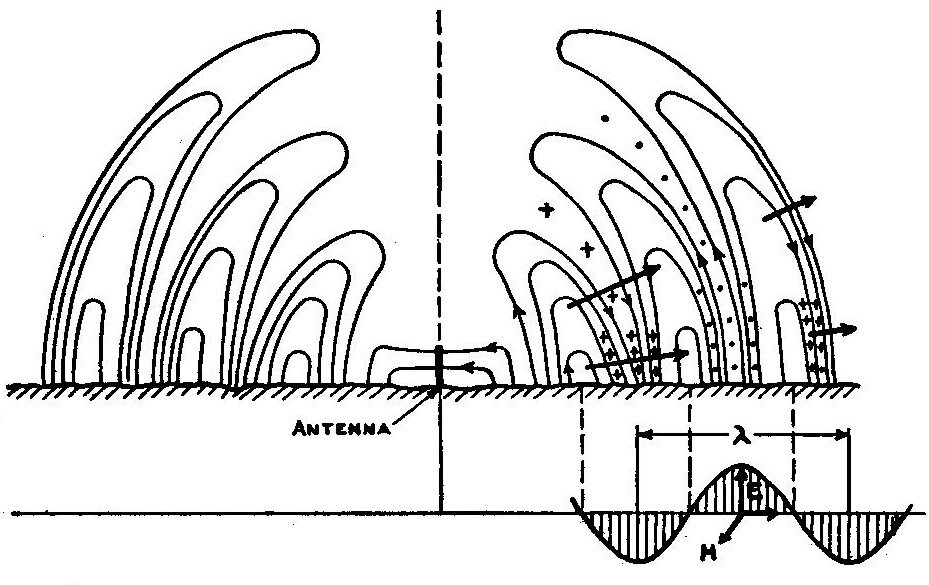
Radio waves work the same way. Wavelength (, lambda) is the physical distance a wave takes to complete one full cycle. Frequency () is the number of cycles that pass a point in one second, measured in Hertz (Hz). One hertz is one cycle per second.
Wavelength and frequency are inversely related. If a wave has a long wavelength, its frequency is low. If it has a short wavelength, its frequency is high. They are linked by the speed of light (), which is how fast all electromagnetic waves travel.
How Radio Waves Travel
When a device like a radio transmitter is turned on, it creates radio waves that spread out in all directions from the antenna. This process is called propagation. These waves can travel through the vacuum of space, the air, and even solid objects like walls, though they get weaker as they go.
Different frequencies propagate differently. Lower-frequency radio waves can travel very long distances and pass through obstacles like buildings and hills more easily. Higher-frequency waves carry more data but have a shorter range and are more easily blocked by physical objects. This is why AM radio stations (which use lower frequencies) can often be heard from much farther away than FM stations.
Carrying Information
A pure radio wave is just a simple, repeating sine wave. It doesn't carry any useful information on its own. To send a song or a message, we need to alter this basic wave in a process called modulation.
Modulation is the technique of adding information to an electromagnetic wave, known as a carrier wave. Think of the carrier wave as a blank piece of paper and modulation as writing a message on it. The two most basic types of modulation are named after the property of the wave they change.
Modulation
noun
The process of varying one or more properties of a periodic waveform, called the carrier signal, with a modulating signal that typically contains information to be transmitted.
Amplitude Modulation (AM) changes the amplitude, or height, of the carrier wave to match the information signal. The frequency of the wave stays constant.
Frequency Modulation (FM) changes the frequency of the carrier wave while keeping the amplitude constant. The frequency gets slightly higher or lower to represent the information being sent.
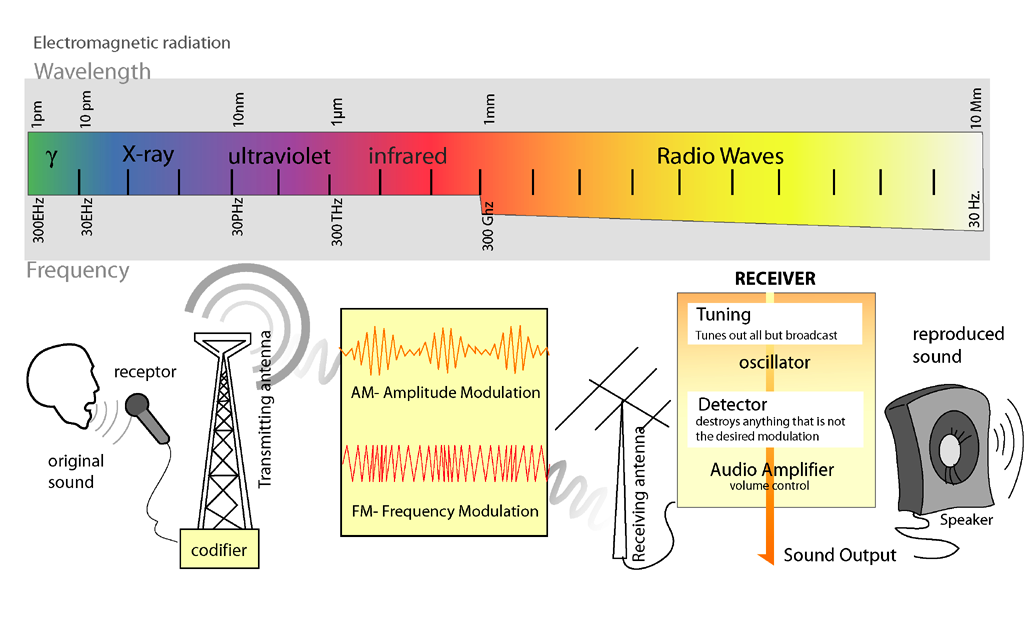
When your radio receiver tunes to a station, it's designed to detect these specific changes in either amplitude or frequency. It then demodulates the signal, stripping away the carrier wave and converting the information back into the sound you hear. This basic principle of modulation is the foundation of all wireless communication.
In the electromagnetic spectrum, how are radio waves characterized compared to other types of radiation like X-rays or gamma rays?
True or False: If a radio wave has a very long wavelength, it must also have a very high frequency.