Wi-Fi Explained
Introduction to Wireless Communication
Signals Through the Air
Wireless communication seems like magic. Information zips from your phone to a router, or from a radio tower to your car, with no wires in sight. But it's not magic, it's physics. The secret lies in electromagnetic waves.
Everything from the light from the sun, to the microwaves that heat your food, to the radio signals that carry your favorite songs are part of the same family: the electromagnetic spectrum. These are waves of energy that travel through space.
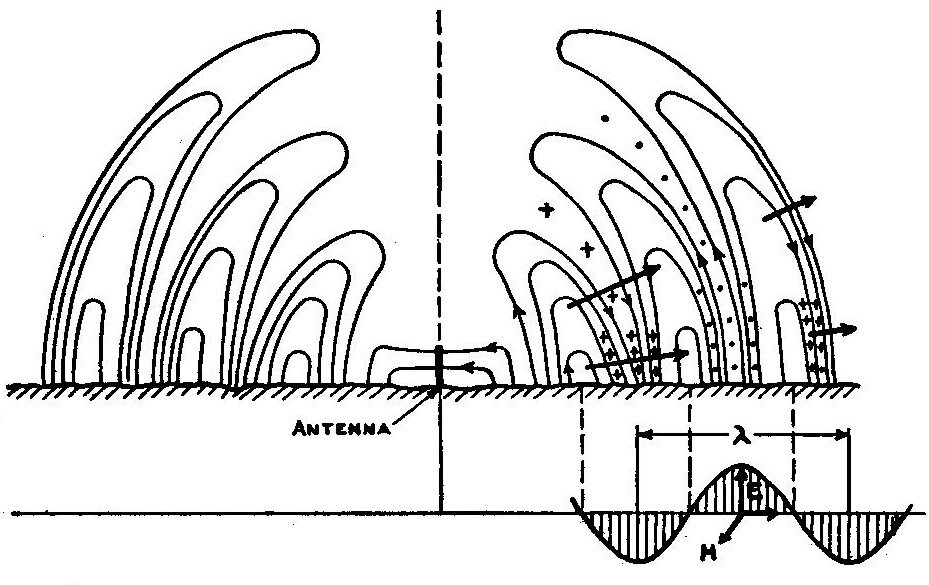
To send information wirelessly, we take an electrical signal and use an antenna to convert it into an electromagnetic wave, specifically a radio wave. A transmitter does this by making electrons wiggle back and forth very quickly. This disturbance creates ripples of electric and magnetic energy that expand outwards at the speed of light.
A receiving antenna, like the one in your phone, is designed to catch these ripples. When a radio wave hits it, it makes the electrons inside the receiver's antenna wiggle in the same pattern. The receiver then converts this wiggling back into an electrical signal, which your device can understand as data, sound, or video.
Think of it like skipping a stone on a pond. Your hand (the transmitter) creates waves (the signal) that travel across the water. A leaf on the other side (the receiver) bobbing up and down is detecting those waves.
The Electromagnetic Spectrum
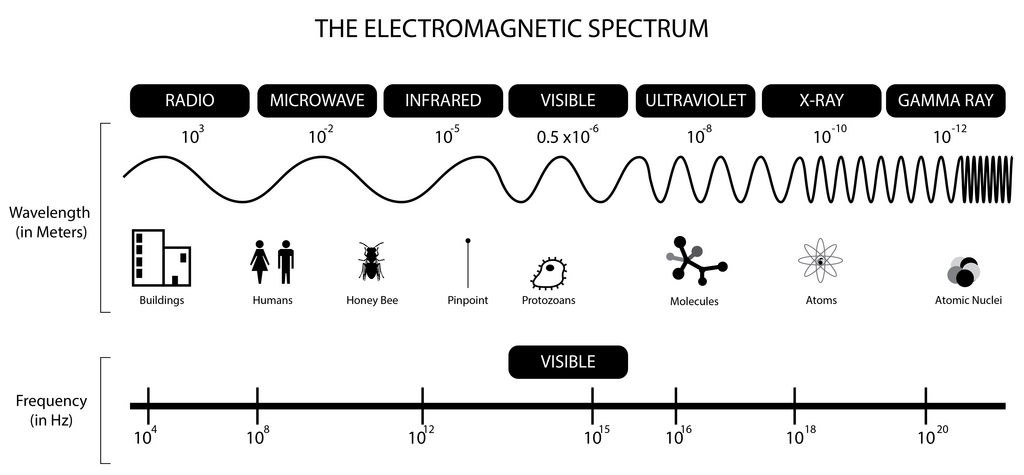
Radio waves are just one small part of a vast range of energy called the electromagnetic spectrum. This spectrum includes everything from very low-energy radio waves to extremely high-energy gamma rays.
What differentiates these waves is their frequency and wavelength.
- Frequency is the number of wave crests that pass a point in one second. It's measured in Hertz (Hz). A higher frequency means more waves pass by per second.
- Wavelength is the physical distance between two consecutive crests of a wave. It's measured in meters. A shorter wavelength means the crests are closer together.
Frequency and wavelength are inversely related. As one goes up, the other goes down. Their relationship is tied together by the speed of light, .
Where is frequency and (lambda) is wavelength. Because the speed of light is constant, a wave with a high frequency must have a short wavelength, and vice versa.
Frequency Bands
To avoid a chaotic mess where every signal interferes with every other signal, the radio portion of the spectrum is divided into sections called frequency bands. Governments and international bodies regulate who can use which bands for what purpose. This is why your FM radio, your garage door opener, and your Wi-Fi network can all operate at the same time without clashing.
Different frequency bands have different properties, which makes them suitable for different jobs.
| Characteristic | Low Frequency (e.g., AM Radio) | High Frequency (e.g., 5G, Wi-Fi) |
|---|---|---|
| Wavelength | Long | Short |
| Range | Travels farther | Shorter range |
| Penetration | Better through walls & obstacles | Easily blocked by obstacles |
| Data Capacity | Lower | Higher |
Low-frequency waves, with their long wavelengths, are great at traveling long distances and passing through obstacles like walls and hills. This is why AM radio stations can cover huge areas. However, they can't carry a lot of data.
High-frequency waves have short wavelengths and can be packed with information, allowing for fast download speeds. The trade-off is that they don't travel as far and are more easily blocked by physical objects. This is why you might have a strong Wi-Fi signal in one room but a weak one just a couple of rooms away.
Pros and Cons
The most obvious advantage of wireless communication is mobility. You can connect to the internet from a coffee shop, make a call while walking down the street, or use GPS in your car, all without being tethered by a cable.
Another benefit is the ease of setup. Adding a new device to a wireless network is usually simple, whereas a wired network requires running physical cables to each new location, which can be costly and inconvenient.
But wireless has its challenges. The biggest one is interference. Signals from other wireless networks, microwave ovens, cordless phones, and even Bluetooth devices can disrupt your connection because they use similar frequency bands. Physical objects like concrete walls, metal filing cabinets, and even water (like in a fish tank or your own body) can block or weaken signals.
Security is also a greater concern. Since wireless signals travel through the air, anyone within range could potentially listen in. This is why strong encryption is essential for protecting your data on a wireless network.
Time to check what you've learned.
What is the fundamental phenomenon that enables wireless communication?
If the frequency of an electromagnetic wave increases, what happens to its wavelength?
Understanding these core principles—how radio waves work, their place in the electromagnetic spectrum, and the trade-offs between different frequencies—is the foundation for seeing how technologies like Wi-Fi build upon them.