Why Stars Move
Earth's Spinning Motion
The Sky's Daily Spin
Have you ever sat on a carousel? As you spin, the world outside seems to rush past in the opposite direction. The ticket booth, the cotton candy stand, and the smiling faces of your family all appear to circle around you, even though you know they're standing still. The night sky works in a similar way.
From our perspective on Earth, the stars seem to march across the sky each night, rising in the east and setting in the west. This apparent movement is called diurnal motion (pronounced die-URN-ull). It's not the stars that are moving, but us. Earth is constantly spinning on its axis, an imaginary line running through the North and South Poles. This rotation, which takes about 24 hours to complete, creates the illusion that the entire universe is revolving around us once a day.
Diurnal Motion
noun
The apparent daily motion of celestial objects across the sky from east to west, caused by the Earth's rotation on its axis.
The Celestial Sphere
To make sense of this motion, ancient astronomers imagined that the Earth was enclosed in a giant, hollow dome with stars painted on its inner surface. They called this the celestial sphere an idea we still find useful today. It's not a real object, but a mental model. Thinking of the stars as fixed points on a spinning sphere makes it much easier to map their locations and predict their movements.
Imagine the Earth's axis extending outwards into space. The point where this imaginary line pierces the celestial sphere in the north is called the North Celestial Pole. The same concept applies in the south, giving us a South Celestial Pole.
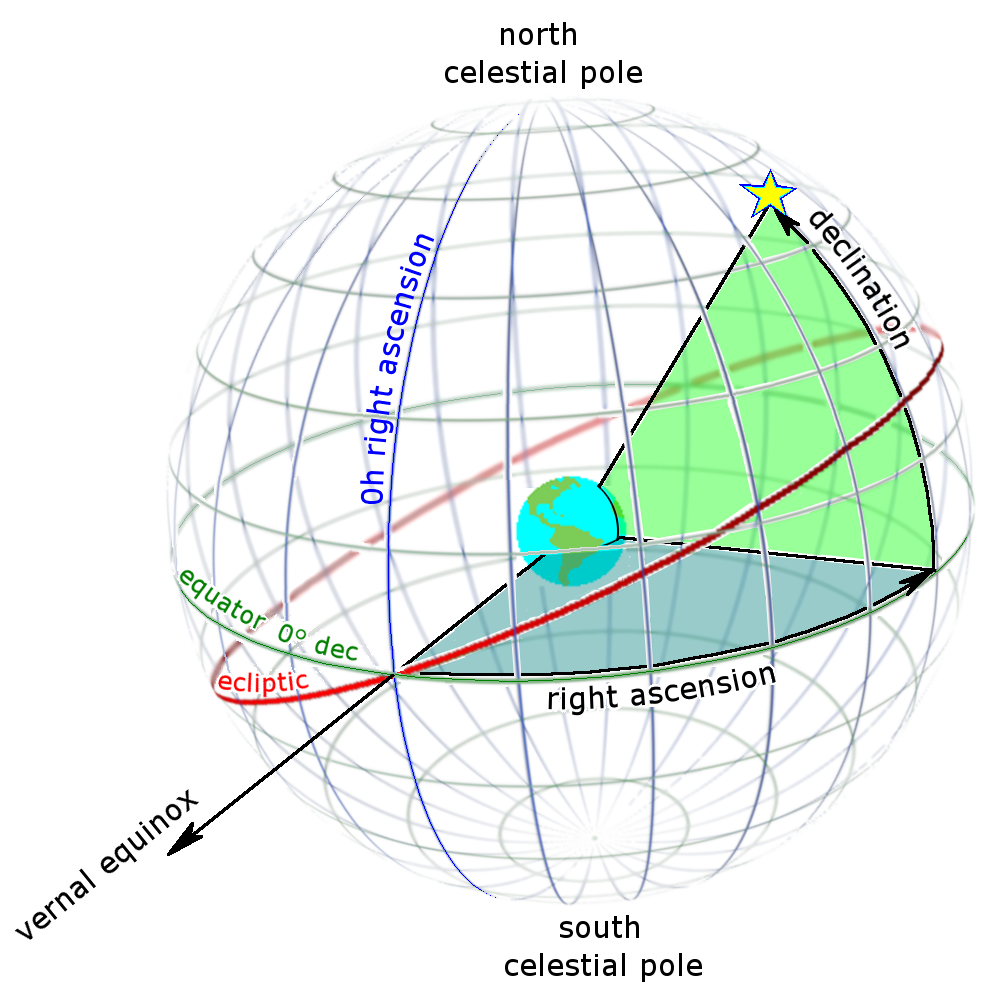
As the Earth spins, the entire celestial sphere appears to rotate around these two poles. For an observer in the Northern Hemisphere, the sky seems to pivot around a single, unmoving point. And right near that point, you'll find a very special star.
The North Star
Almost directly aligned with the North Celestial Pole is a star called Polaris more famously known as the North Star. Because it sits right above Earth's axis of rotation, it appears to stay fixed in the same spot all night long. Other stars circle around it, but Polaris remains a constant anchor in the sky.
For centuries, this unique property has made Polaris an invaluable tool for navigation in the Northern Hemisphere. If you can find Polaris, you know which way is north.
Your location on Earth changes your view. An observer at the North Pole would see Polaris directly overhead, with all other stars tracing perfect horizontal circles around it, never rising or setting. Someone at the equator, however, would see Polaris right on the northern horizon. From their perspective, all stars rise straight up in the east and set straight down in the west, tracing huge arcs across the sky.
Ready to check your understanding of the sky's daily dance?
What is the primary cause of diurnal motion, the apparent movement of stars across the sky each night?
What is the celestial sphere?
The spinning of our planet is the engine behind the most fundamental rhythm of our lives: the cycle of day and night. It dictates when we wake, when we sleep, and how we have viewed the heavens for all of human history.